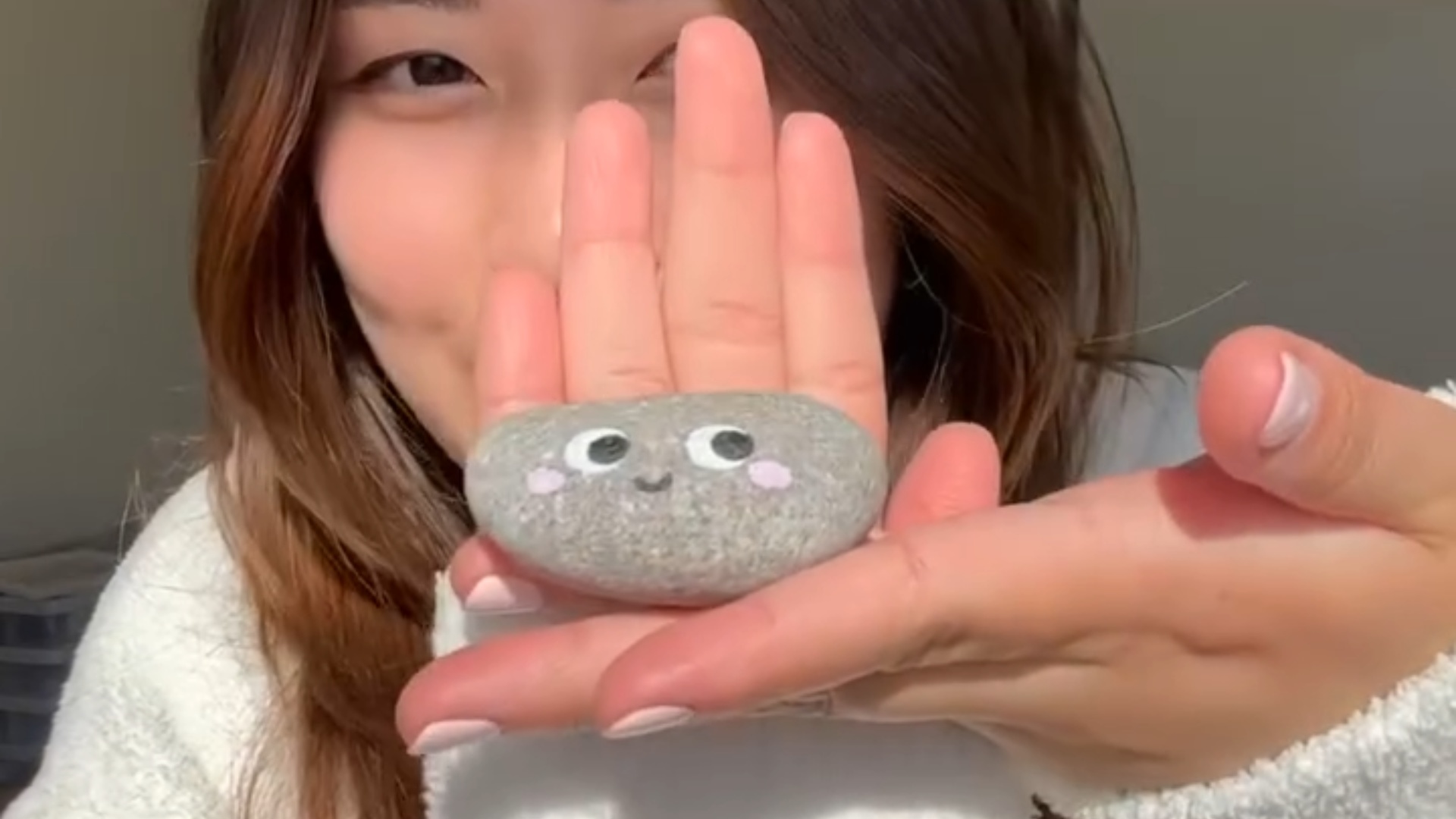
Confined behind a computer all day, Korean workers find solace not in a steaming cup of coffee, but in a companion pebble. This piece of rock, personified with squinty eyes and a sympathetic smile, sits on their desk. In this country, where social isolation is deadly, it offers them a semblance of support and combats a near-morbid loneliness.
A pocket-sized friend carved from rock
They have endearing eyes, adorable faces, and kindness to spare. They fit in the palm of your hand, make no noise, and have a hard surface, yet they fulfill a tender mission. Don't bother trying to solve this riddle; the answer is more unusual than obvious. We're talking about companion pebbles, crafted to give the illusion of presence in the impersonal and self-centered atmosphere of open-plan offices or corporate skyscrapers.
These pebbles, which seem straight out of a Miyazaki animated film, aren't there to furnish the workspace like a pencil holder. They fill the void like cement in a crack, but above all, they fill the gaping wounds of loneliness. There's no need to take them out at the crack of dawn, spoil them with premium kibble, or rearrange your entire home in their honor. Less demanding and energy-intensive than flesh-and-blood pets, they play a similar emotional role. A more rustic equivalent of the Tamagotchi of yesteryear, they readily fill a void of attention, absence, and emotional deprivation.
In these Asian countries, some of which even have a Ministry of Loneliness , people have little time to devote to a pet. Being responsible and rational beings, they therefore prefer the pet rock. This inanimate object may be tiny, but it occupies a significant place in the lives of its owners. It is this rock that holds the fragile foundations of South Korean well-being together.
The "pebble companion," a bulwark against loneliness
To the uninitiated, it's simply a pebble, a stone among thousands of others, a piece of nature, an unremarkable mineral object. Its only apparent purpose is to serve as a holiday souvenir. For South Koreans, however, this personified pebble is a confidant, a source of comfort during times of sadness, a readily available form of therapy. Moreover, for a few handfuls of won, they can acquire their own personal pebble, customize it to their liking, and create a comfortable home for it—sometimes more welcoming and upscale than Barbie's mansion.
This pet pebble, delivered with a straw hat, glasses, and other accessories designed to give it a personality, is the cornerstone of Korean happiness and has reached the height of its popularity. On the Chinese social network Xiaohongshu, more than 70,000 posts are dedicated to this pebble, showcasing its regal lifestyle. It rests in a cozy nest like a baby in a bassinet and poses against majestic landscapes, seemingly mocking its fellow pebbles who are victims of tourists' frantic footsteps. The Douyin platform, the Korean equivalent of TikTok, has amassed ten million views of this pet pebble, proof of its usefulness.
But how did a simple, sharpened rock become the tangible version of the famous imaginary friend? It all started in the United States in the 1970s, where a certain Gary Dahl succeeded in the somewhat crazy endeavor of marketing pebbles with an irresistible gaze, capable of making even the most mature people swoon. In South Korea, a land where employees don't work to live but live to work, this pebble naturally took root in the culture.
A pebble that reveals the harshness of life in Korea
In South Korea, workers practically camp out at their jobs. Still subject to the 40-hour workweek, they sometimes work 52-hour weeks with the permitted overtime. What would be considered exploitation in some countries is perfectly legal there. Performance isn't an option; it's a national rule, a mindset instilled from a very young age. While in France, employees are ready to jump out of their seats five minutes before the end of the workday, in South Korea, they practically work around the clock.
Fatigue almost becomes a badge of honor, and free time, a rare commodity. In this context, the pet pebble appears as a companion particularly well-suited to the local lifestyle: it demands nothing, asks no questions, and never takes sick leave. It waits patiently on a corner of the desk, unperturbed by video conferences, Excel spreadsheets, and days that stretch into the night. While the concept may seem amusing, even childish, it reflects the weight of the pressure to be productive.
While the pet pebble might elicit a laugh, it also speaks to our times: those of individuals surrounded by screens , constantly connected, and yet sometimes terribly lonely. Ultimately, this pebble is a wake-up call and, by extension, embodies the scourge of loneliness.