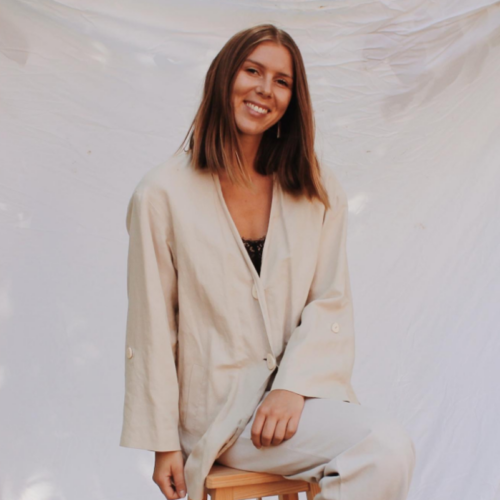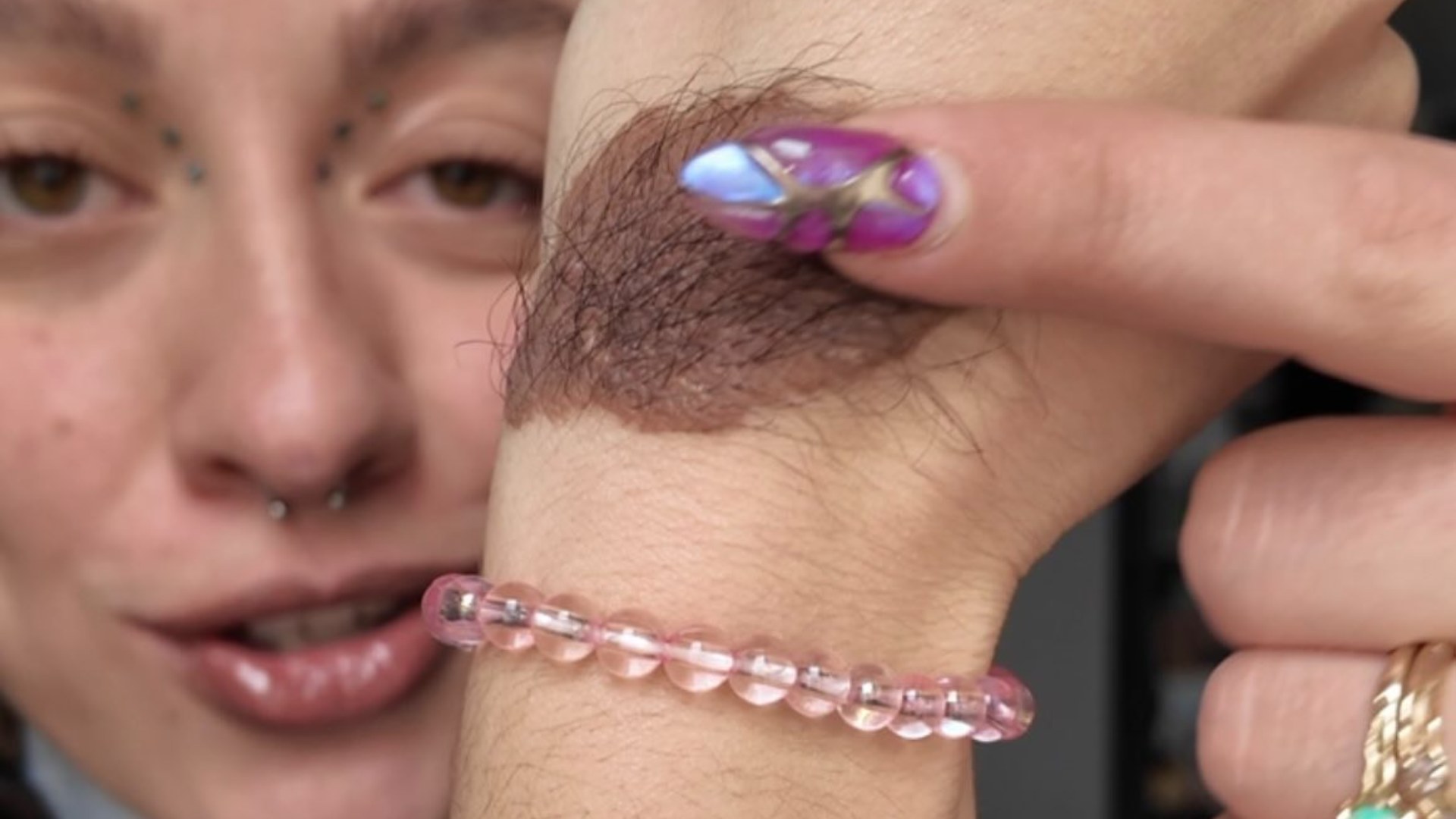
A birthmark is a trademark, the imprint of our identity. It decorates the body like a personalized stamp. Some people have barely visible marks or marks located in places on the body that only close friends and family can see. Others have indentations on the skin, more prominent dermatological versions. Content creator @lise_favre, however, has a congenital nevus. The scientific name for this is a brownish spot covered with hairs.
A magnet for ridicule during childhood
There are as many types of birthmarks as there are people. Some blend in with beauty marks, others give the illusion of having wiped wine with our skin, and still others are more architectural, resembling abstract art or a child's scribble. Some, located in forbidden areas, remain hidden from view, in the shadows of the fabric. Content creator @lise_favre, however, couldn't claim such discretion with her birthmark right in the middle of her hand. Unless she wore gloves year-round, it was difficult for her to deny the existence of this mark of fate.
She has what dermatologists more commonly call a congenital nevus. While this term sounds rather barbaric, it actually refers to an extra-large mole that also serves as a breeding ground for hair. Sometimes as tiny as a pea, it can also cover a large part of the body like a depigmented tapestry. And even though this mark is part of her, Lise has long hoped that it would shrink or disappear from the surface of her hand.
Throughout her childhood, her classmates, with their childish yet sharp sense of humor, compared the birthmark to "poop residue" and didn't hesitate to feign disgust at what was, in fact, a genetic signature. In the eyes of her fellow students, who were equally merciless, there was only disgust. Accused of "not washing" or "being dirty," her birthmark had made her the pariah of the school. Following this onslaught of mockery, insecurities took root in her hand, defined by this natural mark she had been taught to hate.
View this post on Instagram
A sentence that changed his perspective
Criticism after criticism, this birthmark eventually became a source of distress, more than a natural part of life. Instead of peacefully coexisting with this nevus, Lise rejected it entirely and long wanted to have it removed from her skin. For her, this mark topped with long black hairs was nothing but a source of trouble, even a punishment from heaven. While her birthmark only covered a few square centimeters of her skin, it had grown to enormous proportions in the mirror.
What she considered an anatomical flaw to be corrected held a different meaning in the eyes of a handball teammate. It was this visiting friend who opened her eyes to her peculiarity. With healthy curiosity, she questioned her about the mark, clearly visible in the way the ball flew.
Lise, who expected yet another hostile reaction, was pleasantly surprised by Sofia's perspective, to whom she expressed immense gratitude. "It makes you seem so unique, I've never seen anything like it. It's incredibly original," she confessed, in a burst of kindness. This statement had a profound impact on Sofia's self-esteem.
Moral of the story: what makes us unique isn't weird
Even though the opinions of others shouldn't dictate how we think, this sincere compliment was like a reset after years of mistreatment. A fresh start. "Actually, it's all about perception," the content creator observes. Now, when children, in their "why" phase, ask her what's on her hand, she no longer hides her arms behind her back. Nor does she try to downplay it. She confidently replies , "It's a mole, and it's big because I'm very, very beautiful."
Literal translation: If society has led us to believe that difference is abnormal or that singularity is grotesque or problematic, in fact, these particularities are our most precious gifts. After all, the rarer a piece of jewelry, the more valuable it is, and the more collectible a piece is, the higher its value climbs. Why shouldn't it be the same with the unique little works of the human body? Whether it's a birthmark with a graphic shape, a scar, or dark circles under the eyes… all these details make us unique and contribute to our visual identity.
Humans are not born to become clones or to follow highly homogeneous aesthetic guidelines. They are programmed to have no equals.