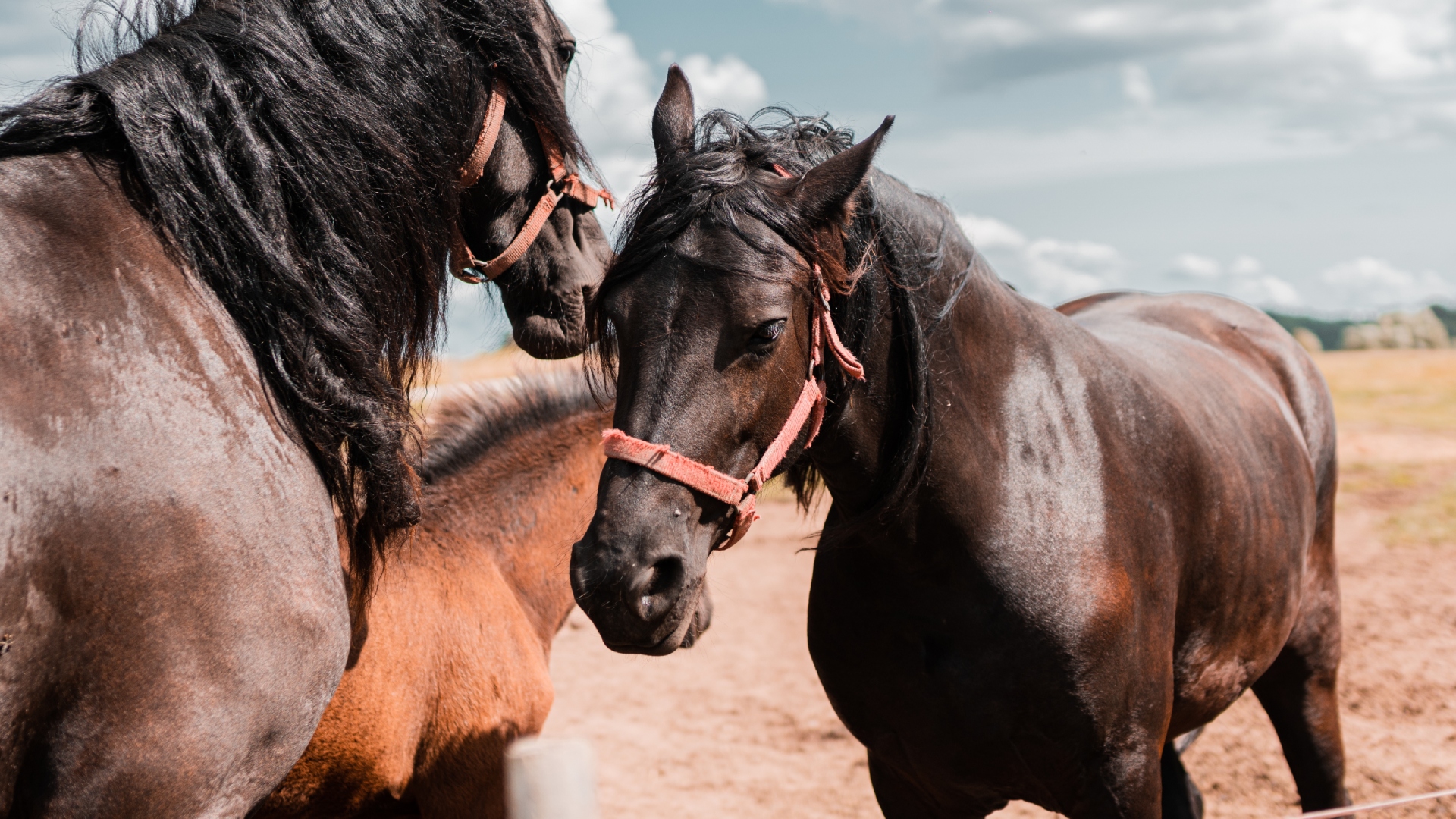
Horses are not just wonderful companions: they seem capable of "reading" our emotions. A recent French study reveals that these animals possess an astonishing sensitivity to human emotional signals, able to detect our fear or joy through olfactory clues, confirming a genuine interspecies emotional contagion.
A unique olfactory experience
To understand this extraordinary ability, researchers at INRAE , led by Léa Lansade, devised an original experiment. They collected the body odors of 30 volunteers after they watched films that elicited either fear (horror films) or joy (comedies), using swabs placed under their armpits. These samples were then presented to 43 Welsh mares in three situations: human interaction, the sudden opening of an umbrella, and the exploration of an unfamiliar object.
The results were striking. Horses exposed to fearful scents were more alert, startled more, and kept a greater distance. In contrast, joyful scents elicited more relaxed and curious behavior.
Fear and joy: measurable reactions
The mares sniffed the new scents for longer, demonstrating their ability to distinguish them finely. Fascinatingly, they preferentially used their left nostril for positive signals, which corresponds to specific brain processing associated with pleasant emotions.
Physiologically, their heart rate increased in response to fear-inducing odors, without a rise in cortisol, indicating an adaptive state of alertness rather than chronic stress. As Léa Lansade explains, "the smell of fear puts horses on high alert, creating an emotional contagion." In other words, our emotions literally cross species.
An intuition that goes far beyond sight and hearing
This sensitivity surpasses horses' already known ability to read our facial expressions and vocal intonations. Their olfactory intuition highlights a natural and powerful empathy, which can be harnessed in animal-assisted therapy or equine therapy. Horses don't simply react; they subtly interpret our signals and adjust their behavior accordingly, contributing to a strong and beneficial emotional bond for both parties.
Towards other emotions and concrete applications
While this study focuses on fear and joy, researchers plan to explore other emotions, such as sadness or anger, as well as emotional reciprocity: can horses influence our emotions as much as we influence theirs?
Questions remain about the exact nature of this perception: is it an instinct inherited from evolution or a social skill acquired through (unfortunately) domestication? Future research, including other breeds and male horses, will allow us to generalize the results and better understand how to use these abilities to promote shared well-being.
Ultimately, this study shows that our emotions are not confined to ourselves: they can be detected, felt, and even amplified by horses. Horses thus become true emotional partners, capable of strengthening our well-being and enriching our interactions.