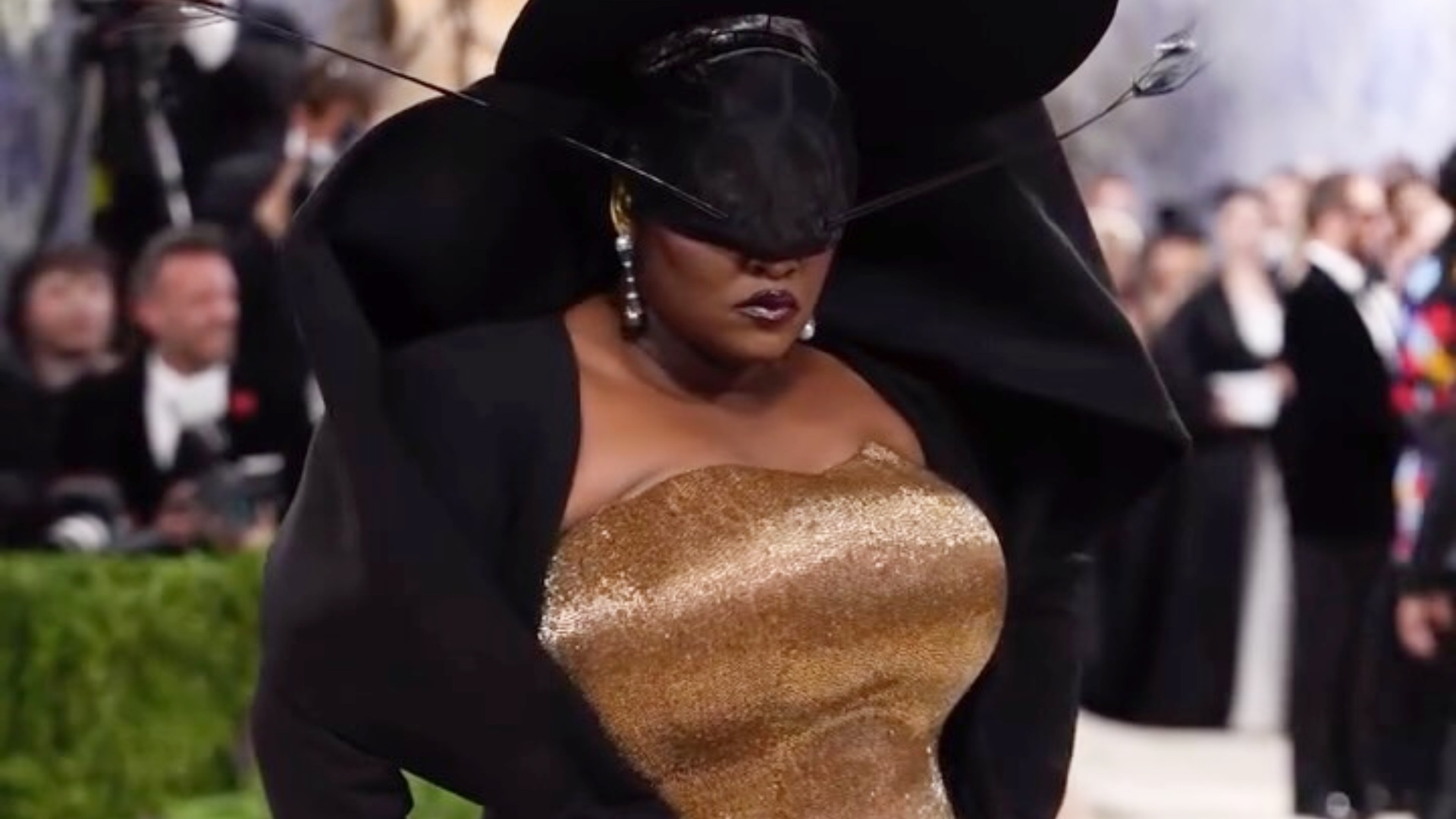
This year, the Met Gala, the Super Bowl of fashion, took on the air of a masquerade ball. Celebrities offered a highly personal interpretation of the theme "Fashion is Art," covering their faces completely or partially. Opaque face shields, metallic facades made of kitchen utensils, and fencing masks with a disturbing mirror effect... the female stars on the red carpet put their signature style on hold. And it wasn't just an aesthetic eccentricity.
The madness of faceless stars
The Met Gala, a glamorous event that brings together celebrities in a burst of creativity, showcased sculptural silhouettes worthy of a museum display case. Each outfit championed an artistic vision and resonated with historical works. Transformed into living tableaux or human sculptures for the occasion, many stars chose to conceal their faces and hide their emotions, barricading their features beneath bespoke creations.
Some did it in a more "moderate" way than others. Sarah Paulson walked the red carpet at the 2026 Met Gala with a dollar bill taped over her eyes, while Rachel Zegler, the actress from "Snow White," imitated Lady Jane Grey by sporting a pristine white blindfold . The most subversive pushed this carnivalesque aesthetic "to the extreme," while maintaining a semblance of anonymity. Gwendoline Christie confounded photographers with her decal mask, a hyper-realistic mask of herself. The unpredictable Katy Perry once again demonstrated her flair for the dramatic and perfectly embodied this style undercover. Armed with a modular fencing mask, she created a stir and maintained suspense until the very last minute.
In the past, Kim Kardashian has also played this game of concealment. The social media icon, who built her entire fame on her looks, eclipsed the fruits of her success for one evening. She appeared with her head wrapped in a flesh-colored veil and her neck adorned with a cascading silver necklace. If they keep their faces hidden, it's not solely for the sake of originality. In this age of media overexposure, female icons, instantly recognizable, yearn for more discretion. Yes, but a discretion that makes a statement.
View this post on Instagram
View this post on Instagram
An ancient aesthetic practice
While today's major fashion houses exploit the mask in all its forms, embellishing it with pearls, rhinestones, and intricate details, this accessory that obscures facial features was already present in the attire of 16th-century women. At that time, high-ranking ladies wore visors, a more rustic and modest equivalent of today's designer creations. This black velvet mask, with its understated appearance, served more of a preventative purpose than a purely visual one.
In reality, it primarily served as a sunshade, fulfilling the same role as a parasol in preserving a pale complexion, once synonymous with nobility. Now, this mask no longer serves the same purpose. It no longer protects against the sun, but against the gaze of others, often intense when one lives in the glare of camera flashes.
This mask, which blocks access to emotions, expressions, and the entire soul, thus becomes a media shield, a lock on one's personal image. Wearing a mask when the face beneath has an international reputation is a meaningful gesture that silently says , "I choose what I show."
Strengthening one's social status
In the world of celebrities and major fashion houses, masks can also serve to reinforce high social status. Wearing a sophisticated mask, a designer balaclava, or a rare accessory becomes a way to display one's belonging to an exclusive and prestigious world.
Firstly, these pieces are often designed by major fashion houses such as Balenciaga, Gucci, or Maison Margiela. Wearing them therefore allows one to indirectly display a certain economic power and privileged access to high fashion.
Furthermore, the mask creates a form of symbolic distance. By concealing her face, the star becomes less accessible, almost untouchable. This distancing reinforces her aura and accentuates the idea that she belongs to an elite. The mask also contributes to the construction of a spectacular image. At prestigious events, such as the Met Gala, appearing masked allows one to make a lasting impression, to stand out, and to assert one's place in the very exclusive world of fashion and luxury.
Finally, this accessory historically evokes aristocratic balls and ceremonies reserved for the privileged classes. By adopting these codes, celebrities revive a whole imagery linked to prestige, distinction, and social refinement.
Breaking free from the constraints of beauty
While celebrities are constantly scrutinized, judged, evaluated on their appearance, and pitted against each other, wearing a mask feels almost like a rebellion, a quiet revolt against this perpetual scrutiny. They camouflage what usually forms the fertile ground for celebrity gossip and online content. This mask is not a reflection of modesty or self-loathing, nor is it a superficial act; it is a militant emblem, a very elegant way to protest against this recurring game of intimidation.
Hiding one's face is therefore a way to divert attention and unsettle the audience, accustomed to commenting on everything they see. Thus, the public no longer has anything to criticize about a woman's face. With this mask, which challenges established norms and creates ambiguity about identity, it becomes impossible to make hasty assumptions about a celebrity's cosmetic surgeries or speculate about her age.
By adopting masks for every appearance, female stars restrict access to their faces, create an air of mystery, and simultaneously enhance their aura. They veil their faces to reveal less.