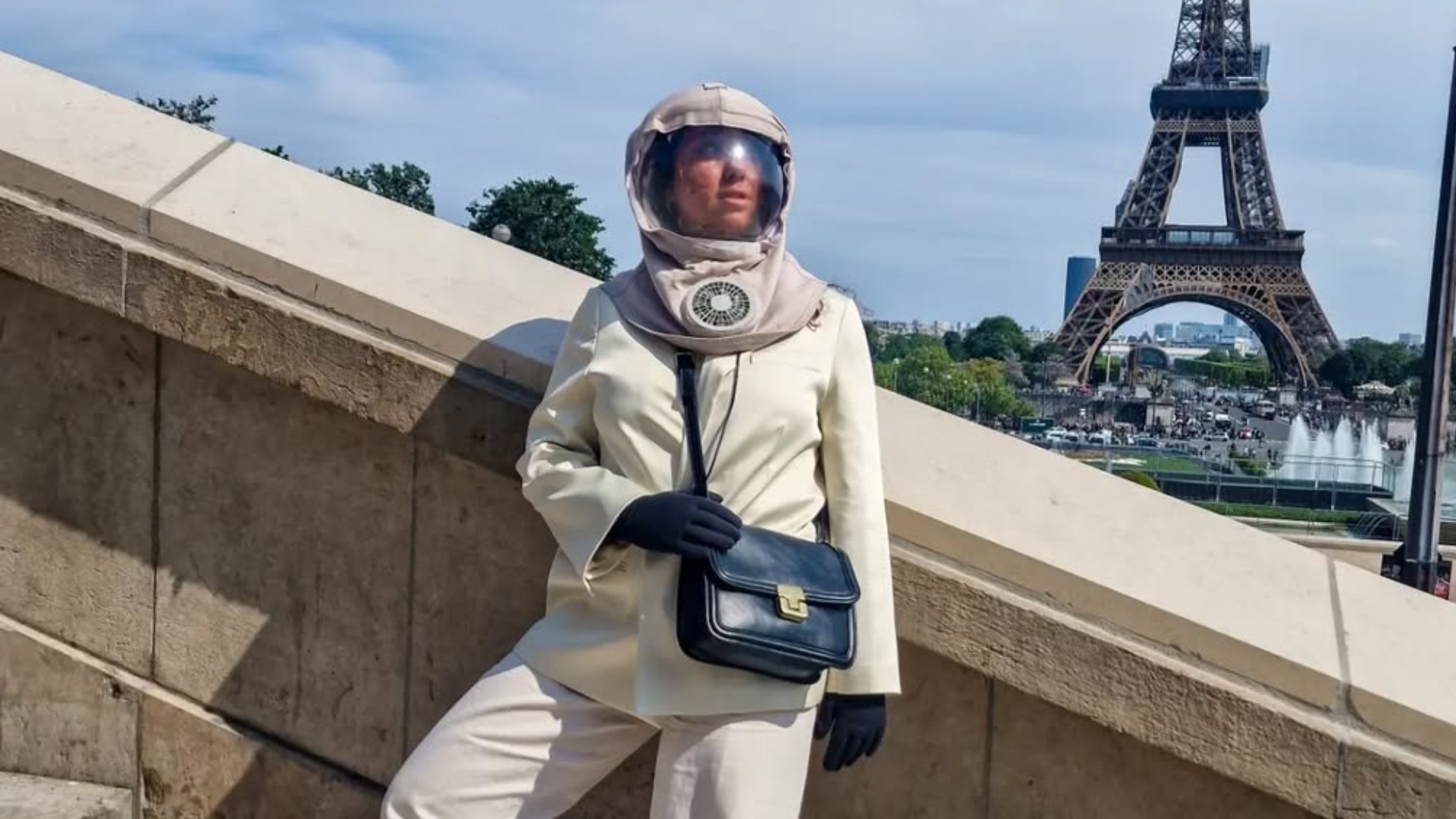
While some can simply slather on sunscreen to protect themselves from UV rays, Nihal has to barricade her skin under thick fabrics and enclose herself in a protective bubble. With a spacesuit strapped to her head and covering her body, she dresses like an astronaut for every urban excursion. Afflicted with "moon disease," this condition doesn't stop her from dreaming big and aiming higher than the stars.
Spacesuits, his daily life
It is said that women descend from Venus, but Nihal is a "child of the moon." She is condemned to live as if in orbit on solid ground, enveloped in a suit that gives the illusion of an imminent launch or a space mission. Equipped with her UV-protective armor, she looks like a science-fiction heroine. This skin condition forces her to remain sheltered from the sun, her worst enemy.
However, once night falls, she can shed this fabric chrysalis and walk by the light of the night sky. We know that the sun, however delightful it may be, is a threat that looms in the sky. Moreover, even though it colors the complexion, it also leaves fatal marks on the body. Nearly 80% of skin melanomas are thought to be caused by sun exposure. For this young woman, who is shedding light on this hidden disease, even the slightest exposure can result in cancerous lesions.
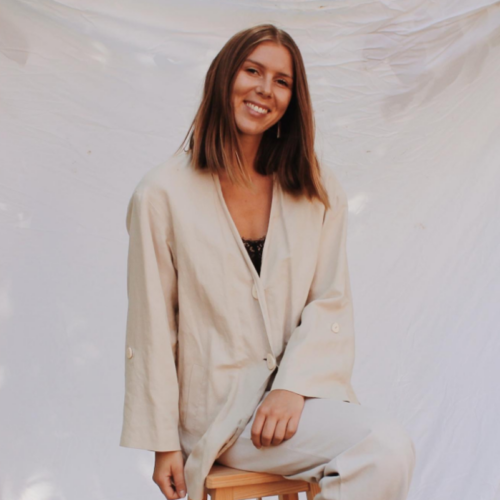
Her face is covered in freckles , a legacy from before her diagnosis. When the medical community diagnosed her with Xeroderma Pigmentosum, the scientific name for this condition that affects fewer than a hundred young French people, her parents did everything they could to ensure she didn't feel like a stranger on her own planet. As she shows on her social media, which serves as a kind of personal diary, this "children of the moon" condition has never overshadowed her dreams and her zest for life.
View this post on Instagram
Raising awareness of a still poorly understood disease
The condition known as "moon children" remains a mystery to most of us. Nihal, who lives in a full-body suit and wears a ventilated astronaut helmet as her primary accessory, sheds light on it with compassion. Seeking respect, she shares glimpses of her daily life and demonstrates that the condition is not a burden. It simply requires a few adjustments. For example, she must wrap her skin in special materials and carry a dosimeter slung over her shoulder to measure the sun's intensity.
Sometimes seen as an alien or a strange creature, Nihal educates where others might retreat into self-doubt. Her response to these uninformed people? "I explain to them that I'm not going to a carnival or that I suffer from breathing problems, but that I have a genetic condition," she explains in the pages of Pourquoi Docteur . What makes her so vulnerable to UV rays? A deficiency in the DNA repair system. In short, in children of the moon, the body is unable to repair the small injuries that the sun can cause to the skin. Hence this textile armor, which could have come straight from the imagination of Steven Spielberg.
Making daily life easier for children with xeroderma pigmentosum (XP), an obvious choice
Nihal, drawing on her experience and a living embodiment of resilience, wants to reassure these young people who feel they weren't born on the right planet and believe it's just bad luck. Nihal takes the stars from the sky and places them in the eyes of children like herself. The stars don't need to align, and they don't have to fade into darkness with this kind soul by their side. To those who doubt it, Nihal is more human than most of us.
She is involved with an association that works to improve the well-being of children with xeroderma pigmentosum (XP) in North Africa, providing them with this invaluable, yet costly, "survival kit." Thanks to her efforts and visibility, AssoFiable sent 35 out of 200 masks to Algeria. As a result, these children, who sometimes live in modest circumstances, can see the light of day without risk. And what's more, they can emulate their greatest rocket heroes and embrace their difference with pride .
Because the condition of "children of the moon" encourages one to aim higher and shine brighter. It's not bad luck, but a sign from the universe to live even more intensely. And if Nihal is intolerant to UV rays, it's perhaps because she herself is a ray of sunshine.