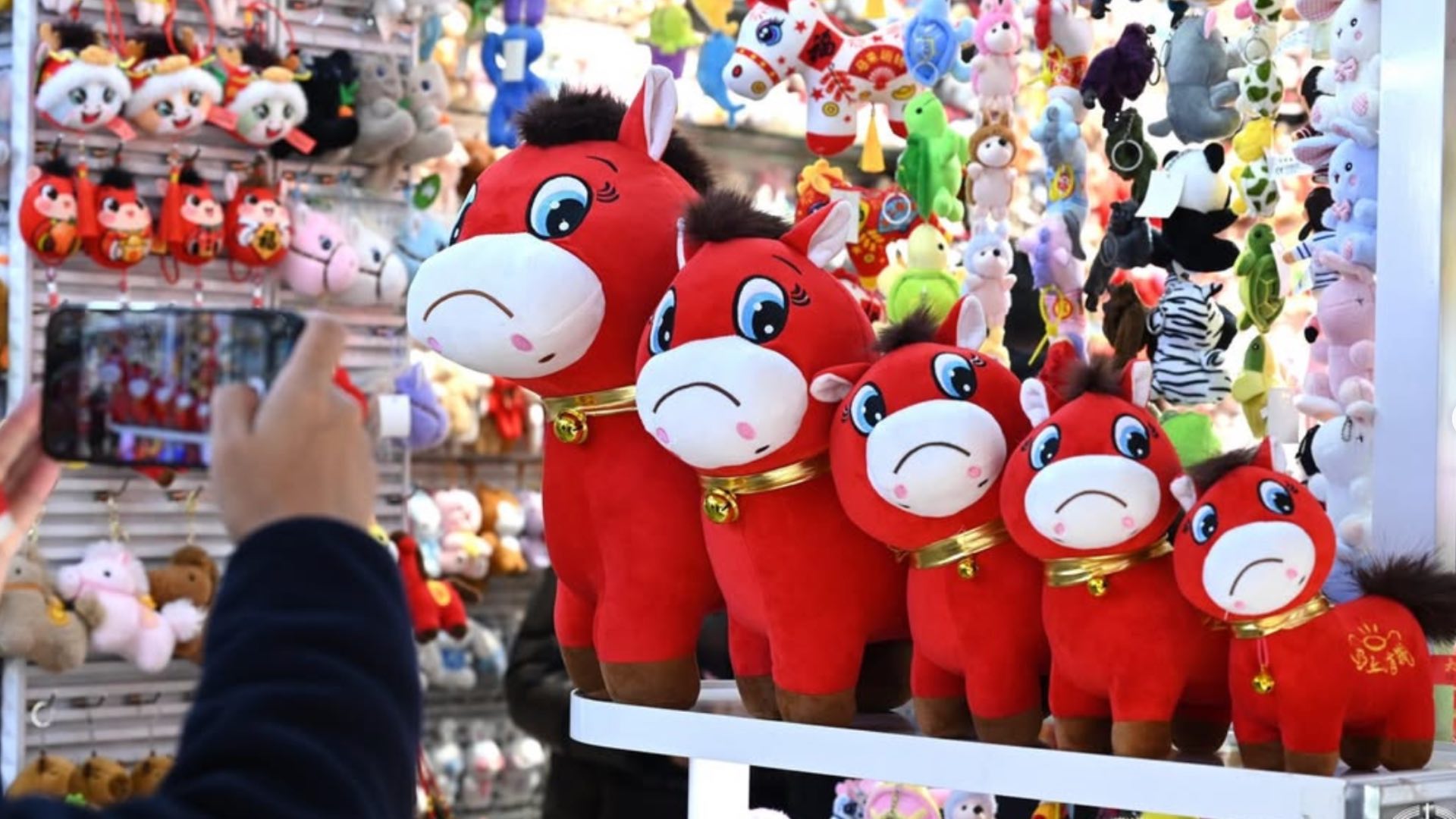
Originally, it was simply a toy designed to celebrate the Year of the Horse in the lunar calendar. This small red plush horse, with its mouth sewn upside down, has ultimately become much more than a festive object: for an entire generation of young Chinese, it is now the silent mirror of a widespread unease.
A manufacturing error that went viral
Made in Yiwu, the world's largest manufactured goods market, this 20cm-tall toy carried a promise of good fortune – the message "Money comes in" embroidered in gold on its side. However, one detail changed its destiny: a stitching flaw around its mouth, giving it a sad, almost dejected look.
Instead of being withdrawn from sale, the horse became a viral phenomenon on Chinese social media, where users immediately identified it as an emotional companion. The horse's somber expression resonated with a specific audience: young, often overworked professionals who instantly saw themselves reflected in it.
View this post on Instagram
An unexpected symbol of generational fatigue
"It looks just like me at the office," wrote one user on RedNote , a Chinese social network. Others place it next to their workstations, its forlorn expression accompanying their day. Far from being a superficial fad, this plush toy has captured something profound: the mental strain, the accumulated frustrations, the lack of recognition, and the silent anguish of a generation trapped in an exhausting daily routine.
This generation, often referred to as "cattle and horse," a metaphor for exploited young workers, still lives with the consequences of the "996" system—working from 9 a.m. to 9 p.m., 6 days a week—even though it was officially banned in 2021.
A therapeutic plush toy in a society under pressure
For many young people, this sad horse is more than just a toy. It has become a tool for emotional projection, a form of gentle resistance in a society where talking about personal difficulties often remains taboo. "This toy has therapeutic virtues," claims one online commenter. By attaching themselves to an imperfect and sad object, they feel less alone in their weariness, as if this horse were expressing for them what they dare not say.
A market response to a real expectation
Faced with the overwhelming enthusiasm, Zhang Huoqing, the plush toy's creator, quickly redirected her entire production to this "defective" model. The result: more than 15,000 sales per day, and orders pouring in from all over Southeast Asia, the Middle East, and South Africa. This unexpected commercial success confirms the emotional power of this unintentional creation. "The effect of this toy surpasses anything a perfect object could produce," analyzes Jason Yu, director of the CTR Market Research firm in Beijing. The "ugly but cute" toy appeals because it reflects reality, unvarnished.
A generation in search of sincere symbols
In a hyper-connected yet often individualistic society, young Chinese adults are searching for genuine symbols of identification. Far from traditional plush toys with their fixed smiles, this stuffed horse speaks to their pain, their contradictions, their humanity. Far from being a mere internet phenomenon, this toy is ultimately an emotional barometer: that of a generation that, caught between mental load, professional pressure, and a need for meaning, demands to be heard—even through the eyes of a sad horse.
Ultimately, this little red horse with its upside-down smile transcends the realm of a simple toy. It embodies the need for expression and recognition of a generation often invisible, yet deeply felt in its weariness and unease. Beneath its apparent sadness lies a silent complicity: a reminder that sometimes, the most authentic emotion is found where it is least expected, even in the cradle of an "imperfect" plush toy.