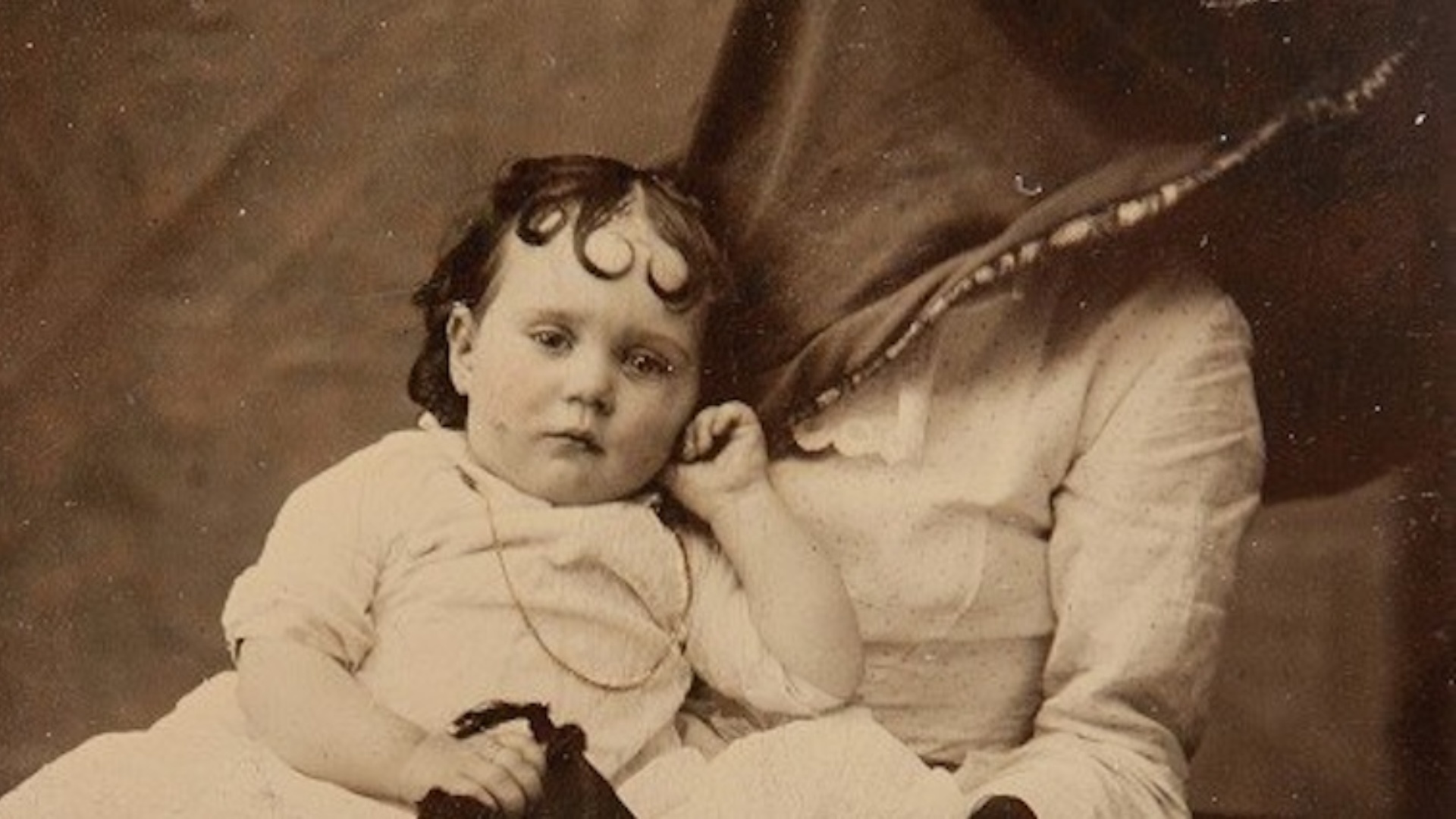
In the digital age, mothers capture their babies from every angle, turning every little moment into an impromptu photoshoot. Yet, they often remain absent from family photos, held back behind the lens. In Victorian times, when taking a photograph was a test of patience and took far more than a millisecond, mothers floated in the background. They were physically present but visually absent, covered by a sheet like ghosts. These portraits, worthy of a Tim Burton film, intrigue the public, 200 years later.
Mothers hidden under sheets
These aged portraits freeze the blood. They bear the marks of time, but above all, they evoke a certain unease in the viewer. They seem to have survived a paranormal scene. Yet, they are simply snapshots of infants taken in the Victorian era, fresh from their cradles. Except that they contain disturbing details, almost requiring the viewer to rub their eyes repeatedly. Unlike current professional photographs, which feature babies in wicker baskets or cotton gauze sheets, these have atypical decorative elements. Like a spectral presence.
The mothers' silhouettes are discernible behind the children, resembling living decorations. The supposed mothers are wrapped in fabrics that make no attempt at subtlety. It's as if they're playing hide-and-seek with the camera, careful not to be discovered. The children, the photographs' main subjects, sit on invisible knees, covered by curtains, or are embraced by arms made simply of fabric. Hands emerge from nowhere, almost creating the illusion of a wandering spirit, and female faces protrude from velvet divans like the White Lady.
Unlike modern photographs, which explicitly depict the mother and make her the protagonist, these Victorian-era portraits of children place her in the background. Concealing the mother under coats and reducing her to an object may seem cruel or even morbid. Yet, it was more a diversionary tactic than a genuine desire to suppress her.
View this post on Instagram
A technique for calming babies
In modern times, a simple click is all it takes to capture a tender moment and follow the timeline of children. In Victorian times, families had to go to the daguerreotype, the ancestor of the camera, to preserve a tangible record of their history and immortalize their baby's face on glossy paper. This device, much larger and more cumbersome than the Polaroids and smartphones that now fill our pockets, required a longer exposure time, ranging from 30 seconds to several minutes.
It was therefore necessary to be resourceful and make do with what was available. The mothers, confined within the physical space and transformed into chameleons, were invaluable emotional support, keeping the baby still for this duration. They officiated the photography and ensured its smooth execution without actually participating, as dictated by the aesthetic codes of the time.
According to Nagler's theory, if the mothers posed under camouflage instead of appearing clearly in the photo, it was not out of necessity but by choice. "The mothers seem to have sought to create an intimate connection between the child and the viewer, rather than between themselves and the child," reads an article in the Telegraph .
Even today, mothers are rarely seen in photographs.
While these Victorian-era portraits of children obscure mothers and silently stifle their role, the photos that grace our personal albums are hardly more revealing. A simple glance through these keepsake books is enough to confirm this. Mothers make fleeting appearances between the glossy pages, but they often remain in the shadows, out of frame. Even in the age of selfie sticks and compact tripods, mothers ultimately end up excluded from this "one, two, three, smile" routine.
And Laura Vallet, a librarian specializing in children's literature, has documented this almost symptomatic disappearance. How? By drawing on her own experience. "Of the 450 photos I sorted, my husband appears twice as often as I do alongside our children," she laments in a post published on X. Her observation? It's as if she's just an extra in her family life, when in reality, she invests her whole soul and devotes all her energy to it.
These Victorian-era photographs, unearthed from archives and displayed in museums, illustrate an unfortunate tendency to eclipse women. However, despite modern technology, mothers still experience far too little of the sensation of a flash on their faces.