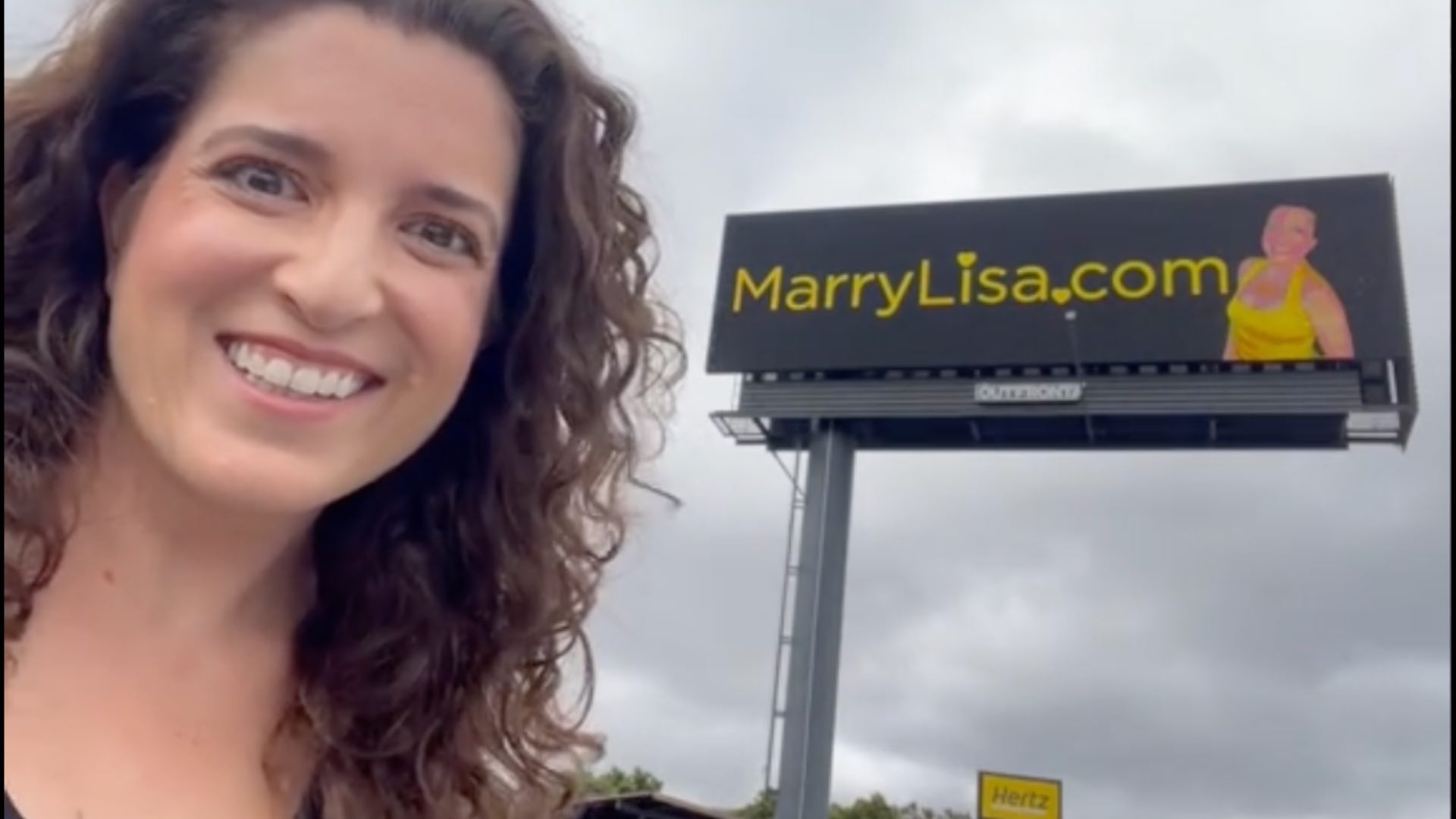
To bypass dating apps, she chose a radically different method. In California, Lisa relied on urban billboards to find her future husband… and the initiative attracted more than 4,000 suitors, according to her.
Giant billboards to find your soulmate
Lisa, a resident of San Mateo, California, decided to think outside the box. Tired of online dating, she rented digital billboards along Highway 101, a busy road connecting Santa Clara to south of San Francisco. Her face is displayed in large format, accompanied by a clear message: she's looking for a husband.
Intrigued drivers are invited to visit her website, where she explains her approach and the criteria she considers essential. The story was reported by the New York Post and subsequently picked up by several international media outlets. The initiative quickly sparked curiosity and reactions on social media.
Detailed criteria
On her website , Lisa specifies that she is looking for "a man aged 35 to 47, wishing to start a family in the near future." She also indicates that she "values sharing political convictions," placing herself on the left. This transparency is an integral part of her approach. The goal: to avoid misunderstandings and save time. In less than a year, more than 4,000 men have responded to her call.
After a careful initial screening, she explained that she had shortlisted about twenty profiles. Of these, five were invited on dates. She described the selection as "thoughtful and organized." On Valentine's Day, Lisa even shared that she had spent the evening with one of the candidates with whom she had connected a few weeks earlier. Their plans included a movie and a simple dinner.
A divisive approach
While some applaud the originality and boldness of the initiative, others strongly criticize it. Reactions on social media are mixed. Some users describe the approach as "desperate," while others see it as "a defiant way to regain control over one's love life."
Lisa explains that she launched this campaign with a touch of humor, frustrated by the limitations of dating apps. She admits she didn't anticipate the media attention the experiment would receive. To protect her privacy, she asks selected candidates to sign a confidentiality agreement. She considers this precaution necessary given the visibility of her project.
When love becomes public
Urban advertising, usually reserved for commercial campaigns, becomes a tool for finding love. Lisa's initiative raises questions about the boundary between private and public space. By displaying her search for a partner on billboards visible to thousands of motorists every day, she transforms an intimate quest into a project.
This choice also highlights the difficulties faced by some single people when using traditional digital tools. By advertising herself on Highway 101, Lisa bypasses algorithms to speak directly to the public. While the outcome of her adventure remains uncertain, one thing is for sure: her initiative has already made an impact.
Ultimately, by renting billboards to find love, Lisa transformed her personal quest into a media phenomenon. Her "experiment" illustrates the creativity some people display in their search for a soulmate. Between audacity, controversy, and hope, this Californian initiative ultimately demonstrates that, sometimes, love can also be found… on a grand scale.