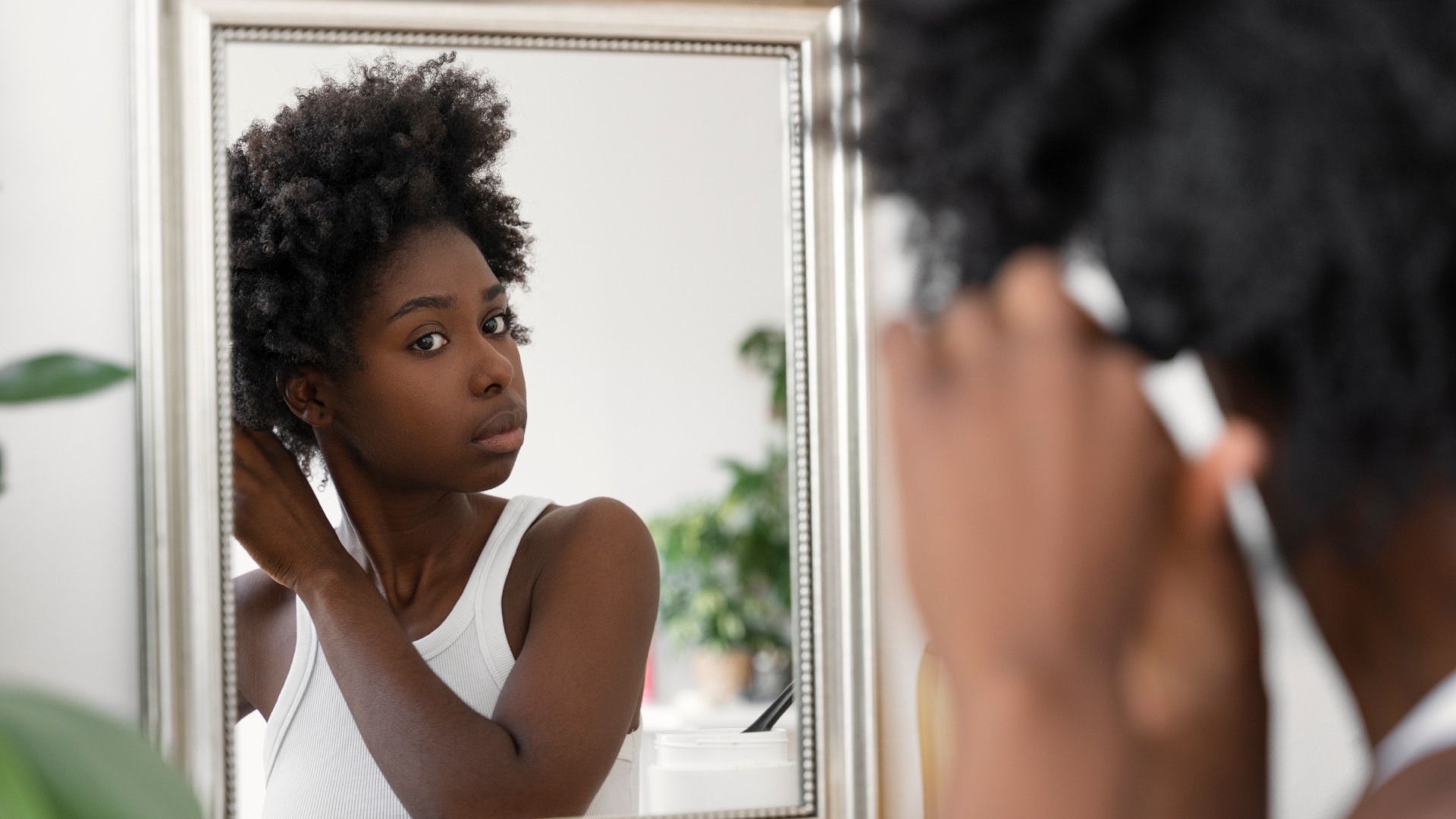
We often think that a mirror simply reflects reality. In reality, it can also alter the way we see ourselves. It's not necessarily the mirror itself that "creates" an insecurity, but rather the way our attention is focused on certain details, especially when we are tired, stressed, or already have low self-esteem. Psychological research shows that simply looking at ourselves while intensely focusing on ourselves can decrease satisfaction with our appearance.
Why doesn't a mirror always reflect a neutral image?
This is where the misunderstanding begins. Facing the mirror, we often believe we're being objective. In reality, we don't always look at our entire face or body: we scan, we compare, we mentally zoom in on what already bothers us. An asymmetry, a blemish, a belly deemed too prominent, or a feature we dislike can suddenly dominate our perception. This attentional bias can make a flaw seem more significant than it actually is.
What research says about self-observation
An experimental study published in the Journal of Behavior Therapy and Experimental Psychiatry showed that after a short period of mirror-gazing, participants reported feeling more dissatisfied with their appearance overall. The researchers emphasized the role of self-centered attention and negative mood: in other words, the mirror seems to become harsher when one observes oneself while ruminating rather than with detachment.
More recent research supports this finding. In 2024, another experimental study observed that self-centered attention while looking in a mirror decreased overall and facial satisfaction related to appearance. The effect was particularly pronounced in individuals with higher pre-existing dysmorphic concerns. This doesn't mean everyone develops a disorder, but it does serve as a reminder that the same mirror doesn't have the same impact depending on the psychological state of the person looking at it.
When attention is focused on what is already disturbing
This research also shows that certain areas of the body attract more attention and emotional reactions, particularly in women with high levels of body dissatisfaction. Here again, the issue is not just what is seen, but what is emotionally activated at the moment of self-reflection.
Why this awareness can bring relief
Understanding this can already be a relief. No, what we feel in front of the mirror isn't always the truth about our appearance. It's sometimes a distorted image, shaped by stress, self-criticism, or internalized beauty standards. The problem, therefore, isn't just "what we see," but how our brain processes that image.
How to re-establish a more peaceful relationship with your reflection
The good news is that this mechanism can also be defused. In psychology, some approaches to "mirror exposure" teach us precisely how to look at our reflection differently: more holistically, with descriptive rather than judgmental words, and without focusing solely on what bothers us. The mirror is then no longer a constant tribunal, but a neutral object that we relearn how to inhabit.
The mirror can accentuate insecurities not because it lies, but because it sometimes amplifies attention already charged with negative emotions. Understanding this allows us to regain perspective: what we see of ourselves is not always the complete reality, but sometimes the fleeting reflection of an overly harsh self-image.