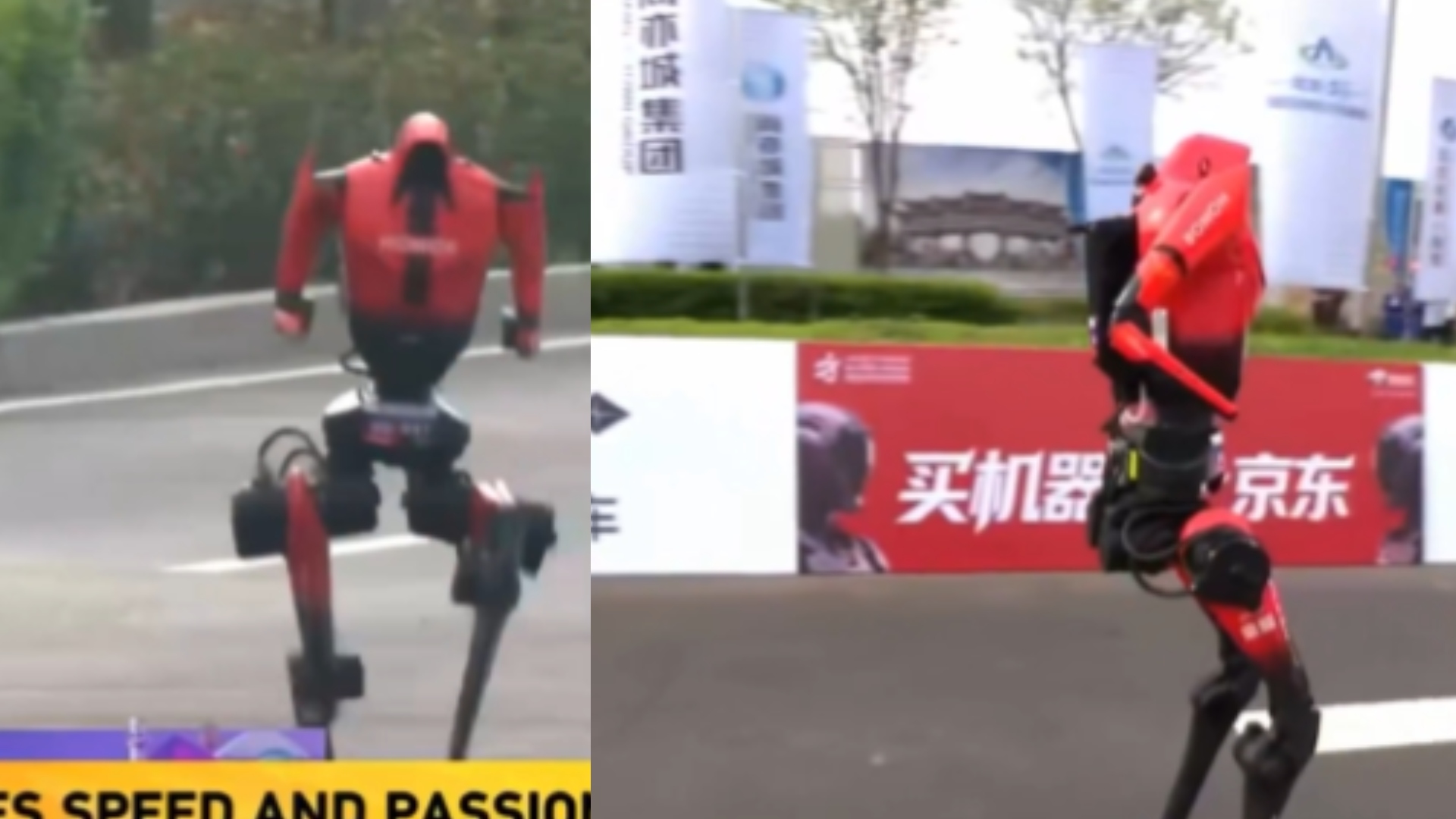
An unprecedented event took place during the Yizhuang Half Marathon, on the outskirts of Beijing, on April 19, 2026. For the first time, humanoid robots participated in a long-distance race alongside human runners, on a parallel course. Among them, one machine particularly distinguished itself by completing the 21.0975 kilometers in approximately 50 minutes, a spectacular time that surpasses current human performances over the distance.
A performance beyond human standards
For comparison, the world record for the half-marathon is held by Jacob Kiplimo, who clocked a time of 57 minutes and 20 seconds in a race in Lisbon in March 2026. The gap is therefore significant, illustrating "the impressive potential of these new technologies," the organizers noted. Despite a fall shortly before the finish line, the robot was able to complete the race thanks to the intervention of its technical team, demonstrating that these machines, while advanced, still rely on human assistance.
This Chinese humanoid robot just shattered the world record for a half marathon, finishing in 50 min 26 sec.
This video shows its crash just meters before the finish line where it had to be picked up by a team of humans. The robot is from Honor, the smartphone maker and Huawei… pic.twitter.com/HflDC0rInX
— Kyle Chan (@kyleichan) April 19, 2026
A rapid evolution of robotics
This type of performance demonstrates the rapid progress in the field of robotics. Just a year earlier, at a similar event, the most advanced robots still took more than two and a half hours to complete the distance. Organized as a technological showcase, the event brought together around a hundred robots, each accompanied by engineers, with the aim of demonstrating advances in mobility, balance, and endurance.
Between fascination and anxieties
This spectacular demonstration inevitably reignites questions about the role of machines in our society. Long confined to industrial tasks, robots now seem capable of competing with, or even surpassing, humans in complex physical domains. These advances are reminiscent of the worlds imagined by authors like Isaac Asimov or Philip K. Dick, where the line between humans and machines becomes increasingly blurred.
Ultimately, this performance marks a symbolic milestone in the evolution of robotics. While its spectacular nature is captivating, it also raises essential questions about the limits, ethics, and future of human-machine coexistence. One thing is certain: technology continues to push the boundaries of what is possible, sometimes faster than we ever imagined.