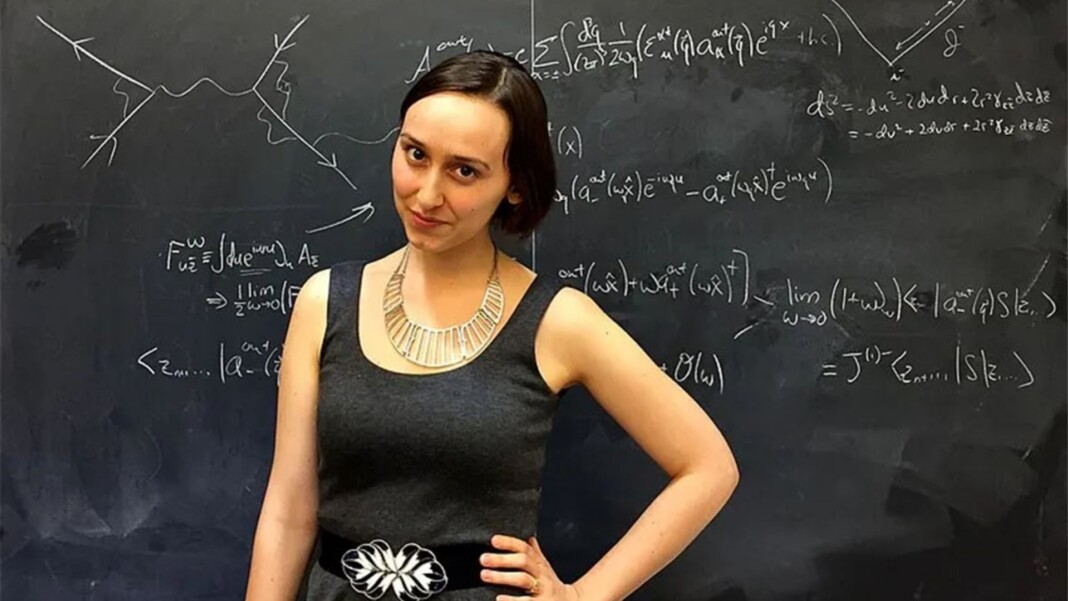
While young women, born with a knack for math and pursuing scientific fields, are still haunted by imposter syndrome, they now have a role model. Presented as the intellectual counterpart to Albert Einstein, Sabrina Gonzalez Pasterski proves that the equation of women and science is possible. The 34-year-old physicist, who built an airplane with her own hands at the age of 12, is well on her way to becoming a textbook subject and making history.
Sabrina Gonzalez Pasterski, a precocious genius
Everyone still remembers the achievements of Albert Einstein, the father of relativity who transformed our understanding of gravity, space, and time. The torch has been passed, and it is a woman who is following in the footsteps of the man estimated to have an IQ of 160. In textbooks, the comical portrait of the physicist sticking his tongue out and sporting wild hair will soon appear alongside that of a young woman with dark hair and a piercing gaze.
Her name? Sabrina Gonzalez Pasterski. At just 34 years old, she has already made major discoveries in a field where women are underrepresented . Her intellect is her greatest asset, and her resume rivals those of the greatest minds history has ever known. From a very young age, she had ambitions worthy of NASA.


At just 12 years old, an age when most ordinary children are building LEGO castles, she embarked on the construction of an airplane. And not a cardboard model. Unlike her classmates, who were probably starting to coo in the schoolyard, she had other priorities. Passionate about aerospace, she built a plane "for her dad" and tested it two years later over Lake Michigan. This already hinted at many feats of ingenuity to come. It was just a warm-up for the Cuban-American, destined to revolutionize science.
A learned woman who is rewriting the history of science
This cognitive frenzy opened many doors for her, notably those of the prestigious Massachusetts Institute of Technology (MIT), which she joined at just 17 years old. As a logical progression, her future unfolded at Harvard, where she pursued her doctorate and completed her dissertation. And when the late Stephen Hawking, the eminent astrophysicist, cited one of her works on the "spin memory effect," it was the ultimate recognition.
While women struggle to find their place in this male-dominated field and still face dubious theories about their abilities, Sabrina Gonzalez Pasterski is single-handedly changing the game. While some have to fight twice as hard for recognition from their peers, this rising star in science received a $1.1 million offer to join Brown University. Humble and steadfast in her convictions, she declined the offer to join the Perimeter Institute for Theoretical Physics, where she currently works.
An inspirational role model for younger generations
Sabrina doesn't just dream up pipe dreams; she has her eyes firmly fixed on the stars, quite literally. Her current job involves encoding the universe in a holographic form to better understand it and shed light on certain mysteries. If you prefer words to numbers, these terms might sound like gibberish.
To put it simply: this woman in her thirties set out to succeed where Einstein had failed and to find answers to questions that the eminent scientists of the time weren't even asking. She didn't necessarily invent a revolutionary machine or discover a new law like E=mc², but she made her own contribution, or rather, a significant one, to the field.
Sabrina also accomplished the unthinkable: restoring the reputation of women in science and giving them a voice. And that was almost as complex as an operation involving x and y. Especially when you consider that among the 956 Nobel laureates, only 60 are women, or 6% .


While girls are scarce in scientific fields, Sabrina supports their applications and excels on their behalf. Hopefully, her discoveries won't be overshadowed like those of Hedy Lamarr, a pioneer of Wi-Fi.