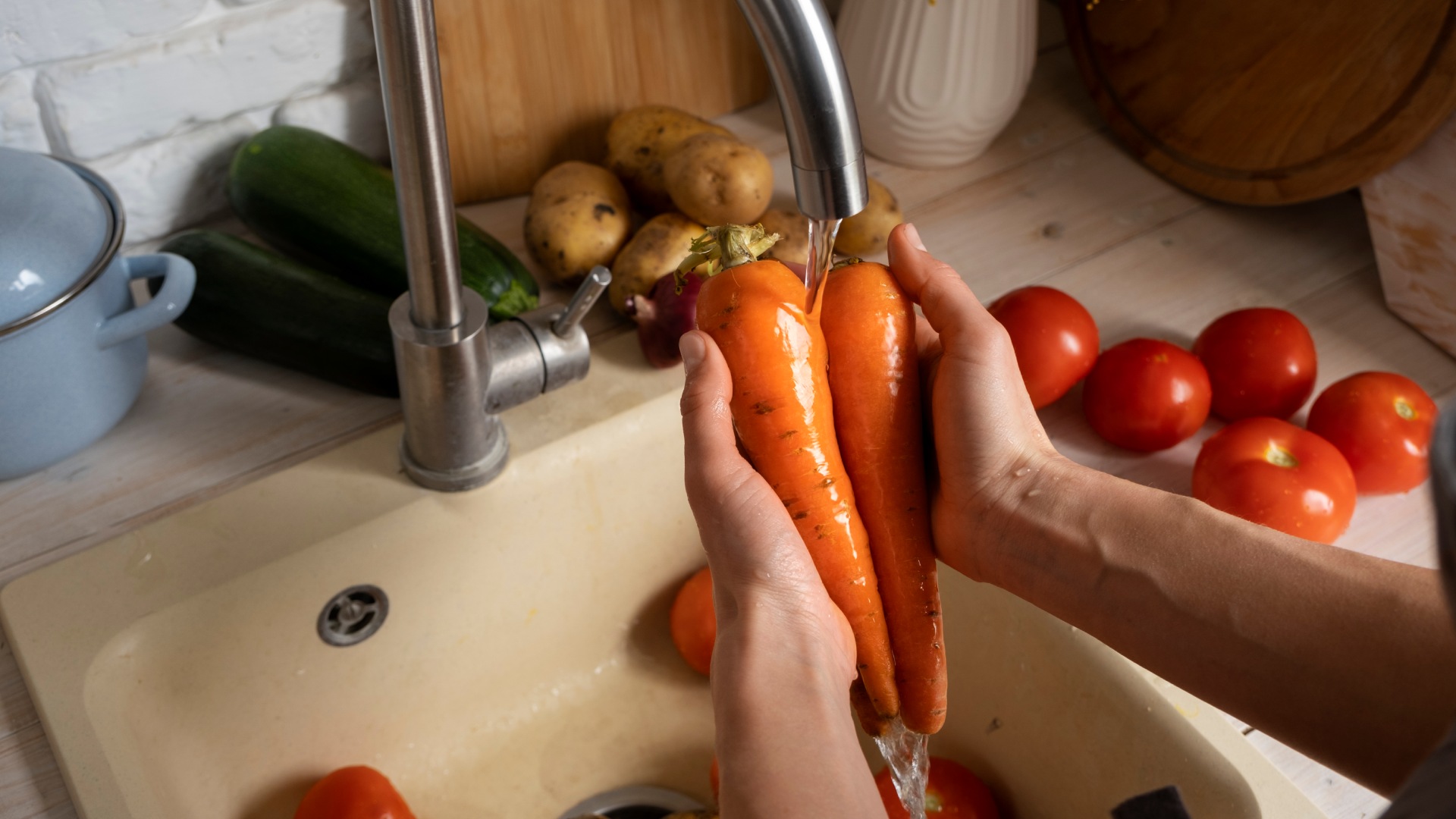
With the current heatwave, you might be living on salads alone. From starter to main course to dessert, fruits and raw vegetables punctuate your meals from beginning to end. To prepare your refreshing recipes, you raid the supermarket shelves and meticulously wash your ingredients, which aren't as natural as they seem. For a menu free of added pesticides, the Japanese have a promising technique.
Fruits and vegetables, tarnished by pesticides
Health organizations recommend we eat five fruits and vegetables a day to stay healthy. However, these treasures of the earth are tainted by pesticides. Farmers don't just use a simple watering can to make their fields grow. Today's agriculture is far from resembling a remake of "Little House on the Prairie." According to statistics , more than 6 out of 10 non-organic fruits and vegetables contain at least one detectable pesticide residue. Among the most contaminated are cherries , grapes, strawberries , and apples. Unless you have a Garden of Eden at your disposal or are self-sufficient, it's difficult to escape this grim reality.
That's why we wash these ingredients better than we wash ourselves. Despite an intensive cleaning session, countless rinses under the tap, and a vigorous massage that would make our partner envious, pesticides persist. According to another study published in the American Chemical Society's journal Nano Letters, rinsing fruits and vegetables with plain water has no effect on pesticides.
"Rather than causing unwarranted apprehension, research suggests that peeling can effectively remove almost all pesticide residues, unlike the frequently recommended practice of washing," it reads. Except that not all fruits are compatible with the peeler in our drawers. If you decide to peel a blueberry, there's not much left to eat.
The Japanese technique that promises to eliminate 80% of pesticides
This is a tip that's gone viral. It doesn't involve leaving your fruits and vegetables to soak in the sink with a splash of vinegar, but rather purifying these produce, grown in a cloud of chemicals, with a mixture that has already proven its worth with our grandmothers. It uses ingredients that we all have in our cupboards: salt and baking soda. And the method is simple.
- Simply add two tablespoons of salt to a bowl filled with eight cups of warm water.
- Next, we add a tablespoon of baking soda, a versatile powder with stripping properties.
- The fruits and vegetables are left to rest in this antiseptic mixture for 5 to 10 minutes, as recommended by the media outlet Top Santé .
- It is also recommended to stir everything to prevent the powder from settling at the bottom of the bowl.
- Finally, all that remains is to pass the fruits and vegetables through the colander and rinse them. This should be done just before eating.
Other good practices to avoid pesticides in your food
While this Japanese method is intriguing in its simplicity, it doesn't eliminate the need to adopt certain daily habits to limit exposure to chemical residues. Because between the treatments applied to crops, transportation, and storage, fruits and vegetables accumulate far more than just a little soil.
The first thing to do is to vary your diet. Always eating the same fruits and vegetables can mean exposing yourself to the same substances over and over again. Alternating products, origins, and seasons allows you to diversify your meals and also reduce this risk of invisible accumulation.
Prioritizing seasonal produce and local sourcing can also make a difference. Fruit picked closer to home often requires less processing to preserve it for long journeys or weeks of storage. Without becoming obsessed with "perfect eating," choosing local when possible remains a worthwhile approach.
Organic produce, often criticized for its higher prices, can also be reserved for the most exposed foods. Not all fruits and vegetables contain the same levels of pesticides. Opting for organic versions of strawberries, apples, grapes, or spinach can be a more realistic compromise than a 100% organic basket.
Eating fruits and vegetables is a healthy habit, provided they are not contaminated by pesticides. The idea is not to become hyper-vigilant about food, but simply to limit the risks without letting laziness get the better of us.