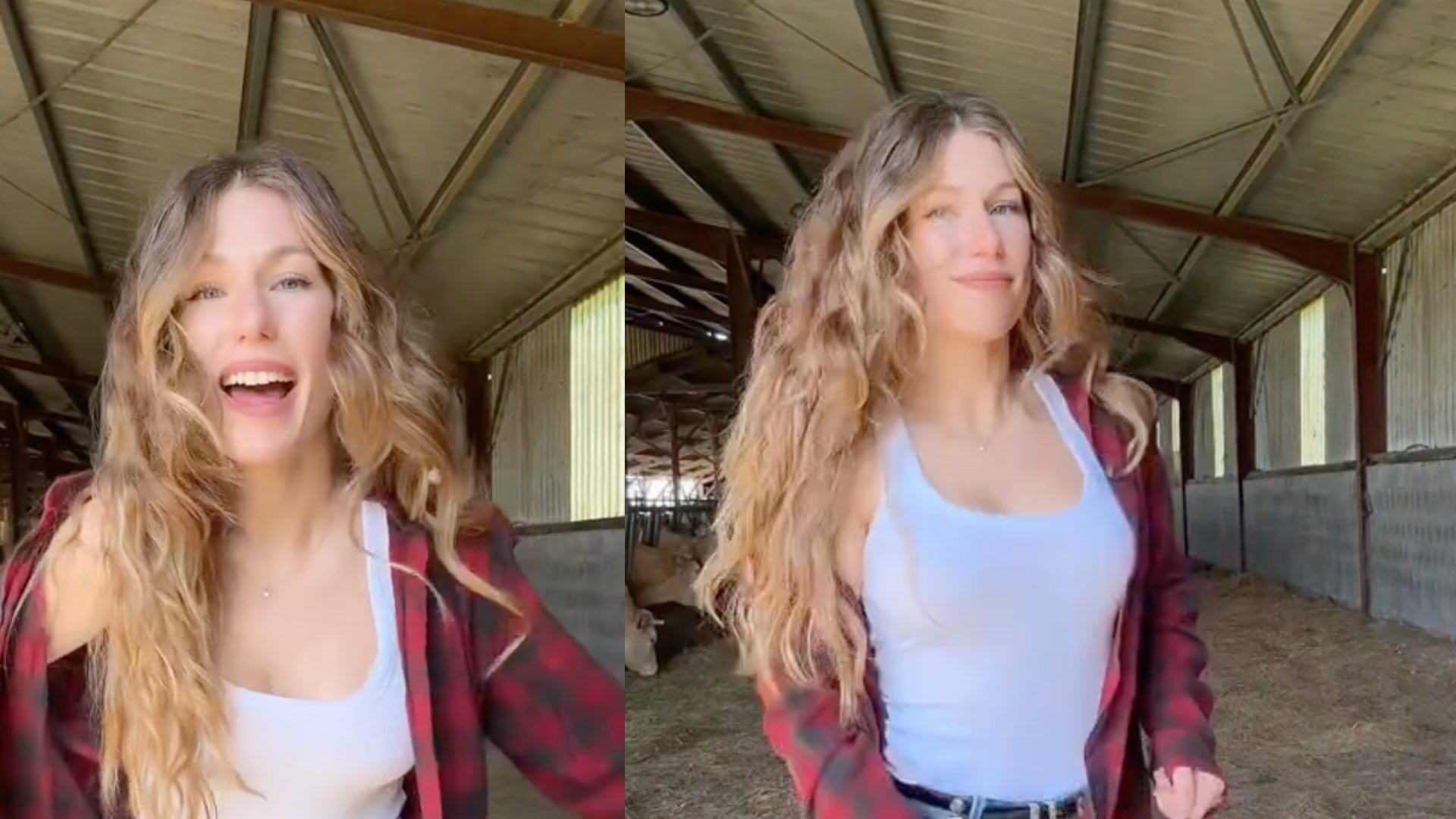
In the Gers region, Zoé (@zoe.la.gersoise) is raising awareness. An art director in graphic design, she is also the wife of Ludovic, a farmer. And for the past few months, her TikTok videos about their life on the farm have been going viral across France.
"Farmer's wife and bon vivant"
This is how Zoé introduces herself on her TikTok account, @zoe.la.gersoise. Originally from eastern France, she arrived in Occitanie at the age of 9, went to study in the United States, then returned to the Gers region where her partner took over the family farm between Samatan and Gimont. She is now an art director in graphic design, based in Toulouse. Far from the stereotype of the farmer's wife "who stays at home," she documents their daily life with a quirky and ironic perspective.
In just three months, her dozens of posts have racked up 15 million views, nearly 16,000 followers, and 837,000 likes. Among her most-viewed posts is a video where she appears in an evening gown because "her boyfriend says to her: 'Shall we go outside?'" —meaning, to the fields. The clip alone has garnered over 800,000 views. The secret? Accessible humor, relatable situations, and an ability to transform everyday farming life into something universal.
@zoe.la.gersoise 🐮👀 #farmer #couple #agri #fyp #foryou ♬ angeleyes - Jaquavious
"Breaking down stereotypes about farmers"
"My goal is to demystify the prejudices surrounding farmers' lives and show how enriching their daily routine can be," explains Zoé. She addresses the heavy workload of livestock farmers—forced to work weekends and in all kinds of weather—but also the "little-known" advantages: the connection to nature and the fact that no two days are ever the same. She receives "a lot of thank-you messages" and notes that "many farmers see themselves" in her videos and support her.
A close-knit duo in front of the camera
Inspired by her partner Ludovic, who manages the family farm, Zoé (@zoe.la.gersoise) posts daily videos, often showcasing their shared adventures. The duo works well together: he's deeply rooted in farming; she's a graphic designer with an outsider's perspective, always on the lookout for the "absurd" or touching detail. A mother of two young daughters, she juggles family life with her passion for content creation.
Ultimately, Zoé wants to shift her account towards "more technical" content, highlighting the work of livestock farmers or grain growers, and evolve into "the account of a young farming couple." This project corresponds to a real demand: her audience wants to see more, understand more, and continue to see themselves reflected in this daily life that has been poorly portrayed to them until now.
@zoe.la.gersoise "Take me for a ride" 🎶🥳 #farmer #farming #fyp #tractor #foryoupage @NAKAMURA ♬ original sound - Swup
An increasingly connected sector
The agricultural sector has an increasingly strong presence on social media: in 2024, 79% of farmers had at least one active account, according to a study by ADquation. And despite the numerous challenges facing the industry, 92% of French people say they "have a positive image of farmers"—a growing appreciation that partly explains the success of agricultural accounts on social media, such as Zoé's (@zoe.la.gersoise).
This "staged" portrayal, however, is not universally accepted. Some denounce it as an idealized vision of the profession, reduced to polished images of sunrises over fields, peaceful married life, and a close bond with animals. This representation is deemed misleading, as it obscures the physical hardship, mental strain, economic insecurity, and psychological distress experienced by a segment of the agricultural community. Others also point to the romanticized depiction of livestock farming, where scenes of tenderness with cows and goats mask the productive reality: animals exploited and then sent to the slaughterhouse. Behind the bucolic narrative, social media thus becomes the arena for a debate about what aspects of the profession we choose—or not—to show.
In short, Zoé (@zoe.la.gersoise) doesn't claim to revolutionize agriculture. With humor, without condescension or "excessive romanticism," she simply reveals a reality that many were unaware of. And clearly, 15 million people agree.