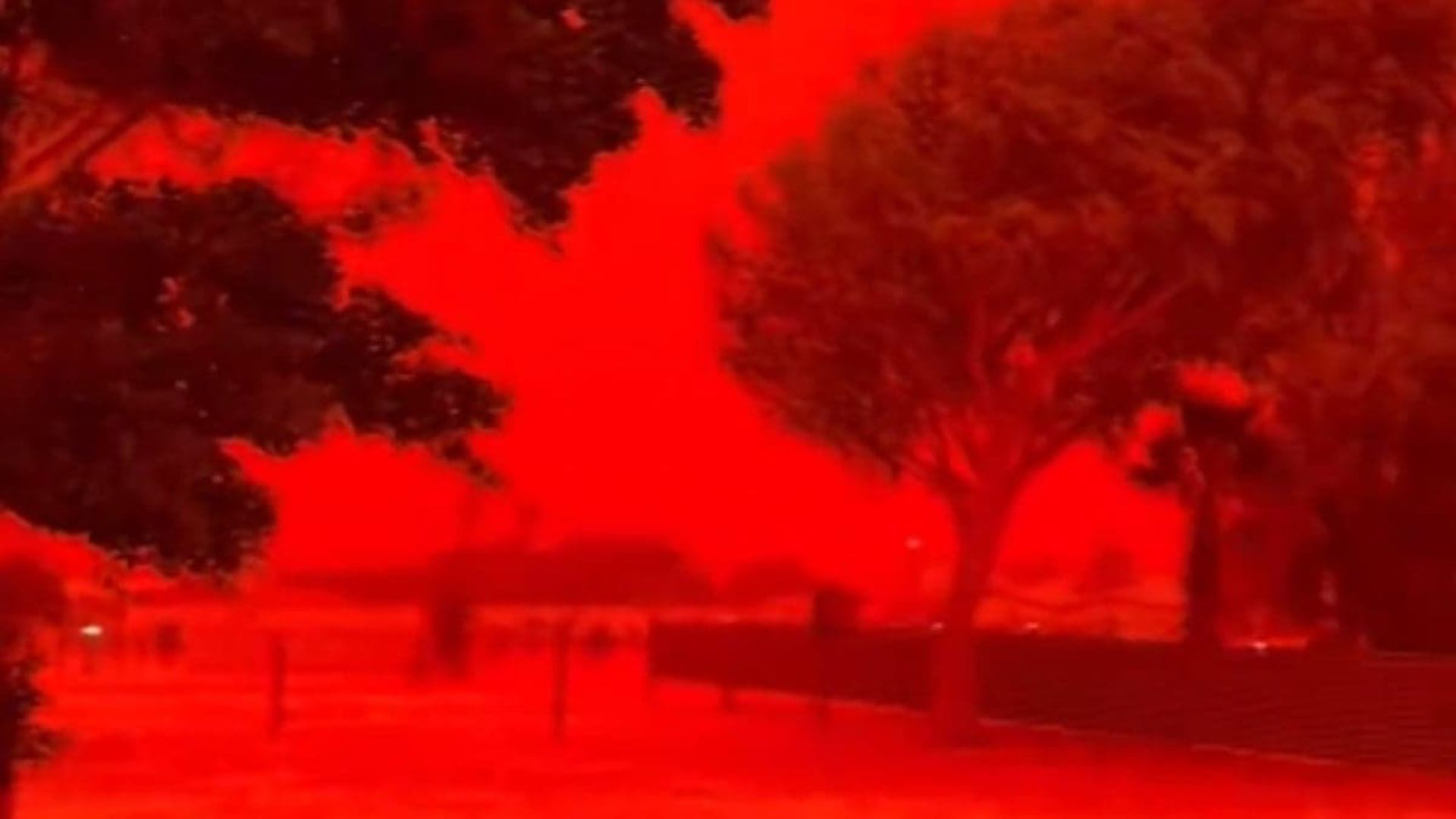
An intense red sky, almost surreal, recently captured everyone's attention in Australia. The images, widely shared on social media, sparked fascination and questions. Behind this impressive spectacle, scientists point to a well-known natural phenomenon.
A particularly powerful weather event
This reddish sky was observed during the passage of an intense weather system: Tropical Cyclone Narelle. As is often the case with this type of phenomenon, strong winds swept through some regions, raising large quantities of dust and sand in their wake.
These particles, released into the atmosphere, alter the way sunlight passes through the air. As a result, the sky can change color and take on unusual hues, ranging from deep orange to spectacular red. Australian meteorological authorities explain that these dust storms affect both visibility and the appearance of the sky. The more particles the air contains, the more pronounced the visual effects can be.
View this post on Instagram
Why is the sky turning red?
This phenomenon may seem impressive, but it relies on a fairly simple physical mechanism: the scattering of light. Sunlight is usually composed of different colors. In a typical atmosphere, blue hues are scattered more, giving the sky its usual appearance.
When the air is filled with dust, sand, or smoke, everything changes. These particles filter out certain wavelengths of light, particularly blue hues. Warm colors, like red and orange, then become more visible. It's a bit like the effect of a blazing sunset. Except here, the effect is amplified by the large quantity of particles suspended in the air.
Images that have gone around the world
Unsurprisingly, these extraordinary landscapes quickly flooded social media. Photos and videos show an almost supernatural sky, transforming everyday life into a scene worthy of a film. Many internet users described an "unreal" or "apocalyptic" atmosphere, proof of the powerful visual impact of this type of phenomenon. Locally, some residents also mentioned a peculiar atmosphere, linked to the presence of dust in the air.
This virality demonstrates how spectacular natural phenomena continue to captivate us. Your gaze is naturally drawn to these extraordinary images that challenge your visual perceptions.
A rare phenomenon… but not unique
While striking, this type of red sky is not entirely unprecedented. Similar phenomena have already been observed in various parts of the world. During sandstorms, pollution episodes, or even fires, the concentration of particles in the air can produce comparable effects. In 2022, for example, a red sky was reported in China under specific weather conditions.
Experts point out that these events remain relatively rare, as they require a combination of several factors: strong winds, a high presence of particles, and specific atmospheric conditions.
A natural spectacle that speaks to our senses
Faced with these images, it's natural to feel surprise, even a sense of fascination. Your perception is directly influenced by light and color, and this type of sky plays precisely with these reference points. This phenomenon also reminds us how alive and constantly evolving the atmosphere is. The colors you observe are never static: they depend on multiple elements invisible to the naked eye.
In short, this impressive red sky is not mysterious at all. It is explained by the massive presence of dust in the air, lifted by powerful winds associated with an intense weather event. Even with a perfectly clear explanation, it still retains that "little something" of the spectacular that continues to amaze us.