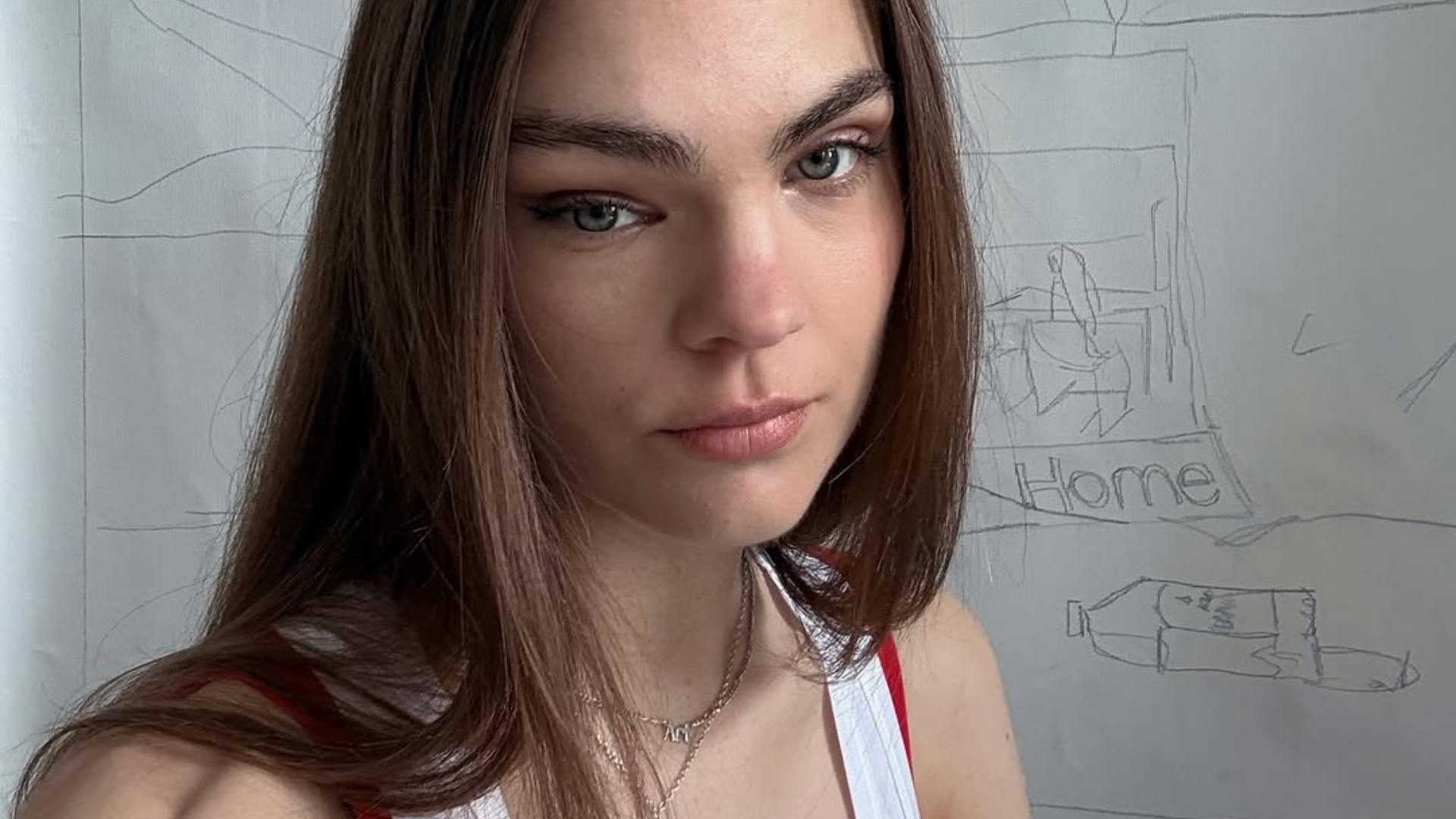
The faces shared behind beauty hashtags are all "harmonious." And this "perfect" geometry seems almost suspicious, even unreal. Even though society has convinced us that a slightly off-center gaze, one eyebrow higher than the other, or a crooked nose are anomalies, in reality, these small peculiarities, visible only under a magnifying glass, are perfectly normal. Virtually no human being on Earth has a symmetrical face, and it's time to celebrate these features that social media is so keen to "correct."
Facial asymmetry, far from being an anatomical flaw
When you linger too long in front of the mirror , you start to feel like a Picasso painting. The more closely you examine yourself, the more your reflection resembles an abstract art portrait. One eye is more open than the other, one eyelid droops on the left but not the right, you have a dimple on one side, and one lip is fuller than the other.
Your face isn't exactly the same on both sides. This asymmetry is even more noticeable in photos. In these pictures, which are meant to be memories and not tools for self-criticism, these small details that usually go unnoticed suddenly stand out. This explains why one of your profiles is more "photogenic" and "attractive" than the other.
While symmetry is often synonymous with perfection, it remains a magazine utopia or a surgeon's office ideal. In fact, you're like 99% of the people in the world: you have an asymmetrical face. "Cro-Magnon man already exhibited this asymmetry. He had square eye sockets, and one was smaller than the other. Lucy did too, for that matter," explains Dr. Marc Divaris .
View this post on Instagram
A face split in two, a guaranteed singularity
In magazines, it's always the same old story. You're encouraged to abandon certain habits to "rebalance" your features and undo the work of genetics, as if it were merely a "perfectible" draft. Yet, this asymmetry, whether more or less noticeable, makes you unique and also more "human." Even if the myth of the perfectly parallel face appeals to many women, it's just another invention of societal pressures. According to the expert, a perfectly proportioned face is "a guaranteed monster's head."
According to the expert, you have a face with two distinct styles. He describes one side as softer, sometimes called the "childlike side." The features may appear finer, with more delicate contours. Because the bone structure is often less pronounced, the tissues are also slightly less firm, which can cause signs of aging to appear a little earlier.
Conversely, the other side of the face may appear more structured, with slightly fuller or more defined features. This side, sometimes called the "adult side," is often perceived as more robust. Thanks to this natural support, it tends to be more resistant to aging and to change more slowly.
Asymmetrical face and cognitive power: the strange link
After reading entertaining books or seeing edited photos that give the illusion of uniform faces, you've probably tried to create a custom look and even out your features. Perhaps by slightly extending your lips with your makeup, reshaping your uneven eyebrows , or artificially straightening your nose through the art of contouring.
Yet, what society tirelessly presents as a flaw is actually a wonderful gift. This is the conclusion of a study conducted by researchers at the School of Psychology at the University of Auckland and published in the scientific journal Symmetry . Their work suggests that asymmetry is not a "problem" of growth, but rather a natural characteristic of living beings, deeply rooted in our biology. It may even play a role in the proper functioning of certain human abilities.
To reach these conclusions, the researchers studied the evolution of asymmetries in humans, as well as in other species. They observed that these differences between the two sides of the body have always been present and that they contribute to the development of essential functions such as language, coordination, and fine motor skills (for example, the use of the hands).
Another interesting point concerns the brain: it is naturally asymmetrical, with hemispheres that do not have exactly the same roles. This organization allows for a form of specialization, where each "side" of the brain contributes to different skills, making our overall functioning more efficient and better adapted.
Ultimately, having an asymmetrical face isn't weird. What is weird is believing it is. So the next time you see a picture of a clean-cut girl with a perfectly sculpted face, don't question your appearance, but rather the beauty standards.