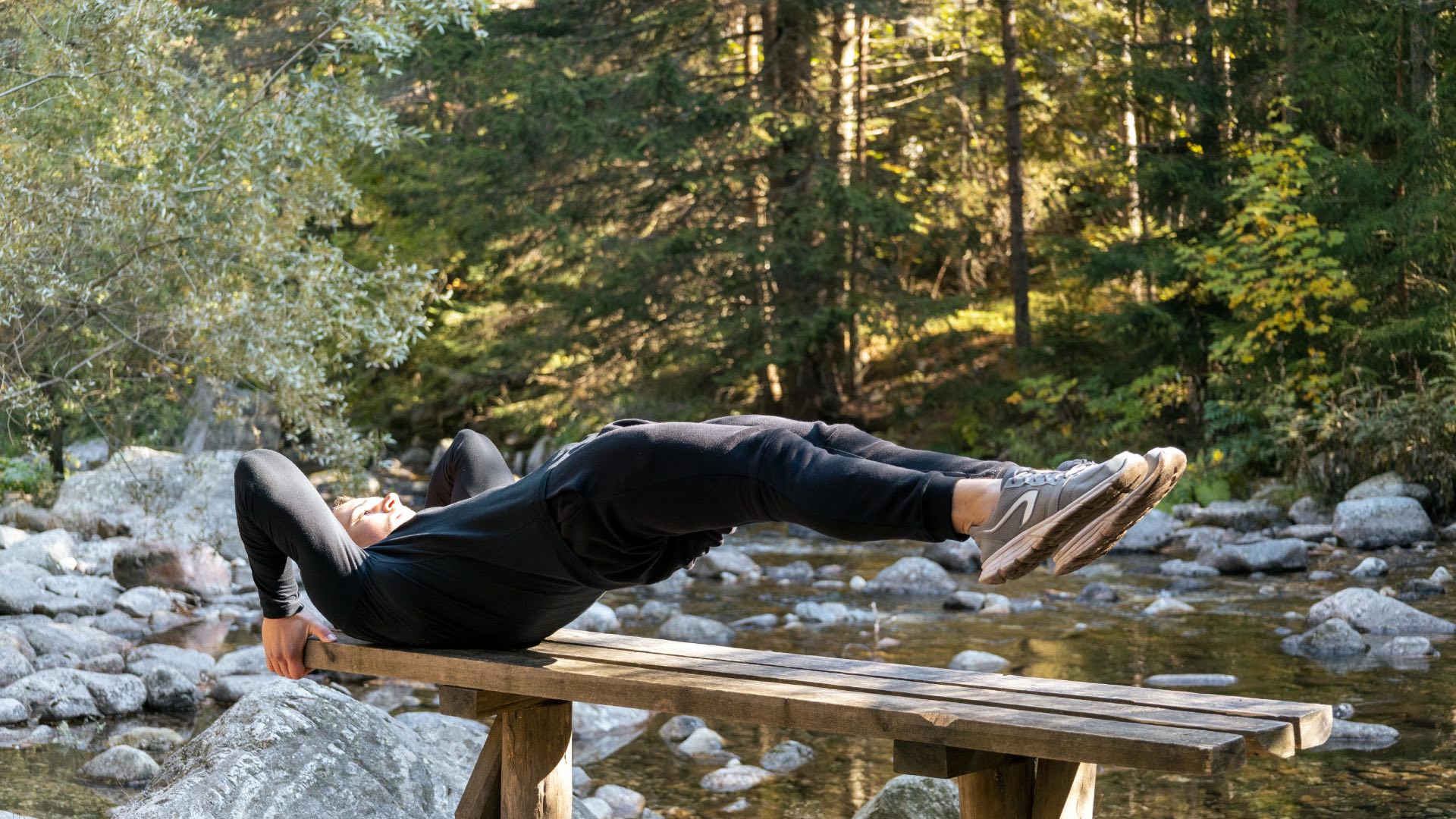
You may have already seen this pose in a gym or on social media: a perfectly straight body, suspended in the air, slowly descending without ever touching the ground. It's the famous "Dragon Flag," a legendary exercise by Bruce Lee that inspires as much as it frightens. Rest assured, it's not mandatory to achieve this pose to feel good in your body.
Origins and muscles involved
The "Dragon Flag" was popularized in the 1970s by Bruce Lee and has since become a staple of modern calisthenics. It's an anti-extension exercise that challenges the entire core: abdominal muscles (rectus abdominis, obliques, transverse abdominis), lower back, glutes, and even shoulders are all engaged simultaneously. Unlike traditional crunches that isolate specific muscles, the "Dragon Flag" requires continuous tension throughout the entire body, enhancing stability and overall control.
It's important to remember that you don't need to do this move to be strong, toned, or satisfied with your body. The Dragon Flag is spectacular, but it's not a prerequisite for feeling good or accepting your body as it is.
View this post on Instagram
Basic technique
For those who want to try this exercise: lie on a bench or the floor, grasp a fixed point behind your head, then raise your legs, hips, and torso until they form a straight line from your shoulders to your feet. Lower yourself slowly, without arching your back or touching the ground, for 3 to 5 repetitions per set. Breathing plays a key role: hold your breath as you lower yourself and exhale as you raise yourself to maintain control.
This exercise requires significant coordination and concentration. Again, the "Dragon Flag" is not mandatory. It can be explored as a fun challenge, without pressure, and without it defining your worth or appearance.
Progressions for beginners
For beginners, several variations allow them to become familiar with the movement:
- The Dragon Flag tuck, with knees bent towards the torso.
- The negative, a slow assisted descent to feel the tension in the trunk.
- The one-leg and the straddle, where one or two legs are extended progressively before moving on to the full Dragon Flag.
Coaches' tips for making progress without risk
Experts recommend keeping your abs and glutes constantly engaged, avoiding momentum, and using resistance bands or a partner if needed. The "Dragon Flag" exercise can be incorporated into a program with ab wheels or planks, but again, it's not essential for feeling good in your body. Accepting your body as it is remains the best approach for a healthy relationship with yourself.
In short, the "Dragon Flag" is a spectacular exercise that can be a fun challenge for people who enjoy testing their bodies and coordination. However, it's essential to remember that well-being isn't about performance or appearance. You don't need to master this exercise to have a "strong" body. Every body is valid, beautiful, and sufficient just as it is.