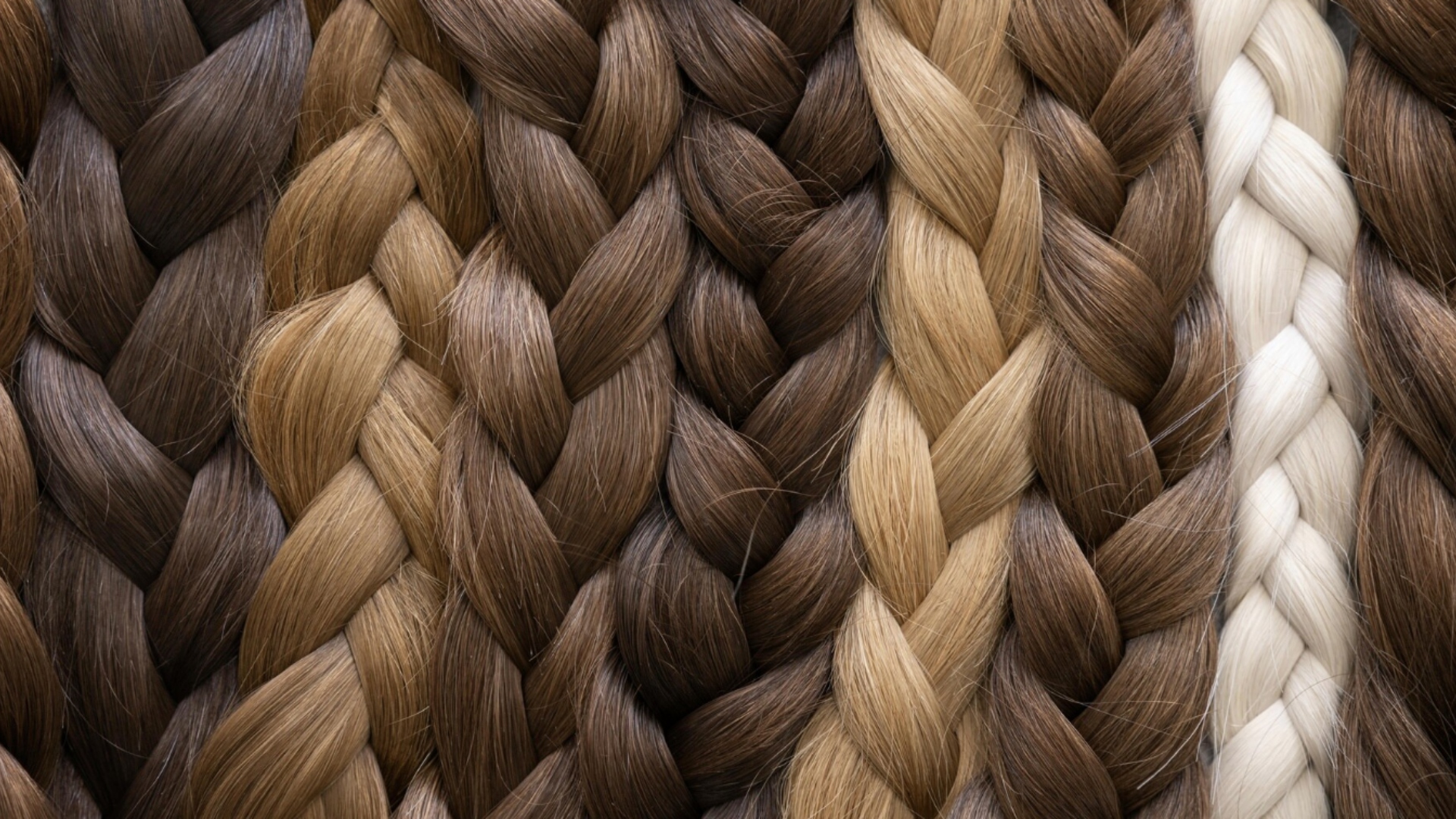
Globally, black and brown overwhelmingly dominate the spectrum of human hair colors. All other shades are, by comparison, exceptions. But what is the rarest natural hair color? Let's decipher a story that is primarily genetic.
Genetics is more subtle than it seems.
A large-scale study published in 2018 , involving approximately 350,000 people, clarified these mechanisms. Its authors showed that the MC1R gene only explains about 73% of the heritability of red hair: other genes play a role in "activating" or "deactivating" its effect. Even more surprising, the majority of people carrying two variants of MC1R are not redheads, but blondes or light brown-haired. In other words, hair color depends on a complex interplay of several genes, not just one.
Red hair, the rarest color
Red hair affects only about 1 to 2% of the world's population, making it the rarest natural hair color. This shade results from variations of a specific gene, MC1R, which determines the type of pigment (melanin) produced by the body. When this gene functions "normally," it promotes the production of eumelanin, a dark pigment. However, some versions of the gene reduce this production in favor of pheomelanin, a red-orange pigment, which is responsible for red hair. An important characteristic is that this trait is recessive. To have red hair, one must inherit a variant of the gene from each of their two parents, which explains its rarity.
A very uneven geographical distribution
Red hair is not evenly distributed across the globe: it is concentrated in populations of Northern and Western Europe. Scotland holds the record, with approximately 13% of the population being redheads, followed by Ireland (around 10%). In these regions, a much larger proportion of the population—up to 40% in Scotland—carries a variant of the gene without expressing it. These are "hidden" carriers, able to pass on the hair color to their children without exhibiting it themselves.
Natural blonde, another uncommon shade
Often associated with Northern Europe, natural blond hair is also rare worldwide, affecting approximately 2 to 3% of the population. While it appears common in Scandinavia, it becomes very rare when considering all continents. Here again, genetics plays a central role, but through a more complex mechanism than for red hair.
If red hair is so fascinating, it's undoubtedly because it combines statistical rarity with a unique genetic history. The rarest hair color in the world, it's not likely to disappear: the gene responsible continues to be passed down discreetly from generation to generation. An uncommon hair color, but one firmly rooted in human heritage.