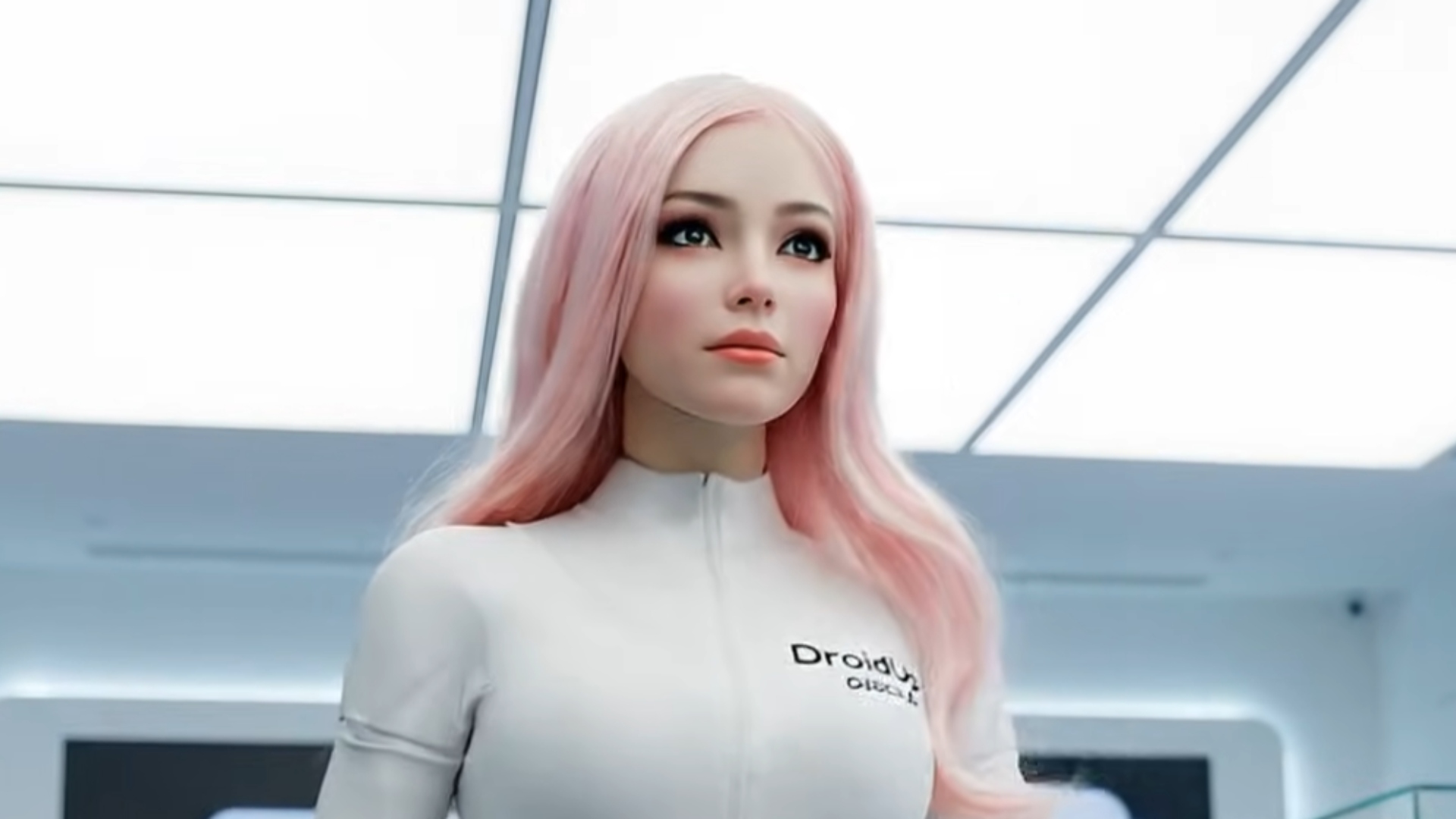
In China, the company DroidUp has just unveiled Moya, a humanoid robot of astonishing realism. Equipped with integrated artificial intelligence and a biomimetic body capable of imitating human movements and expressions, this prototype is generating as much admiration as concern.
A robot with a human-like appearance
Designed to push the boundaries of robotics, Moya is described as "the world's first intelligent biomimetic robot." The humanoid, standing 1.65 meters tall and weighing 32 kilograms, boasts perfectly proportioned features, a fluid gait, and even a simulated body temperature between 32 and 36°C. During its official unveiling—reported by the South China Morning Post —Moya captivated audiences: it smiles, walks, reacts to eye contact, and reproduces facial micro-expressions with a subtlety rarely seen in a robot. These characteristics make this robot a technological marvel, but also a subject of debate.
View this post on Instagram
The unease of the "uncanny valley"
While Moya impresses with its realism, many internet users have also expressed unease at its "almost human, but not quite" movements. This unease corresponds to the well-known "uncanny valley" phenomenon, described in 1970 by the Japanese roboticist Masahiro Mori. According to this theory, the closer a robot's face and mannerisms become to those of a human being, the more unsettling even the smallest imperfections become, creating a feeling of uncanny strangeness.
On Chinese social media, reactions range from technological admiration to widespread fear, with some describing Moya as "too human to be reassuring." Others are once again criticizing the choice of a highly conventional appearance: a slim female body, with accentuated curves on top, wearing makeup, long pink hair, fair skin, and dressed in a form-fitting jumpsuit in soft colors.
Towards a new generation of humanoids
DroidUp asserts that Moya is not limited to a demonstration role. The company plans to deploy this robot in sectors requiring direct human interaction, such as healthcare, education, and retail reception. Unlike other manufacturers who favor deliberately stylized or mechanical robots to avoid confusion, DroidUp is betting on complete realism, banking on the gradual acceptance of this new generation of "living" machines. Moya is expected to be commercially available by the end of 2026, at an estimated price of around 1.2 million yuan (approximately €147,000).
In summary, Moya marks a significant step in the evolution of robots embodying artificial intelligence, capable of interacting emotionally and intuitively. This advancement, however, raises the question of the limits of human imitation. Between scientific prowess and existential vertigo, Moya seems to embody the future that is taking shape...