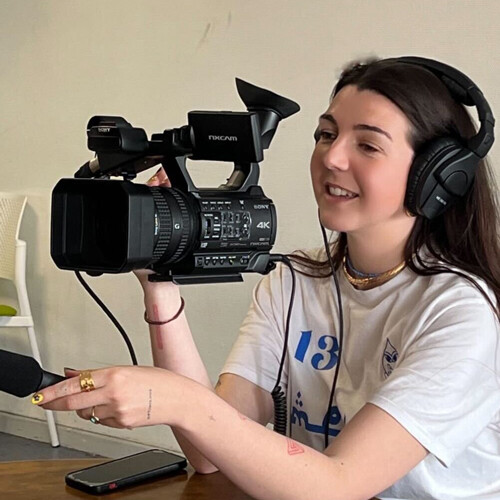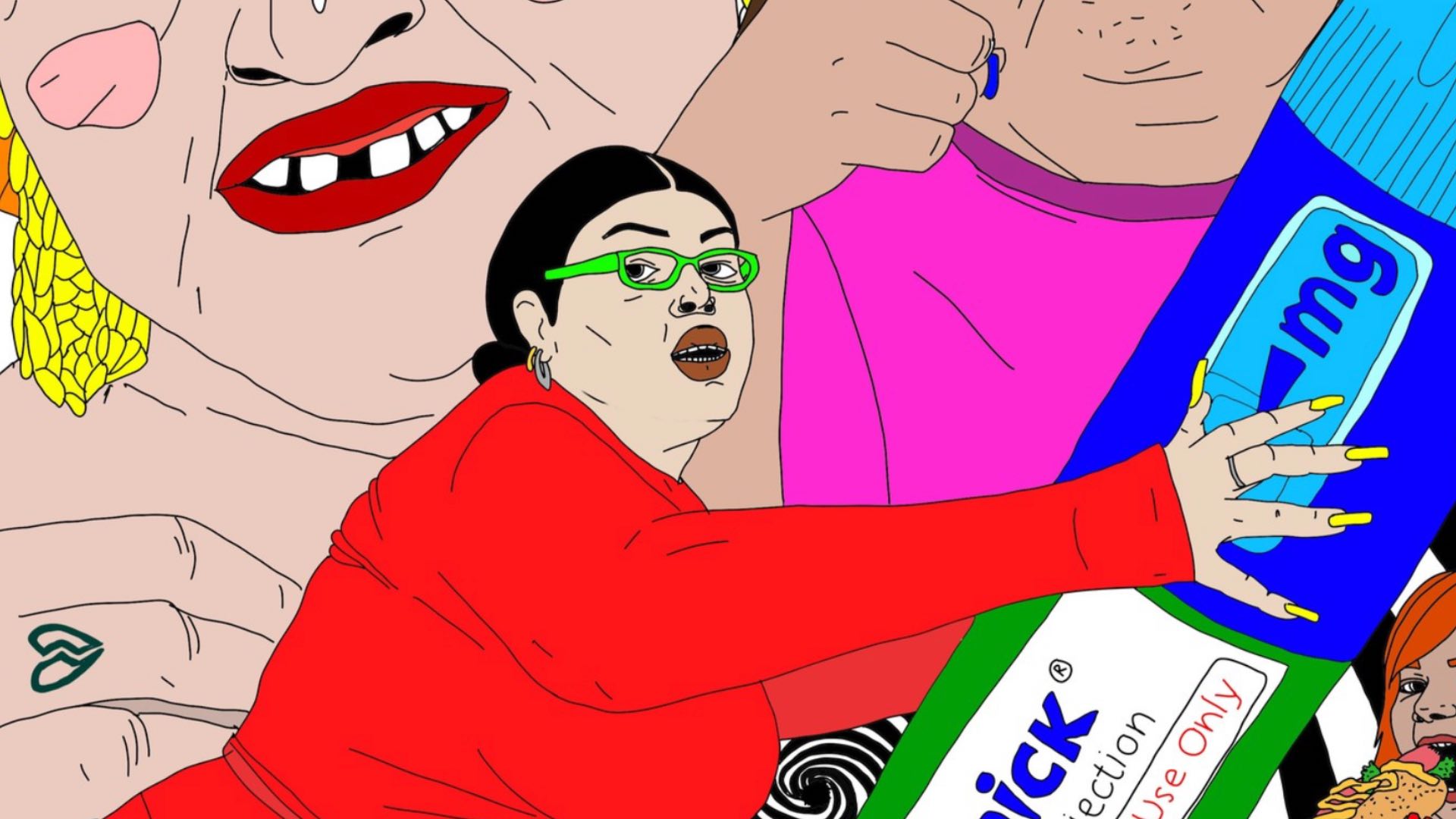
In galleries and on catwalks alike, certain bodies remain sadly relegated to the margins. What if art became a space where you could finally see them differently? With a direct, sensitive, and deeply embodied work, Sophia Lang places fat bodies at the center of the frame and invites you to shift your perspective.
From fashion to the workshop: changing the focus
Sophia Lang began her career in the highly codified world of fashion. She worked as a stylist for Lacoste and modeled for Pierre et Gilles, major figures in staged photography. An immersion into the heart of an industry where image reigns supreme… and where body standards are particularly restrictive.
The lack of size diversity in fashion is indeed regularly criticized. A recent report by the Council of Fashion Designers of America (CFDA) and PVH Corp. highlighted the underrepresentation of plus-size body types in fashion shows and campaigns. In this context, Sophia Lang's move to contemporary art is far from insignificant. Leaving behind a world where the body is standardized to make it a free, central, and political subject: that is the real shift in focus.
When a scale becomes threatening
Some works are immediately striking. Among them, a scale bristling with nails transforms a commonplace object into a hostile instrument. Weighing oneself, a daily ritual for many, suddenly becomes a dangerous experience. The reference is clear. The body mass index (BMI), widely used by the World Health Organization (WHO), classifies bodies according to normative categories. Yet, numerous social science studies highlight the limitations and stigmatizing effects of this tool.
Research published in Social Science & Medicine shows how the medicalization of weight can reinforce discrimination. In France, sociologist Solenne Carof, in her book "Fatphobia: Sociology of an Invisible Discrimination," analyzes these mechanisms of exclusion in detail. By sculpting an aggressive scale, Sophia Lang represents not just an object: she materializes the pervasive social pressure, the kind that seeps into the most intimate aspects of life.
Flesh as aesthetic power
His work is not limited to denunciation. He also celebrates matter. In his installations, volumes are embraced, amplified, sometimes fragmented. Skin, folds, and curves become integral plastic elements.
Art history has already celebrated bodies far removed from current standards—from the canvases of Peter Paul Rubens to the voluptuous sculptures of Fernando Botero. The difference here lies in the perspective: it is no longer an external gaze that stylizes, but an approach rooted in lived experience and critical reflection. The journal Body & Society has shown how the visibility of marginalized bodies transforms collective imaginations. By exhibiting, notably at the Salon de Montrouge, the artist Sophia Lang inscribes these bodies within the legitimate spaces of contemporary art.
View this post on Instagram
Between pathologization and hypersexualization
The fat body often oscillates between two extremes: perceived as a "medical problem" or reduced to a fantasy.American historian Sabrina Strings , in "Fearing the Black Body," aptly traces the racial and moral roots of modern fatphobia. British researcher Charlotte Cooper, for her part, analyzes how visual culture confines fat bodies to comic or exaggerated roles. Sophia Lang defies these categorizations. Her works do not caricature or dramatize. They add complexity. You are not confronted with a provocation, but with a presence.
An art that refocuses and restores value
In her installations, Sophia Lang evokes everyday situations: eating on the subway, going to the beach, visiting a doctor. Contexts where the fat body often becomes the target of commentary. The World Obesity Federation documents the stigma associated with weight, including within medical circles. By incorporating these realities, Sophia Lang reverses the perspective: the problem is not the body, but the way it is perceived. Her works function as devices. They force you to position yourself. Do you observe? Do you judge? Or do you accept deconstructing what you thought was obvious?
By exhibiting fat bodies in art institutions, Sophia Lang is not simply seeking visibility. She is shifting the very definition of aesthetic value. She is asserting that all body types deserve to be shown, sculpted, and celebrated. Through sculptures, videos, and installations, flesh becomes language. Curves become strength. The term "fat body," used descriptively and assertively, contributes to a powerful reappropriation.
Ultimately, Sophia Lang's work opens up a space where bodily diversity is no longer peripheral but central. A space where you are invited to look differently—and perhaps, to look at yourself differently as well.