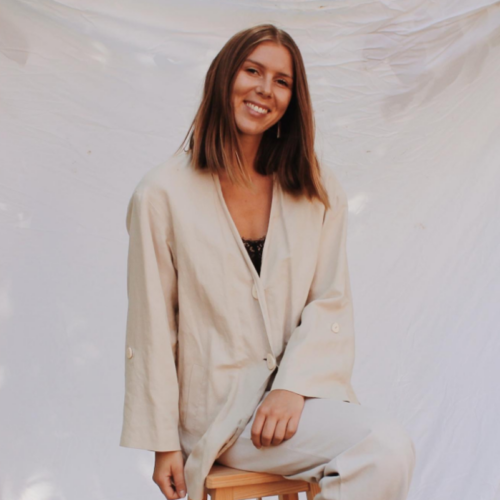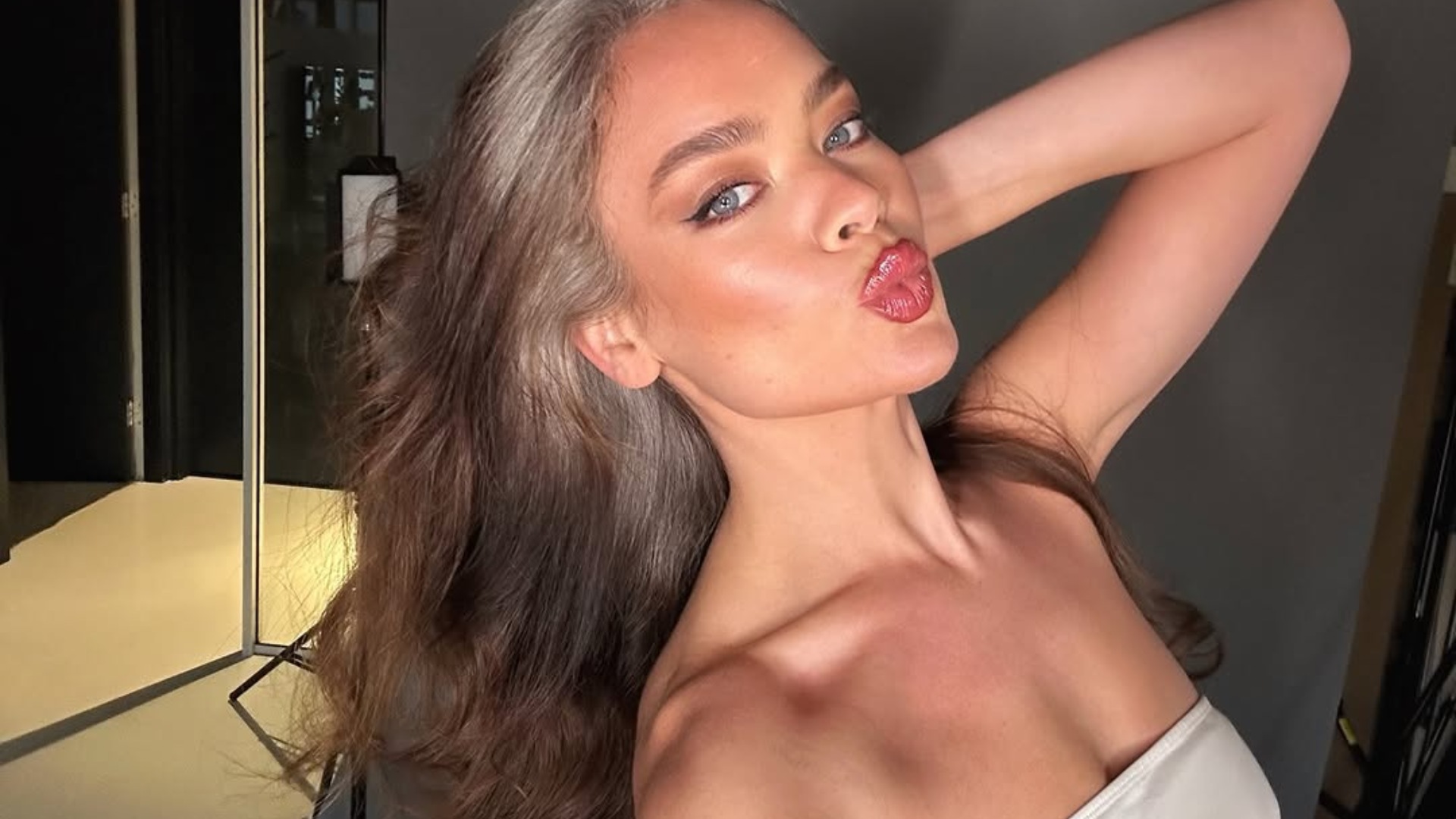
Her brown hair is gradually turning gray. This silvery hue seeps into the strands, almost giving the impression of a deliberate dye job. Yet, her muted hair isn't the result of a trend sparked by a hashtag, but rather the product of nature and biology. At 33, her hair is already thinning, but her charm continues to shine. Far from succumbing to the temptation of fashion dictates, Chanelle Soncini (@chanellesoncini) shares her journey of acceptance and this hair transition that she has chosen not to conceal.
A gradient of grey at an early age
At first glance, her two-tone hair seems to mimic current hair coloring trends, like that of figure skater Alysa Liu, who popularized the striped pattern beyond just wardrobes. However, it's not the artistic creation of a trendy salon, nor is it a manifestation of a passing fad. Genetics is the author of this pepper-dusted hairstyle.
Chanelle Soncini (@chanellesoncini) couldn't have done it on purpose. It all started with a single, isolated strand. An intruder among the rest of her hair. Then, little by little, the top of her head changed color, going from mahogany brown to steel gray. It was as if a can of paint had fallen on her head. We often say that gray hair is a sign of age, the hallmark of older people. Yet, at only 33, an age when hair rarely lacks melanin, the feel-good content creator @chanellesoncini has to get used to this new shade and adjust to this premature graying.
In a society that equates gray hair with excessive stress or a sign of aging, she could have succumbed to societal pressure and dyed her silver roots. Far from denying it or fighting this reality with ammonia, Chanelle Soncini (@chanellesoncini) has made it a signature, an act of resistance and resilience. "Fear is not innate, it is created." It is with these almost philosophical words that she addresses this hair transformation. Because this gray line is not a blemish on her face, but an aesthetic adornment.
View this post on Instagram
Accept instead of demonizing
In this age of youth obsession, where hyaluronic acid flows freely and high-tech treatments promise to slow down the passage of time, the slightest sign of aging becomes a matter of national importance, a collective battle. Gray hair is only tolerated if it falls on wrinkled skin and magnifying glasses. On women in their thirties, however, it's practically forbidden. For American actor Patrick Dempsey or Franco-American actor George Clooney, salt-and-pepper hair is an added touch of soul, while for women, it's seen as a sign of neglect.
But now, tired of this discrimination based on appearance, the younger generation has redefined this ideal of beauty to its advantage. Women like Chanelle now offer a different example: one of acceptance rather than submission. Gray roots , once considered a sign of aesthetic laxity, are more than just "deliberate whims." They are proof of freedom and self-gratification. The professional model, who bears a resemblance to Margot Robbie, hasn't always proudly displayed her flowing hair like a white flag.
With a marketing industry declaring war on gray hair and a society reminding us that gray is the color of decline, it's hard to stay true to yourself. Before proudly displaying her ash-blonde locks, she rejected them, wearing silk scarves tightly around her head. Then, Chanelle Soncini (@chanellesoncini) learned to coexist with these gray strands, which are slowly gaining ground. "It's not about following anything. It's finally about feeling comfortable not hiding and ultimately realizing that YOU are the one making the decisions in your life, not society or the industry," she says with a touch of wisdom online.
View this post on Instagram
Put this reality into perspective, post after post
Just a year ago, Chanelle didn't have a single gray hair in sight. Then, seemingly overnight, those barely visible gray roots spread across the top of her head, becoming increasingly prominent. For her, it wasn't a matter of bad timing, but a "gift from heaven." It was simply genetics taking its course, perhaps having gotten a little ahead of schedule.
Rather than hiding this transformation or accepting it as inevitable, Chanelle chose to tell her story. On her social media, she documents this hair evolution with transparency, humor, and a great deal of perspective. Each post becomes a way to defuse the drama and put into perspective what is wrongly considered a "flaw."
Where some might see an anomaly, she sees a singularity. She plays with this duality, exposes it to the light, stages it without ever seeking to smooth it over. Her photos, far from rigid standards, tell a different story of beauty: more fluid, freer, less constrained by invisible rules.
Ultimately, her gray hair is no longer the issue in itself. It becomes almost secondary to the message it conveys: that of a woman who has decided to stop fighting her reflection and instead embrace it. And in this acceptance, there is something profoundly soothing, almost revolutionary.