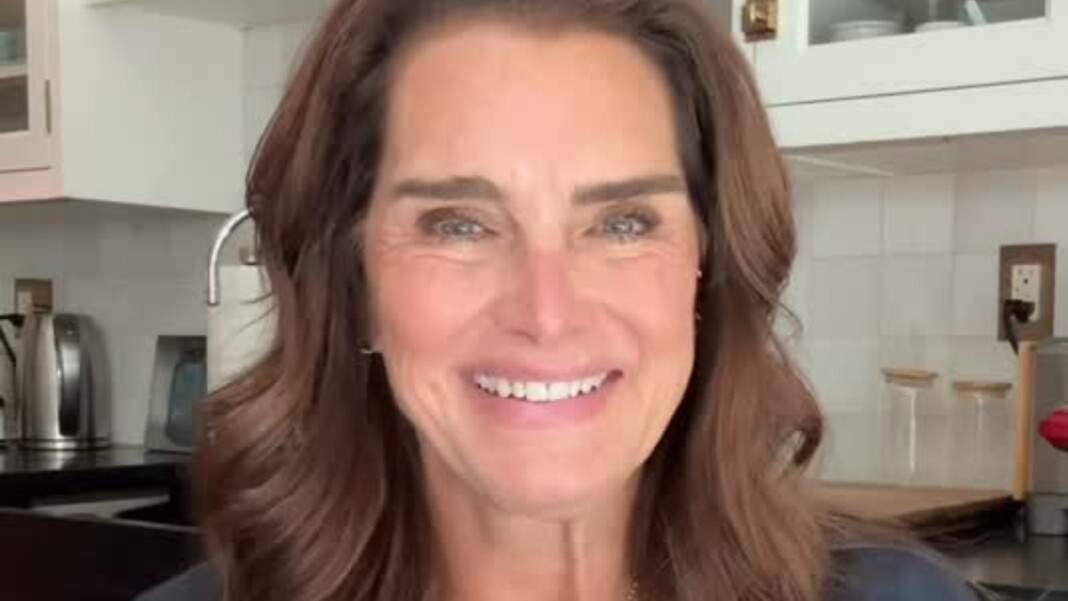
During a recent appearance on Jesse Tyler Ferguson's podcast " Dinner's on Me ," American actress and model Brooke Shields revisited an interview that left a lasting mark on her. At the age of 15, already a famous young actress and model, she was interviewed by American journalist Barbara Walters. Four decades later, Shields described the exchange as "insane" and the main question she was asked as "inappropriate." This testimony contributes to a broader debate about how young women have historically been interviewed in the media.
A question that should never have been asked
Brooke Shields now has the perspective to name what she experienced as a teenager. In the podcast, she recalls: "It was insane that Barbara Walters asked me for my measurements" when she was only 15. "But, well... what was that all about?" she adds. A question which, placed in its context, sadly illustrates how the media industry of the 1980s treated young women on the rise: through the lens of their bodies before that of their work.
Brooke Shields, however, qualifies her statement with a certain degree of generosity: "These women were working in a time when women had no power, and in a male-dominated world, they didn't even think about me." This insightful analysis serves as a reminder of how much the pioneers of television journalism themselves had to contend with deeply sexist norms to succeed in their profession.
This statement is part of a broader debate.
Brooke Shields' testimony didn't come out of nowhere. Since the death of American journalist, television host, and producer Barbara Walters in 2022 at the age of 93, several of her interviews have been subject to critical re-examination. In the documentary "Tell Me Everything," released last year, several of the journalist's close associates acknowledged that some of her approaches "haven't aged well," in the words of journalist Cynthia McFadden.
One of the most frequently cited examples remains the interview with American businesswoman Monica Lewinsky, whom Barbara Walters asked if she didn't feel responsible for having done "something bad for the country" during her affair with Bill Clinton. This approach is now considered particularly harsh towards a young woman already devastated by the scandal. The "Broke Shields case" follows this same pattern: that of an era when female journalists themselves participated, sometimes unknowingly, in a system that reduced their guests to their bodies or their "responsibility."
The weight of validation, even at the top
Beyond the specific memory of this interview, Brooke Shields offers a broader reflection on the quest for recognition among women in the public eye. During her appearances on The View, the show Barbara Walters hosted for years, the actress recounts feeling that the journalist herself was seeking a form of validation from her co-hosts. "Suddenly, my presence had more value in the context of The View than she ever had before," she explains.
And to continue, more broadly: "The cycle of women needing validation from others in the public eye never stops, no matter who you are." An observation that resonates particularly at a time when women over 50 are speaking out is becoming a central topic in the media - a fight that Brooke Shields herself has been leading for several years, notably through her book "Brooke Shields Is Not Allowed to Get Old" and her hair care brand "Commence".
Through this testimony, Brooke Shields is not attacking an individual, but rather shedding light on a system. By revisiting this "inappropriate" question posed 45 years ago, she reminds us how the media's portrayal of young women has long been marked by problematic codes.