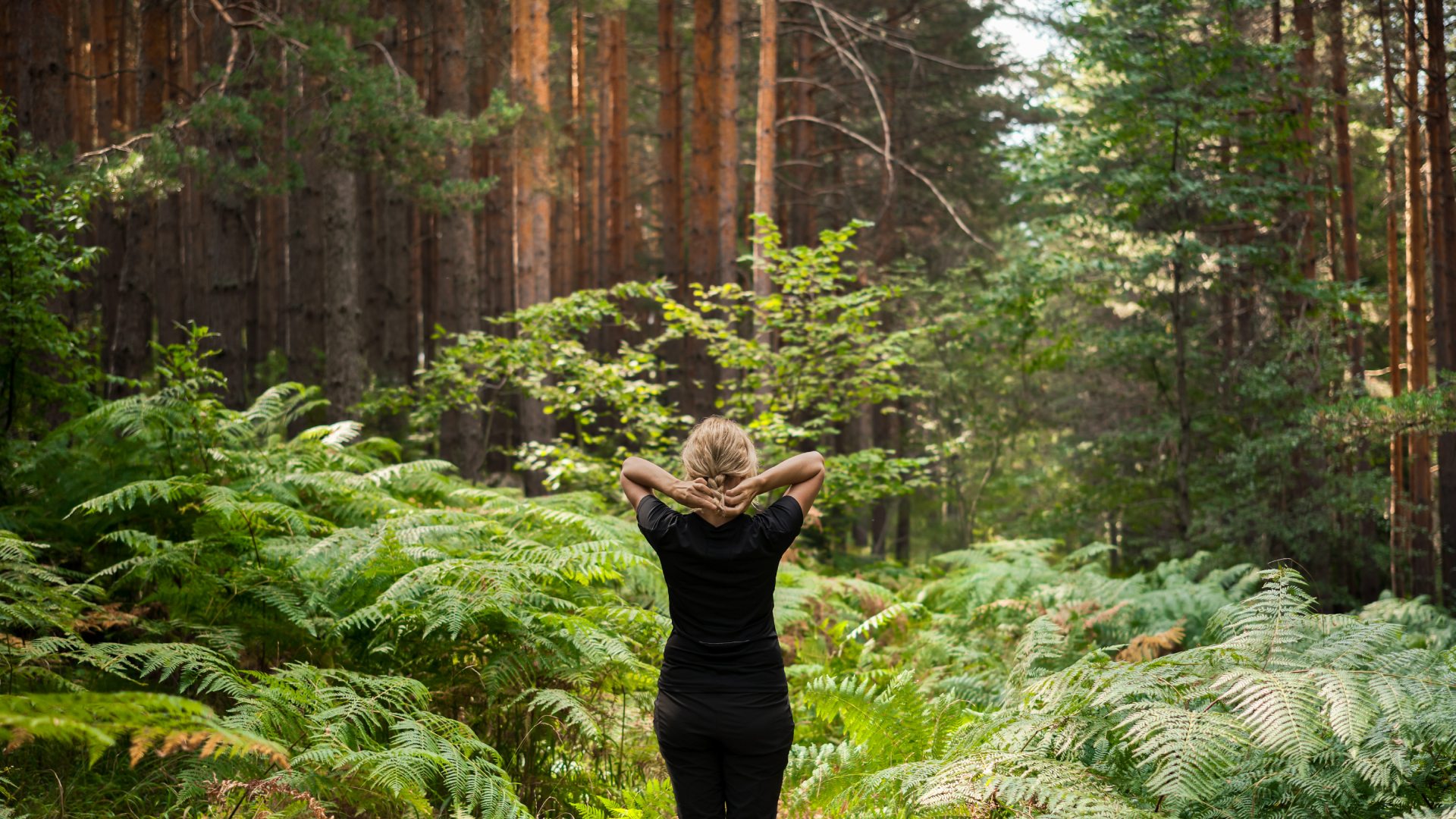
What if slowing down was the most revolutionary thing you could do for your body and mind? Originating in Japan, a gentle and accessible practice invites you to reconnect with nature to soothe stress, without pills or performance pressure. Welcome to the world of shinrin-yoku, or the art of taking care of yourself exactly as you are.
Forest bathing, an invitation to breathe differently
Shinrin-yoku, which can be translated as "forest bathing," is neither a sporting feat nor a timed hike. Originating in Japan in the 1980s, it consists of walking slowly through the forest, fully engaging your senses: listening to the rustling of leaves, smelling the earth, observing the light filtering through the branches. You're not trying to get anywhere; you're already exactly where you need to be.
This practice emerged in a very specific context: that of a society facing extreme, sometimes fatal, work-related stress. Faced with burnout, Japanese authorities devised a preventative, natural, and profoundly humane response. Today, shinrin-yoku is officially recognized as a public health tool in Japan.
A structured practice… but resolutely free
Since its official launch by the Japanese Ministry of Agriculture in 1982, forest bathing has found its place in over fifty so-called "therapeutic" forests. These spaces offer guided sessions lasting several hours, focused on slowness, breathing, and sensory connection with the trees. Here, there is no pressure to push your limits. Your body is respected, listened to, and valued. Whether you are tired, a senior citizen, an overwhelmed parent, or simply seeking tranquility, shinrin-yoku adapts to you, not the other way around.
Benefits validated by science
What might seem poetic is actually well-documented. Scientific research has compared the effects of a walk in the forest to those of an equivalent urban stroll. The verdict: nature wins hands down.
After a short immersion in the forest, the body shows clear signs of calming: a drop in cortisol, a decrease in blood pressure, and improvements in mood and sleep. Even more surprisingly, the activity of certain immune-related cells increases for several days. Your body, in all its richness and diversity, knows how to regulate itself when given the space.
How to adopt shinrin-yoku in everyday life
Good news: no need for a ticket to Tokyo. A forest, a park, or even a garden can become your refuge. The key is to intentionally slow down, walk without a specific destination, and allow yourself to feel. Touch the bark, breathe deeply, leave your phone at the bottom of your bag.
In the Paris region, places like the Bois de Vincennes, the Fontainebleau forest, or the Parc de Saint-Cloud offer an ideal setting for this reconnection. And if two hours seems long, start with less: your body will guide you.
A gentle, inclusive, and pressure-free therapy
The secret of shinrin-yoku lies not only in the natural substances emitted by the trees, but also in the overall experience: you are enveloped, supported, never judged. No body is "too much" or "not enough" for the forest.
Easy to integrate into city life, forest bathing can become a weekly ritual, a complement to meditation, or simply a moment to remind you that you have the right to slow down. Free and without side effects, shinrin-yoku is emerging as a modern response to a world that moves too fast. What if your next prescription was a walk among the trees?