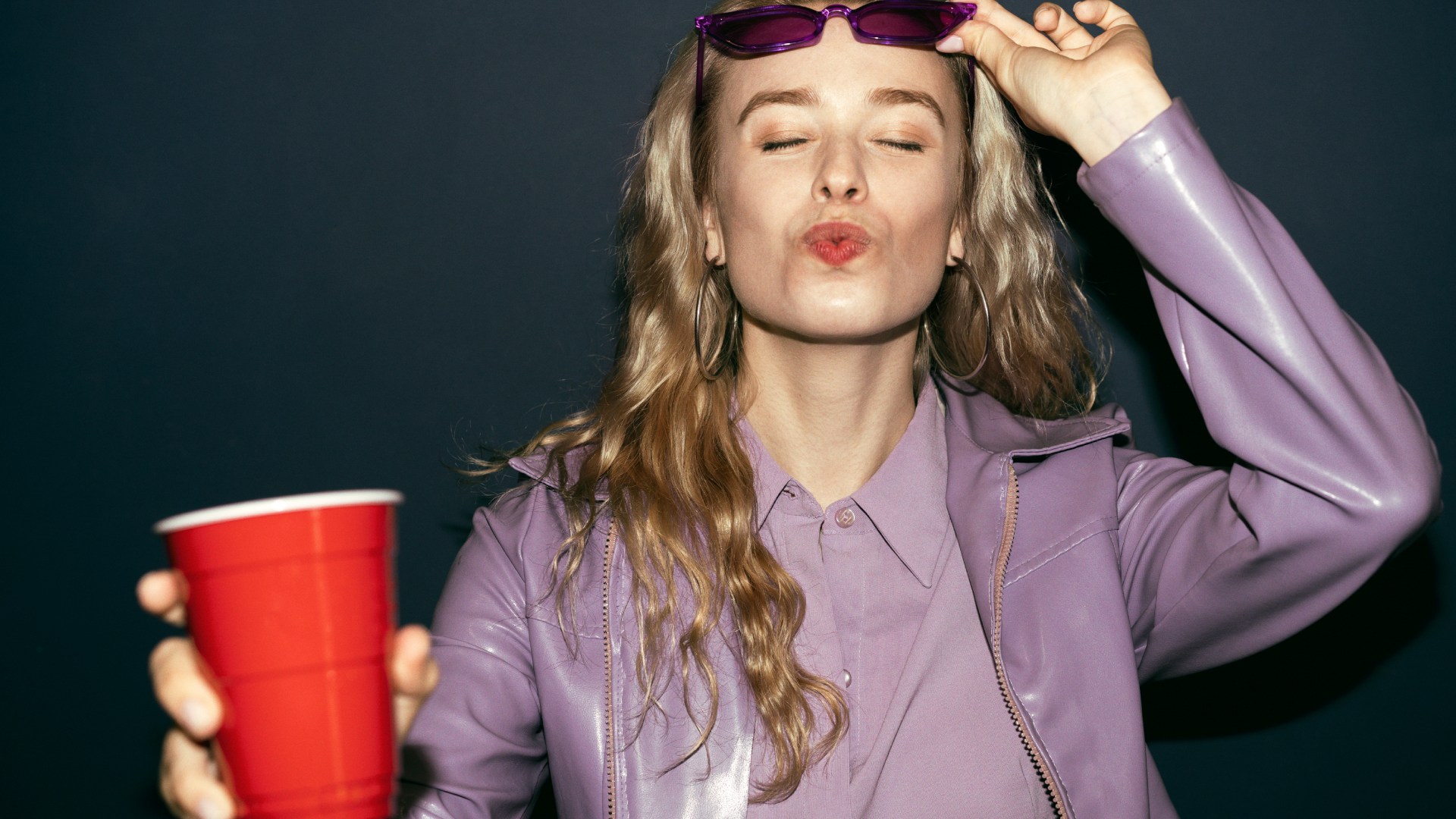
It's often said that alcohol lowers inhibitions and liberates even the shyest people. We have a few drinks to connect with others, more easily bridge the distance, and build relationships without having to search for the right words. Constantly presented as a "social" potion, alcohol gives the illusion of making us more outgoing at parties, when in reality it transforms us from within. It may bring us closer to others, but it primarily distances us from ourselves. This is the observation made by Tatjana from the @tatjanova_ account.
Alcohol and sensitivity don't mix well.
In the evening, at a leaving party, after-work drinks, or a birthday dinner, alcohol fills the glasses and rivals the sacrosanct spring water. This beverage, measured in degrees, sometimes claims to lower the tension and drown out stubborn shyness. Under its influence, naturally timid people approach strangers without hesitation and launch into endless monologues, whereas they would normally remain silent.
Used as a way to connect with others, or even as a remedy for introverts, alcohol dissolves all inhibitions. We often accept a glass or two hoping to be less rigid and step out of our comfort zone. And then, at the end of the evening, we leave with a contact list as long as our arm, which we won't remember the next day. Alcohol seems to act as a "glue" between people.
That's what Tatjana from the @tatjanova_ account thought before realizing the deception, the scam. In an insightful post that resonated widely, she lists the harmful effects of alcohol on sensitive personalities, especially women. While alcohol may give the impression of being unfiltered and appearing more extroverted to others, in reality, it's just a placebo. Worse, it's poison for personal growth. "When you're sensitive, alcohol doesn't help you; it slowly distances you from yourself," explains the content creator, who offers coaching to help people manage their sensitivity.
The side effects of alcohol in sensitive individuals
We all know the physical after-effects of alcohol: the nausea upon waking, the foggy head, the radiating migraine, the feeling of being stuck in slow motion. We regret having forgotten the meaning of the word "moderation." Generally, one doesn't emerge unscathed from a night of heavy drinking.
While the biological effects of alcohol are well-documented and sometimes alleviated with an aspirin, its impact on the mind remains relatively unknown. Practitioners of so-called "spiritual" medicine, those who dabble in the divine, even speak of it as a "subtle solvent." Tatjana, for her part, draws on her own experience to list all that alcohol drowns within us.
View this post on Instagram
"It amplifies what you're trying to calm down."
In the frenzy of the moment, we let ourselves be carried away, we stop asking ourselves questions, and our inner voice seems to have switched to silent mode. Our only concern is managing the playlist playing on the speaker. We are nothing but joy and elation. Yet, when the alcohol wears off, the emotions resurface in amplified form. "Anxiety, emptiness, sadness, overanalyzing: it all comes flooding back," observes the content creator.
"He makes you confuse intensity with authenticity."
After a few drinks, we feel more alive, less fearful, and above all, less susceptible to the judgment of others. We find ourselves telling our colleague she has bad breath or flirting with our childhood crush. We literally have no more social barriers . Some believe that alcohol reveals the true face of those who consume it. However, it's not a sincere reflection of our personality, simply the expression of our darker sides.
"It deeply depletes your energy."
Highly sensitive people experience everything at maximum intensity and absorb emotions that the human body cannot store on its own. And ultimately, alcohol is the final straw. It's the last straw. "Alcohol overloads your system even more and often leaves you feeling heavy inside," adds the content creator, who speaks from experience.
"It prevents you from learning how to truly regulate yourself."
By drinking alcohol at strategic moments, to more easily navigate crowds or converse without obstacles, we flee reality and numb our discomfort instead of calmly accepting it. Instead of becoming familiar with this emotion, this loneliness, or this unease, we facilitate its absorption with alcohol.
"It takes you away from your intuition."
While alcohol lowers inhibitions, it also obstructs other aspects of our personality and being. In addition to contributing to a genuine mental breakdown, it plunges us into a state of lethargy. It's as if we are physically present but mentally absent. Our mind is blank, and our capacity for discernment diminishes with each drink. "Your boundaries become blurred, and so do your needs," the content creator explains.
In other words, while alcohol may unlock a certain confidence in the moment, it also alters personality and drains our energy like an insidious poison. A 2017 study confirms Tatjana's account and acknowledges its highly permissive nature as well as its collateral damage to mental health.