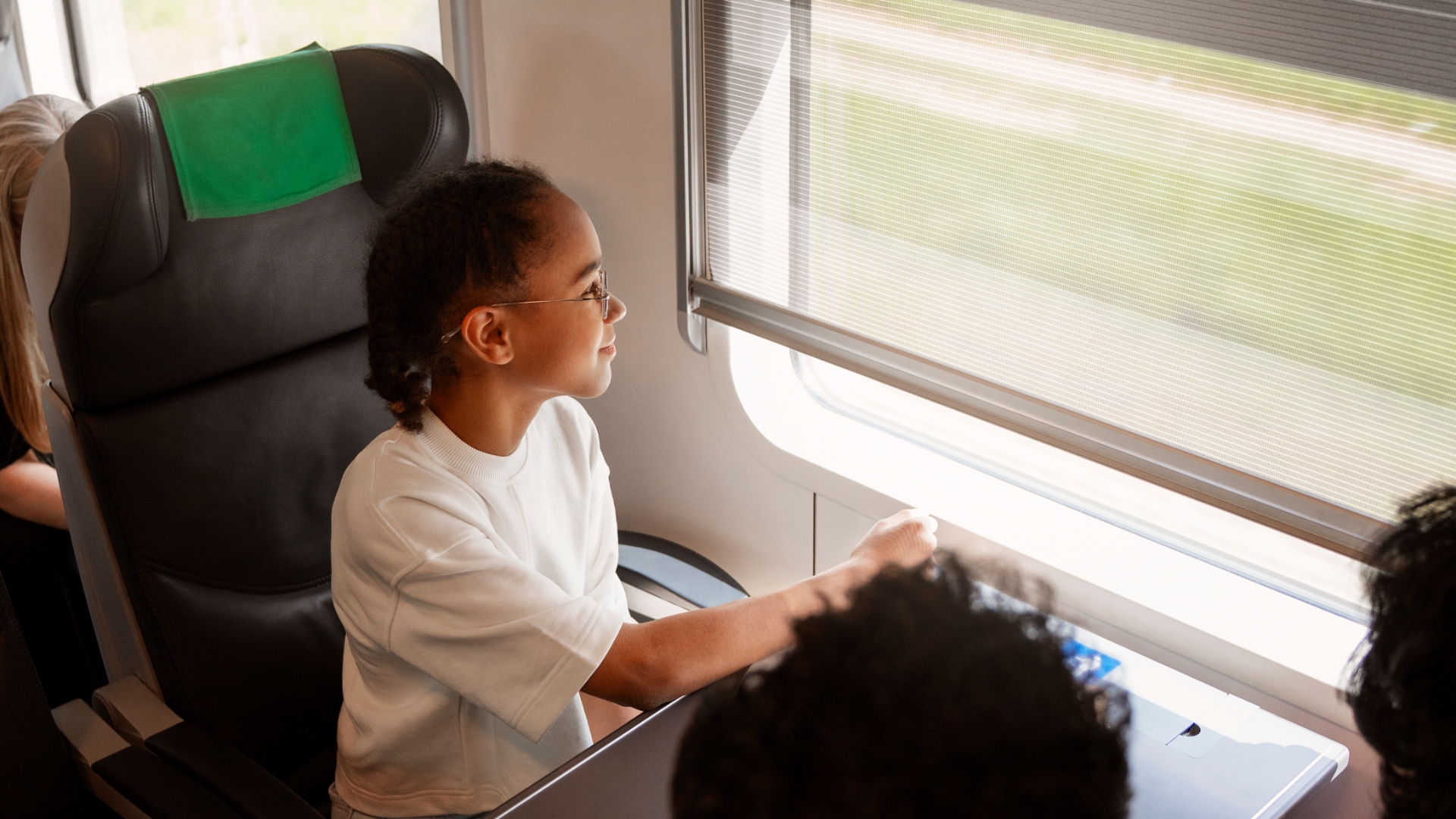
As SNCF, the French national railway company, tests carriages reserved for children over 12, controversy is growing over the potential exclusion of younger passengers. Between the pursuit of peace and quiet and the inclusion of families, Europe offers very different models.
A "no kids" option that is causing controversy
Since January 8, 2026, SNCF has been testing a new category called "Optimum Plus" on the Paris-Lyon line, where children under 12 are not allowed. This initiative was presented as "a response to the demand for peace and comfort," but was immediately denounced as "symbolic of a growing rejection of children in public spaces."
This measure is part of a broader "no kids" movement, which has appeared in some public places and businesses, and which raises the question of the place given to childhood in society.
In Switzerland and Finland, pampered children
Conversely, several European countries have focused on family inclusion to encourage train travel over car use. In Switzerland, Intercity trains have family carriages decorated with a jungle theme, featuring a play area, books, and toys freely available. A striking detail: adults who frequently travel with children even receive a special discount card—a way of rewarding family travel.
In Finland, almost all major train lines have a family compartment: play areas, nurseries equipped with bottle warmers, cots for naps, and even activity trolleys. The idea is simple: children can let off steam and play without disturbing other passengers. For the VR company, this isn't a matter of tolerance but a right to comfort for everyone—adults and children alike.
Among the many ways Finland makes life more manageable for families with kids: here's a look at the playground + library inside our train compartment. Five-hour train journey with our one-year-old made easy! Our last Amtrak, by contrast, had no changing tables on board. 👀 pic.twitter.com/v1y4bIHS4G
— Zach Parolin (@ZParolin) August 2, 2024
Compromises elsewhere in Europe
Austria follows a similar approach. Its high-speed trains offer dedicated spaces for families, as well as quiet zones for passengers wishing to travel in peace and quiet, without prohibiting children. Some trains even include a small cinema for younger children to keep them entertained on long journeys.
Belgium and Italy also allow children in quiet carriages, relying on parental responsibility rather than exclusion. In contrast, in Spain, the national railway company Renfe explicitly prohibits access to "quiet areas" for minors under 14 and for animals, thus adopting a policy similar to that tested by SNCF.
A societal issue rather than a simple matter of comfort
Behind this controversy lies a vision of living together. Should certain spaces be reserved for adults seeking tranquility, at the risk of excluding younger people? Or should trains be redesigned so that they truly accommodate all types of travelers, including children?
In Finland and Switzerland, train companies have demonstrated that it is possible to reconcile a peaceful and family-friendly atmosphere. While France advocates for a "child-free" carriage, other countries have chosen to offer more space for children.
Ultimately, SNCF's "no kids" experiment goes beyond the simple question of comfort. It reveals a tension between two approaches: one of separation, the other of inclusion. In trying to preserve tranquility, the company risks reflecting a social weariness with the presence of children. Yet, Europe proves that balanced solutions exist: play areas for some, quiet zones for others. The challenge for SNCF may be less about exclusion than about inventing a train where everyone naturally finds their place.