On social media, self-assured podcasters dictate to women how to "keep a man." The problem? They don't exist, and their retrograde discourse mainly serves to sell illusions and training programs.
"Love coaches" who never existed
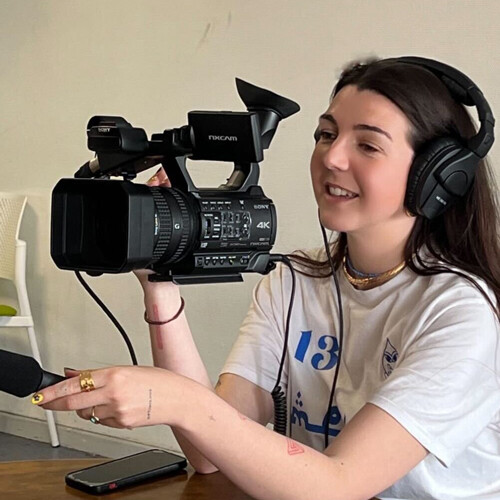
Dimly lit studio, professional microphone, composed voice: these "relationship experts" have all the hallmarks of successful podcasters. Everything, that is, except the essentials. They are entirely AI-generated, from their voices to their facial expressions. No full-length show lies behind these personas: only short clips, tailored for the algorithm, endlessly replayed on TikTok, Instagram, Facebook, and YouTube.
One investigation described the case of a virtual "host" who amassed over 110,000 subscribers in just a few months, with videos viewed by millions, even though no real woman was behind the screen. The method is all the more effective because it plays on a familiar register: that of benevolent advice, of the friend who "knows best."
An old patriarchal discourse, repackaged by AI
Behind the modern veneer of technology, the underlying message is stale. These videos recycle deeply patriarchal scenarios: never become "a source of stress" for your partner, "make yourself desirable" by doing nothing, or accept the idea that a man could love a woman "without doing anything" when the reverse is rare. Most of this content confines men and women to traditional roles and presents these injunctions as universal truths.
The implicit message is crystal clear: women must efface themselves, become "practical," and calibrate their ambitions so as not to bruise male egos. Masculine avatars, all muscles and deep voices, readily pit the sexes against each other and play on insecurities. Far from "emancipating," as they claim, these discourses reactivate the most entrenched hierarchies between genders.
The burden of the couple, still and always on the shoulders of women
The most striking bias is also the most revealing: these videos are aimed almost exclusively at women. They are the ones who have to adapt, anticipate the other person's needs, and be soothing, while the man's responsibility is almost never questioned.
But experts remind us that a balanced relationship relies on the effort of both partners, not solely on women's concessions. By transforming love into a list of rules to follow in order to be worth keeping, this content places the entire burden of emotional labor on women. This asymmetry, under the guise of "clever" advice, perpetuates precisely the imbalances that decades of feminist struggles have sought to dismantle.
A standardized aesthetic and a deceptively neutral tone
The packaging, too, tells a story. The vast majority of female avatars sport smooth, standardized features, a calibrated beauty meant to embody the "fulfilled" woman who has it all figured out. The message of self-confidence is thus delivered from the face of a perfect, artificial woman—an unattainable ideal, because it literally doesn't exist.
It is precisely this superficial banality that makes the process so insidious. While some AI-generated content is distinguished by its strange or spectacular aspects, these clips adopt a perfectly ordinary tone. Nothing alerts the audience that they are watching fiction: only the ideology conveyed stands out, and even then, only to those who pay close attention. The apparent naturalness defuses suspicion and makes the retrograde seem self-evident.
A broader wave of online "re-traditionalization"
These synthetic podcasters did not come out of nowhere. They are part of a well-documented digital trend: the "re-traditionalization" of gender roles, driven in recent years by the "tradwive" movement, influencers who glorify the submissive housewife and openly reject feminism.
Researchers have shown that this content, beneath its veneer of domestic sweetness, functions as a veritable anti-feminist propaganda targeting a young audience. A study from the University of Hawaii, published in the journal Terrorism and Political Violence, identified recurring themes: the idea that feminism is opposed to femininity, that it "harms" women, and that it should be blamed rather than the true structural causes of women's difficulties. Other studies, such as those conducted at the Annenberg School of the University of Pennsylvania, analyze how these narratives exploit the aesthetic and algorithmic codes of the platforms to spread massively. AI-generated podcasters are the automated, industrialized version, capable of producing this discourse endlessly.
Behind the message, a cash machine
Make no mistake: the goal isn't to spark a debate about love. These accounts thrive in a booming market. According to Grand View Research , the virtual influencer sector could reach nearly $45.9 billion by 2030, with annual growth exceeding 40%.
Almost all of these pages serve as a funnel to paid training courses supposedly teaching how to create this type of content yourself: starter kits, accelerated programs, courses promising to master the "formula for realism," dubbing, and voice cloning to "turn views into revenue." The same pattern is everywhere: once the video goes viral, the account redirects to an "AI influence school" or a masterclass selling the promise of getting rich by producing similar content. The real product isn't the couple; it's the women and men who watch.
Maintaining a critical mindset in the face of "soft propaganda"
A podcast host quoted by WIRED sums up the danger of this approach: it's "soft propaganda," a clean, repeatable, and easily digestible narrative that subtly shapes expectations without ever offering nuance, depth, or accountability. The risk is all the greater because this advice targets an audience seeking emotional reassurance, ready to trust a confident and polished tone.
Faced with this subtle offensive, the best weapon remains critical thinking: identifying these contents for what they are—commercial fictions, rejecting the idea that love boils down to a list of efforts to be made by women, and remembering that no artificial intelligence, however polished, holds the recipe for a healthy couple.
Beneath their seemingly innocuous exterior, these virtual podcasters disseminate a reductive and unequal view of relationships, primarily serving financial interests. At a time when AI is blurring the lines between truth and falsehood, they remind us of an obvious truth: behind every piece of advice too polished to be genuine often lies an ideology and a cash register. More than ever, knowing the origin of a message, and who benefits from it, is a political act, especially in a patriarchal society.