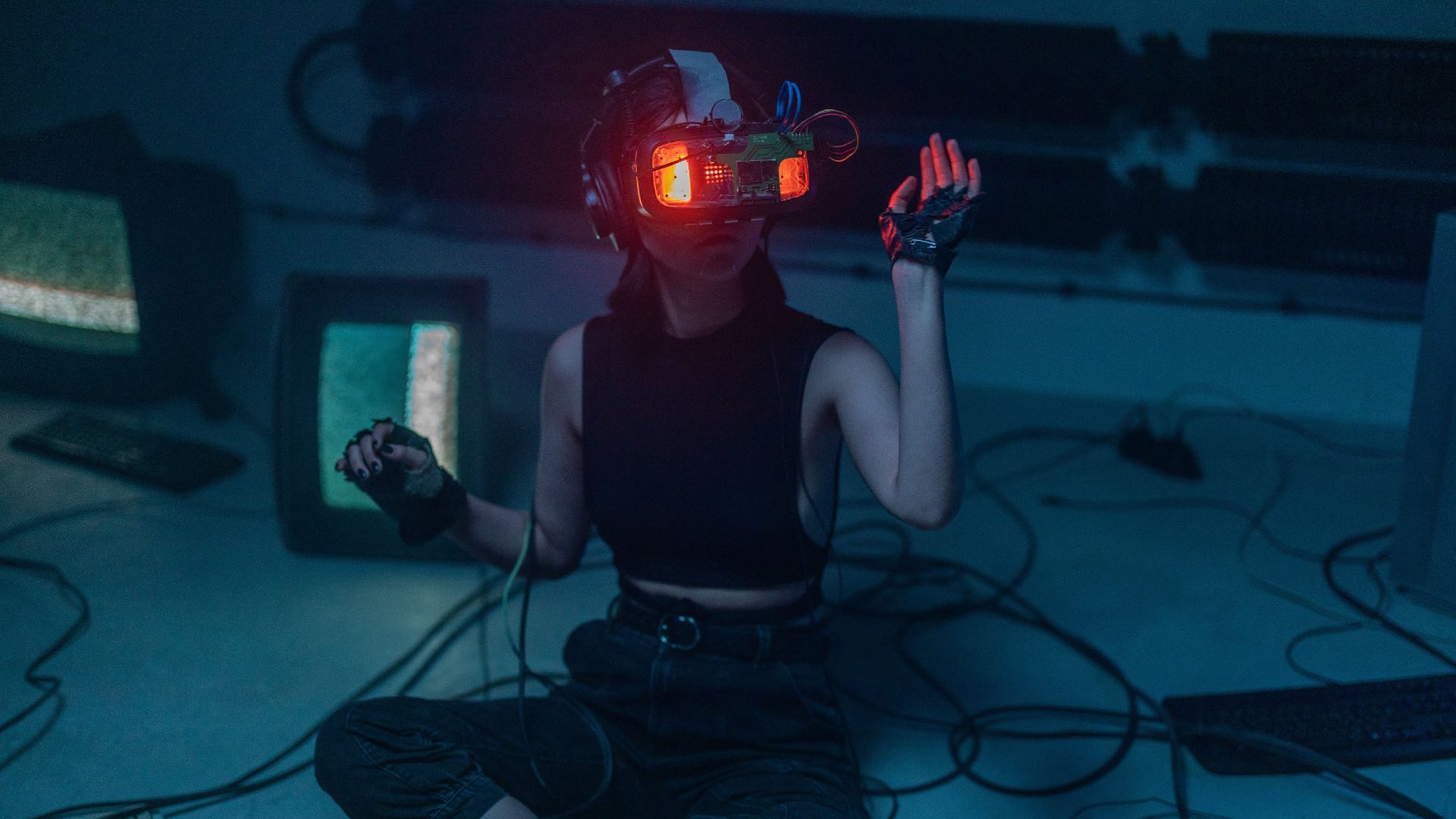
At a time when our phones, computers, and smartwatches have become nothing more than data-mining devices, a generation of young women has decided to distance themselves. On TikTok and Instagram, they build their own computers, nesting them in seashells, makeup palettes, or pearl-encrusted clutches. The movement, dubbed "cyberdeck girls," has exploded in recent months and has already garnered tens of millions of views. Behind the pink and pearly aesthetic, a genuine political statement is unfolding—feminist, anti-surveillance, and profoundly joyful.
Cyberdecks: a return to the roots of cyberpunk fiction
The term "cyberdeck" is far from innocent. It was coined in 1984 by science fiction writer William Gibson in his cult novel "Neuromancer," where hackers navigated a digital matrix using miniature, homemade personal computers. Forty years later, young makers have taken up the concept, but this time, the dark, industrial cyberpunk aesthetic has been shelved in favor of a pastel palette, pink seashells, and mermaid-like accents.
In practical terms, a cyberdeck consists of simple components: a Raspberry Pi nano-computer (an electronic board the size of a matchbox), a small screen, a mechanical keyboard, a battery, and a case chosen by the creator herself. All this for a cost often less than 200 euros. These machines are intentionally "impractical and inefficient" compared to a standard laptop—a deliberate choice in a tech culture obsessed with optimization at all costs.
When the seashell becomes a computer
What makes this trend so fascinating is the limitless creativity of the devices. A certain CC, who describes herself as an "open source baddie" and runs the blog Bimbo Tech , popularized the movement with her "P-Sea SeaShell," a cyberdeck housed in a pink seashell, which serves alternately as a Tamagotchi, an e-reader, a Markdown note editor, and a server monitor. Connected to her local AI setup and her VPN mesh, the device allows its creator to do everything without ever relying on major platforms.
Creator Annike Tan, aka Ube Boobey on TikTok , designed a "mermaid" cyberdeck with gold accents and pearls tucked under the keyboard. Her video, ironically titled "Cunty cyberdeck," has racked up tens of millions of views. A young software engineer from New York, Brianna, programmed a mini barista game inside a pink Dunkin' box. Others are doing the same with Hello Kitty boxes, rubber ducks, or old plastic makeup containers. The idea is simple: to transform what mainstream culture considers "girly," and therefore frivolous, into a tool of power.
@ubeboobey working on the bluetooth part #fyp #mp3 #diy #electronics #technology ♬ Bloopin - Eddie EWI
A political response to Silicon Valley
Beyond aesthetics, these creations carry a true manifesto against the culture imposed by American tech giants. For decades, the tech industry has sold the idea that the "right" machine was a minimalist, functional, anonymous, masculine aluminum rectangle. An aesthetic calibrated for productivity, never for beauty or personal connection.
The cyberdeck girls take a direct stance against this philosophy. Their machines are unique, fragile, personal, and marked. These objects are designed to "resemble their creator" rather than to survive a nuclear winter. And behind this joyful reappropriation also lies a direct attack on the culture of optimization and performance that has structured Silicon Valley for the last thirty years.
Persistent sexism in tech, as told by its victims
The movement likely wouldn't have exploded so much without the persistence of sexism in traditional tech communities. Creator CC, for example, openly recounts the condescending comments she received from men on specialized forums: "A guy on Reddit told me, 'You built your first computer a month ago, calm down.' Except I've been building PCs for years," she confides. The man in question eventually apologized and bought the circuit board for her next project.
This anecdote is far from trivial. It illustrates a long-documented reality: electronics, hardware, and hacking communities have historically been hostile spaces for women, where every skill had to be proven twice as much as a male counterpart. This is precisely what cyberdeck girls are overturning by building their own community, sharing their own tutorials, and bypassing traditional sites like Reddit. The hashtag #techbygirls has become a marker of this new solidarity.
Anti-AI, anti-surveillance: a manifesto for digital sovereignty
If this trend is happening right now, it's no coincidence. It coincides with the explosion of generative artificial intelligence, the consequences of which in terms of surveillance, energy consumption, and the extraction of creative data are beginning to cause serious concern.
“I don’t want Meta AI glasses. I want to hack into books in a small, embellished seashell. No one can watch me there,” summarizes creator Sarahbelle Kim . This simultaneously funny and direct statement encapsulates the entire political project of the movement: to reclaim the tools, to house one’s data at home, and to refuse to feed the algorithms of the major platforms.
In concrete terms, this translates into very specific practices: self-hosting (hosting your own servers), local AI (running models on your own machine rather than in the cloud), custom operating systems, sharing open-source tutorials, and mesh VPNs. A true silent revolution, driven by soldering irons and pearlescent paint.
A community that shares and learns
The movement's other strength lies in its educational approach. On TikTok, Instagram, and blogs like Bimbo Tech, these creators share their tutorials, mistakes, purchases, and tips. No knowledge is kept to themselves. Assembly guides include links to each component, detailed shopping lists, and explanations tailored for those unfamiliar with memory cards or motherboards.
According to Annike Tan, approximately three-quarters of the audience following this movement are women. This is a significant statistic in a sector where, statistically, women represent barely 20 to 25% of professionals. And the new community seems fully aware of what it is building: a parallel, feminist, open, and accessible school that trains female technicians whom the educational and professional system has long discouraged.
A joyous revolution, which is only just beginning
Every era has its tools of resistance. Every generation of women has its refusal to wait for permission. Cyberdeck girls didn't appear out of thin air: they are part of a long tradition of women who understood, before others, that to have a voice, you first had to build the machine to carry it. Yesterday, it was clandestine printing presses and pirate radio stations. Today, it's Raspberry Pi boards. The form changes. The gesture remains the same: to take back control, to reject the system, to pass it on to those who will come after.
In a seashell, in a makeup palette, in a rubber duck, it's actually an entire world that's being reinvented. A world where technological knowledge is no longer monopolized by a select few. A world where beauty, fragility, and DIY are no longer viewed with suspicion. A world, above all, where our machines truly become ours again.
It remains to be seen whether this silent revolution will manage to spread beyond the screens that gave birth to it. Whether algorithms will ultimately co-opt, as they so readily do, the movement's aesthetics only to drain it of its substance. Whether manufacturers will launch, tomorrow, a "seashell collection," certified by them, devoid of any trace of dissent.
But for now, one thing is certain: these young women no longer ask for permission. They build, they share, they pass on knowledge. And in an era where attention has become a resource extracted without our knowledge, where technical know-how remains largely the preserve of men, where every app wants to sell us something or categorize us, this gesture is a feminist act. It's about continuing to invent the world rather than waiting for someone else to do it for us.