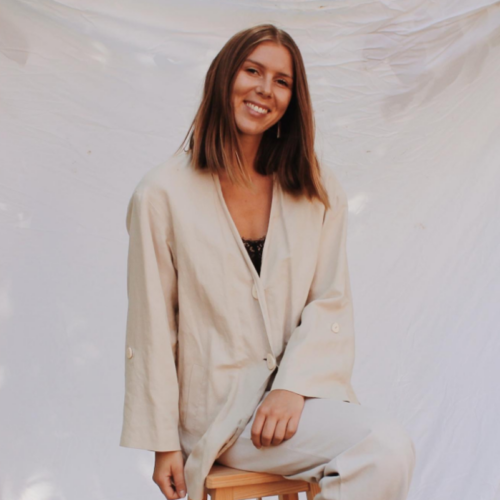
In this 2026 World Cup, the football jersey has become an everyday staple. Worn in unison by the most followed it-girls online, this numbered garment, a clear sign of our sporting leanings, is scoring points in wardrobes. While fashion enthusiasts wear it with cascades of necklaces or tied at the waist, this self-taught stylist gives it a makeover, scissors in hand. The result after this little creative surgery is stunning!
When the football jersey becomes a creative canvas
Once worn on match days by proud fans, the football jersey is no longer the occasional garment brought out once every four years. While a few years ago this banner-like jersey was part of the starter pack for die-hard fans, today it's a mainstream item. Better yet, it's even a style statement. It's no longer just paired with Bermuda shorts and sandals with socks. This jersey, emblazoned with our favorite team's logo, goes perfectly with designer ballet flats, lace skirts, or even baggy shorts.
Brought out of its comfort zone by inspired influencers and viral hashtags, the football jersey is undoubtedly the most sought-after item right now. On social media, some share their personal tips for customizing this urban-style garment, while others, like @fioonaax, reinterpret them from the ground up. This textile artist doesn't settle for a few minimalist tweaks. She revisits the fundamentals of this stadium essential and isn't afraid to offer her own unique interpretation.
These videos, which are akin to unbearable horror scenes for purists of this garment, show the entire transformation process, from the first cut to the last stitch. And it's no longer just fashion design, but art. The football jersey serves as a canvas for her boundless imagination, morphing sometimes into an elegant dress, sometimes into a biker jacket.
View this post on Instagram
A designer with a golden touch
While football players may have gold bars for feet, this creative mind, followed by nearly 400,000 subscribers, has magic wands for fingers. She cuts the jersey in half, fuses it with another material, and sews them together with a sewing machine, much like a scrapbooking project.
Whether it's Ronaldo's number 7 or Kroos's number 8, each jersey is reborn in a new form. In her makeshift workshop, she assembles the jerseys like puzzle pieces, always careful to choose elegant patterns. The former cheerleader, who studied design, has a unique identity, a blend of chic and sportswear . She brings together worlds that, at first glance, seem to have nothing in common.
Furthermore, to kick off the 2026 World Cup, she created a collage of jerseys from all the nations, combining them into a single design. And, building on her success, she doesn't just create pieces for show. Football celebrities, like the iconic Thomas Müller, commission her designs.
View this post on Instagram
The biggest names in sports are clamoring for his creations.
The budding designer has a whole fan club behind her digital videos. The young woman, who uses her own measurements as a guide, is receiving a veritable collective "hola" on social media. While some point out that the jersey is a sacred totem, Fiona Rörig seems to have a special privilege. In the most-viewed video, she dedicates her creation to Antonella Roccuzzo, Lionel Messi's wife, and gives her a subtle hint. And the comments are full of praise for her talent. The most admiring can only use the onomatopoeia "wow" to describe this creation. "I want the same one," demands one user, while another chimes in, "It's a work of art."
And through her viral posts, Fiona has managed to attract the attention of key figures in the sports world. For example, in 2024, she dressed Lisa Füllkrug, wife of Nicolas Füllkrug, in a pink t-shirt dress. But the most striking achievement on her resume remains the gift of a unique piece to Müller upon his departure from Bayern Munich.
Through her creations, Fiona Rörig proves that a jersey isn't destined to languish in a closet after a competition. It can have a second life, more creative, more sustainable, and more personal. It's also a way to subvert fast fashion by transforming existing pieces rather than producing entirely new garments.