Strengthening your glutes without leaving home is not only possible, but also remarkably effective. Bodyweight alone is more than enough to sculpt, tone, and develop the muscle mass of your buttocks.
No need for a gym or expensive equipment: a well-structured session, repeated regularly, produces concrete results.
In this post we present the 10 essential glute exercises to do at home, accompanied by a structured program and practical advice to progress at your own pace, whatever your level.
Anatomy and role of the gluteal muscles
Understanding the mechanics of your glutes is the first step towards truly effective training. The gluteal muscles consist of three distinct structures , each playing a specific role in body movement and stability.
The gluteus maximus is the largest and most superficial of the three muscles. It determines the shape, volume, and rounded form of the buttocks. It is primarily involved in hip extension during squats, lunges, and hip thrusts.
To get shapely buttocks, this is the muscle that receives the most attention in weight training sessions.
The gluteus medius , located between the gluteus maximus and minimus, performs two essential functions: abduction of the legs (moving them apart) and stabilization of the pelvis. Without it, every step would be unbalanced.
Exercises like the fire hydrant or the lateral walk in squat particularly target this muscle.
Finally, the gluteus minimus , the deepest of the three, contributes to leg rotation and reinforces hip stability. Discreet yet essential, it complements the action of the other two muscles to ensure a harmonious shape across the entire surface of the buttocks.
These three muscles collectively extend the hip, abduct the thigh, and stabilize the pelvis during walking, running, or jumping. A balanced result therefore requires engaging the entire gluteal group, not just the gluteus maximus.
Strong glutes also relieve pressure on the lower back, hips, knees, and ankles. This is a major functional advantage, far beyond mere aesthetics.
Why work your glutes at home?
Working out at home offers tangible benefits that are often underestimated. The main advantage: developing strength and muscle hypertrophy without leaving home. For beginners, progress is even faster than expected.
The body reacts quickly to the first stimuli, and the transformation can be visible in just a few weeks.
Convenience also plays a key role. No travel, no waiting for machines, no time constraints. Training can be done in your living room, on vacation, or during a business trip.
This flexibility promotes regularity , which remains the key to any sustainable progress.
Working with bodyweight offers another often overlooked benefit: technical mastery . Without heavy loads, you can fully concentrate on your position, back placement, knee flexion, and muscle engagement.
This is a solid foundation before incorporating dumbbells or a barbell.
Safety is also a factor. Lifting heavy weights without proper technique can lead to preventable injuries. At home, you can progress at your own pace, without external pressure.
It's an ideal setting to get acquainted with weight training in a comfortable and supportive environment. Strong glutes protect the entire lower body: they stabilize the hips, relieve knee strain, and reduce lower back pain.
The 10 best glute exercises to do at home
Standing exercises: squats, sumo squats, and lunges
The classic squat remains the fundamental exercise of any glute program. With feet hip-width apart, bend your knees and hips to lower your buttocks towards the ground, then push back up through your heels.
Targeted muscles: glutes, thighs, core. According to several studies in sports biomechanics, the squat generates a strong stretch tension at the bottom of the movement , which promotes muscle hypertrophy more than exercises focused solely on contraction.
The sumo squat adopts a wider stance, with toes and knees pointing outwards. The gluteal stretch is more pronounced, making it an excellent complement for toning the figure.
Alternating reverse lunges form the third standing pillar: a step backward, back knee toward the ground, torso slightly inclined forward to amplify the gluteal stretch. A complete exercise that also works the quadriceps and hamstrings.
Bulgarian lunges represent the advanced variant: rear foot raised on a chair, lower the rear knee while bending the front knee, torso leaning slightly forward.
This exercise corrects muscular imbalances between the two legs and develops remarkable stability.
Floor exercises: hip thrust, glute bridge and donkey kick
The floor hip thrust (or glute bridge) is one of the most effective movements for targeting the gluteus maximus. Lying on your back with your feet flat, push through your heels to lift your hips while intensely contracting your glutes.
The unilateral variant, performed on one leg only, intensifies the work and improves stability.
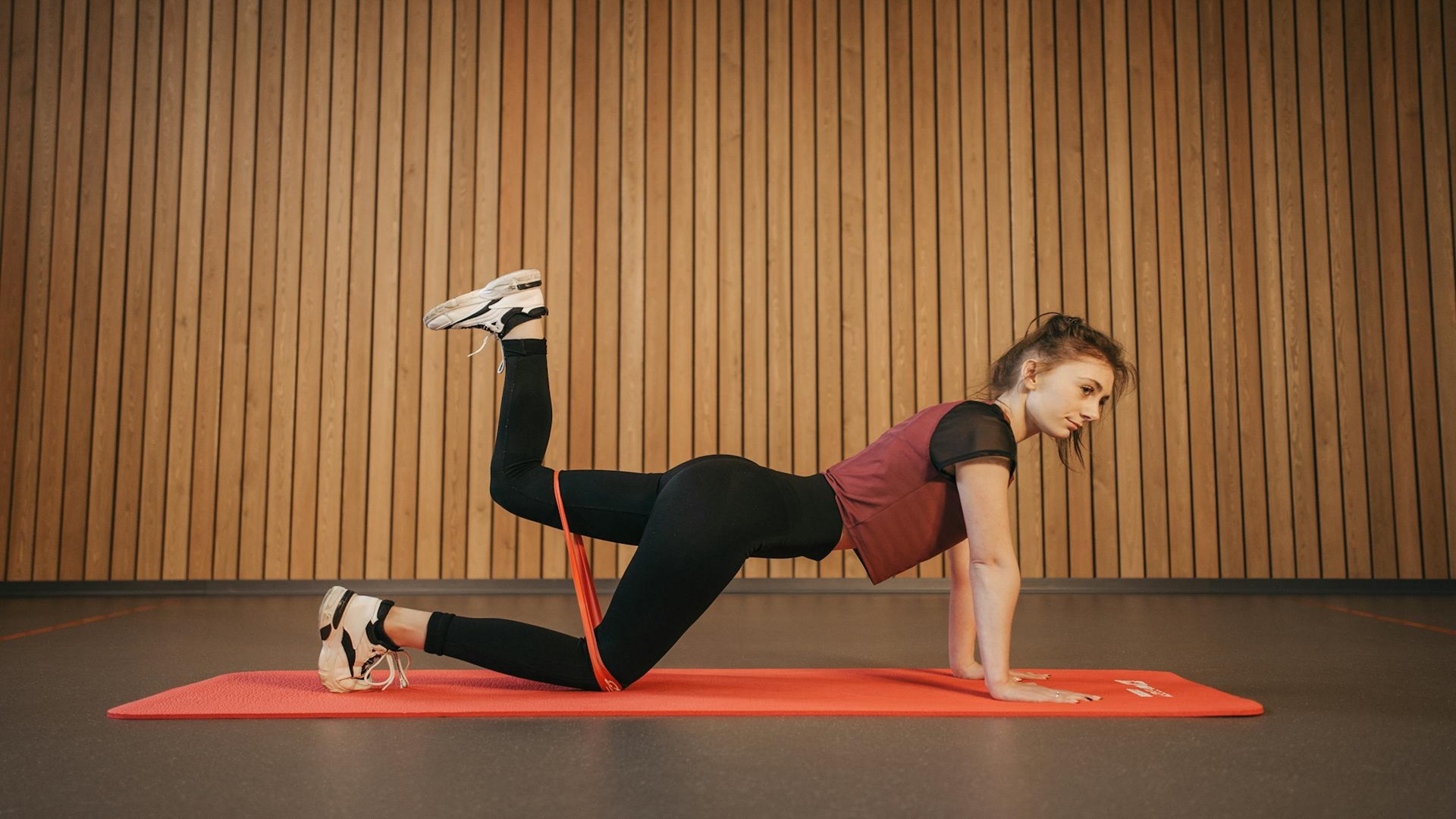
The donkey kick is performed on all fours: push your heel towards the ceiling with your knee bent, keeping your back straight and your abdominal muscles engaged. It's a must for precisely targeting the gluteus maximus.
The fire hydrant, a variation of the donkey kick, consists of raising the knee to the side at 90°. It primarily targets the gluteus medius and the pelvic stabilizers.
Stability and coordination exercises
Lateral squatting is performed in a half-squat position, with sideways shuffles. It emphasizes the gluteus medius and minimus muscles. The muscle burn can be very intense if repetitions are performed continuously.
The single-leg Romanian deadlift completes this selection. Standing on one foot, push your hips back while bending your torso and raising your free leg straight behind you.
This movement targets the glutes, hamstrings and strengthens the deep core.
A complete glute workout program to try at home
Three training formats are adapted to different profiles and objectives.
- Circuit training (4 rounds) : 15 to 20 repetitions per movement, 2 minutes rest between each round. Perform a series of squats, lateral walks, unilateral deadlifts, hip thrusts, reverse lunges, Bulgarian split squats, and donkey kicks.
- Tabata : 20 seconds of effort, 10 seconds of rest, 4 to 6 rounds over 15 to 20 minutes. Ideal for combining cardio and toning.
- Supersets : 3 sets per pair of exercises, 30 to 60 seconds of rest. Example: sumo squat combined with lateral walking, unilateral hip thrust coupled with fire hydrant.
We recommend a minimum of 2 to 3 sessions per week to achieve visible results. A difference is generally noticeable after six weeks.
Each session begins with 5 to 10 minutes of cardio warm-up and ends with stretching to promote recovery.
Tips for optimizing your glute workouts at home
Progressive overload is the fundamental principle of all muscle development. Without it, the glutes adapt quickly and progress stalls. Here are several concrete methods to progress:
- Gradually increase the number of repetitions per set.
- Incorporate isometric contractions (hold the high position of the glute bridge for 20 seconds).
- Slow down the concentric phase to accentuate muscle tension.
- Reduce rest periods between sets.
- Working unilaterally to intensify muscle engagement.
Simple accessories can be used to add strength without expensive equipment.
A resistance band placed above the knees during squats or glute bridges forces the knees outward, further activating the glutes. A backpack filled with water bottles can replace a weight when you want to increase the intensity.
Focusing on each contraction makes all the difference. Feeling your glutes working with every repetition guarantees an effective workout.
A diet rich in protein also supports muscle development: without sufficient nutritional intake, muscle fibers struggle to rebuild.
Several factors influence the results: the frequency of sessions, the level of sport, genetics, age and diet.
Beginners progress faster than experienced practitioners because their bodies respond more intensely to new stimuli. Good news for all those starting out.
Incorporating these glute exercises into a comprehensive program including cardio, muscle strengthening and stretching remains the winning formula for a balanced figure and lasting health.