Working your abs at home, without any equipment, is much more beneficial than you might think. A session of just 15 minutes, structured into 4 blocks , is enough to target the entire abdominal area: rectus abdominis, transverse abdominis, and obliques.
For women, this work deserves special attention: every body is different, every morphology has its own needs: and technique always takes precedence over quantity.
We will present 6 ab exercises accessible to all levels , from beginner movement to advanced core strengthening, as well as a complete one-month program.
Breathing and the perineum are central to this method: neglecting them reduces the effectiveness of each repetition and risks unnecessary pain.
How to properly work your abs at home: technique and breathing are key.
Breathing is the invisible engine of all abdominal exercises. Bernadette de Gasquet , a doctor and yoga teacher, reminds us that most traditional fitness exercises can be counterproductive when they push the stomach forward or downward.
She advocates an approach that lengthens the spine and promotes smooth, conscious breathing.
The rule is basic: exhale through the mouth while pulling in the stomach during exertion, and inhale while still pulling in the stomach to return to the initial position.
Holding your breath or inflating your stomach negates much of the muscular work. The goal is to expel the air upwards by lengthening your spine as much as possible.
Contracting the perineum with every movement is non-negotiable.
This deep muscle protects the entire pelvic floor during exertion. Exhaling, lengthening the spine, and drawing in the stomach: these are the three pillars of an effective and safe abdominal workout.
6 abdominal exercises for women to do at home without equipment
These six movements target the entire abdominal area. Each one requires controlled breathing and pelvic floor engagement throughout the exercise. Adjust the range of motion and intensity to your fitness level.
Exercise 1: The plank or core exercise
Position yourself facing the mat, supported on your forearms and feet, back flat, pelvis tilted posteriorly . Hold this position for 30 seconds to start, aiming for 1 minute 30 seconds of contraction . Perform 3 to 5 sets. This exercise particularly targets the rectus abdominis and transverse abdominis muscles.
Exercise 2: The crunch or torso raise
Lying on your back with your hands behind your head to support your neck, engage your upperabdominal muscles to lift your shoulders and then your shoulder blades. Return to the starting position in a controlled manner. Do not pull on your neck : your hands are there for support, not traction.
Exercise 3: The hip thrust
Lying on your back with your arms at your sides, contract your lower rectus abdominis muscle, below your navel, to curl your pelvis and lift your buttocks. Lower yourself slowly. This flexion movement specifically targets the lower abdomen.
Exercise 4: The torso raise with rotation
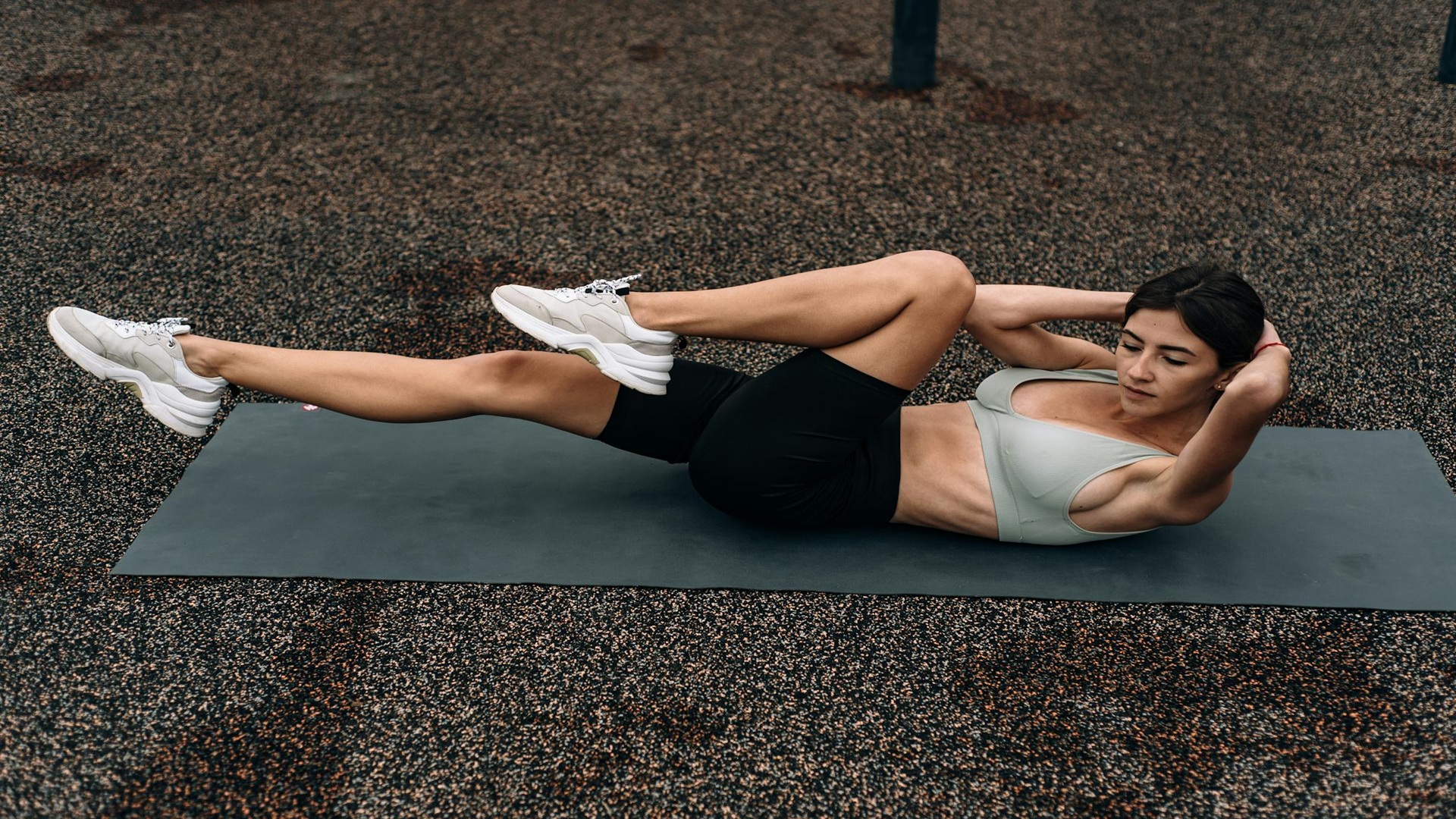
Start in the same position as for a crunch. Lift one shoulder blade off the ground, bringing your elbow towards the opposite knee to target your obliques. Return to the starting position before switching sides. Keep the range of motion moderate : quality is more important than height.
Exercise 5: Lateral plank
Lying on your side, supported by one forearm and your feet, with your body facing the mat. Align your shoulder, hip, and ankle in a straight line. Hold this position and repeat on both sides. This exercise works the obliques and transverse abdominis muscles deeply.
Exercise 6: The Reverse Crunch
Lie on your back with your head on the floor and your legs bent slightly above 90 degrees to engage your lower back . Keep your arms at your sides. As you exhale, lift your buttocks, bringing your knees towards the ceiling.
This movement protects the lower back while effectively working the inferior rectus abdominis.
What ab workout program should I follow at home to make progress in 1 month?
A one-month program, organized into three sessions per week , allows for progress without overworking the muscles. Muscle fibers need 24 hours to rebuild: respecting this timeframe guarantees lasting results.
| Day | Session | Targeted muscles |
| Monday | Session 1: immense right | Crunch, hip raise, front plank |
| Wednesday | Session 2: Obliques | Back raise with rotation, side plank |
| Friday | Session 3: Lower back and trunk | Torso extension, lateral leg raise |
For each exercise, hold the contraction for 30 seconds initially , with the progressive goal of reaching 1 minute 30 seconds.
Perform 3 to 5 sets. As soon as a movement becomes too easy, move on to the next level by increasing the duration or the range of motion.
Consistency, far more than raw intensity, remains the true secret to progress. Quality sleep and a balanced diet significantly amplify the results.
How to structure a complete ab workout at home?
A complete session is organized into 4 consecutive blocks , with 40 seconds of effort and 20 seconds of recovery between each exercise.
A 30-second break between blocks is possible if necessary to maintain good technique.
- Block 1: Dynamic warm-up (3 minutes): high knees, jumping jacks, mountain climbers to activate the cardiovascular system and prepare the abdominal muscles for exertion.
- Block 2: Straight abs and core strengthening (3 minutes): rope climb lying down, static plank, static bear plank to strengthen the rectus abdominis and transverse abdominis.
- Block 3: Obliques and waist (6 minutes): Russian twist, ankle touch, right and left side planks, dynamic bear plank, slow and controlled mountain climber.
- Block 4: Finisher core (3 minutes): dynamic plank, fast rope climb, intense knee raise to mobilize all the muscles used during the session.
Always finish with stretches. The cobra pose, the standing side stretch, and the child's pose improve muscle recovery, increase flexibility, and reduce the risk of injury.
These few minutes of stretching make all the difference in the long run.
Which abdominal exercises should women avoid and what precautions should they take?
Repetitive high-speed crunches, poorly executed scissor kicks, or any movement that pushes the belly forward puts excessive pressure on the back and perineum.
Bernadette de Gasquet has documented that these traditional exercises can be painful and counterproductive when they do not respect the mechanics of the female body.
Regardless of your lying position, your lower back should remain flat on the floor. If you can slide your hand between your lower back and the mat, your posture is incorrect and the risk of back pain increases.
Make corrections immediately before continuing training.
Here are the essential principles to respect:
- Never hold your breath or inflate your stomach during exercise.
- Prioritize 3 sets of 15 well-executed repetitions rather than 50 sloppy repetitions.
- Do not exceed 5 sets maximum for beginners.
- Engage the perineum systematically with each abdominal contraction.
- Consult a healthcare professional if you experience persistent pain, especially in the spine or pelvic floor.
A short, controlled workout is better than a long but poorly managed session. Every body deserves a tailored approach, without compromising safety.
To go further: integrate abdominal exercises into your daily routine
Bernadette de Gasquet suggests an often underestimated tip: working your abs simply by sitting on a chair.
Press your buttocks into the seat , lengthen your spine as if a weight were resting on your head, contract your perineum, then inhale and exhale slowly, stretching your spine from your coccyx to the top of your skull.
All the abdominal muscles are working, without any equipment, without even getting up.
This type of positional exercise , practiced several times a day, effectively complements your formal sessions.
Correct posture at the office or at home maintains a slight, permanent contraction of the transverse abdominis: the deep muscle that guarantees postural support and a flatter stomach in the long term.
Beginner, intermediate, and advanced levels exist for each movement. A bodyweight WOD, for example, can last between 16 and 41 minutes depending on the chosen intensity.
The key is to progress at your own pace, without ever sacrificing technique on the altar of performance.