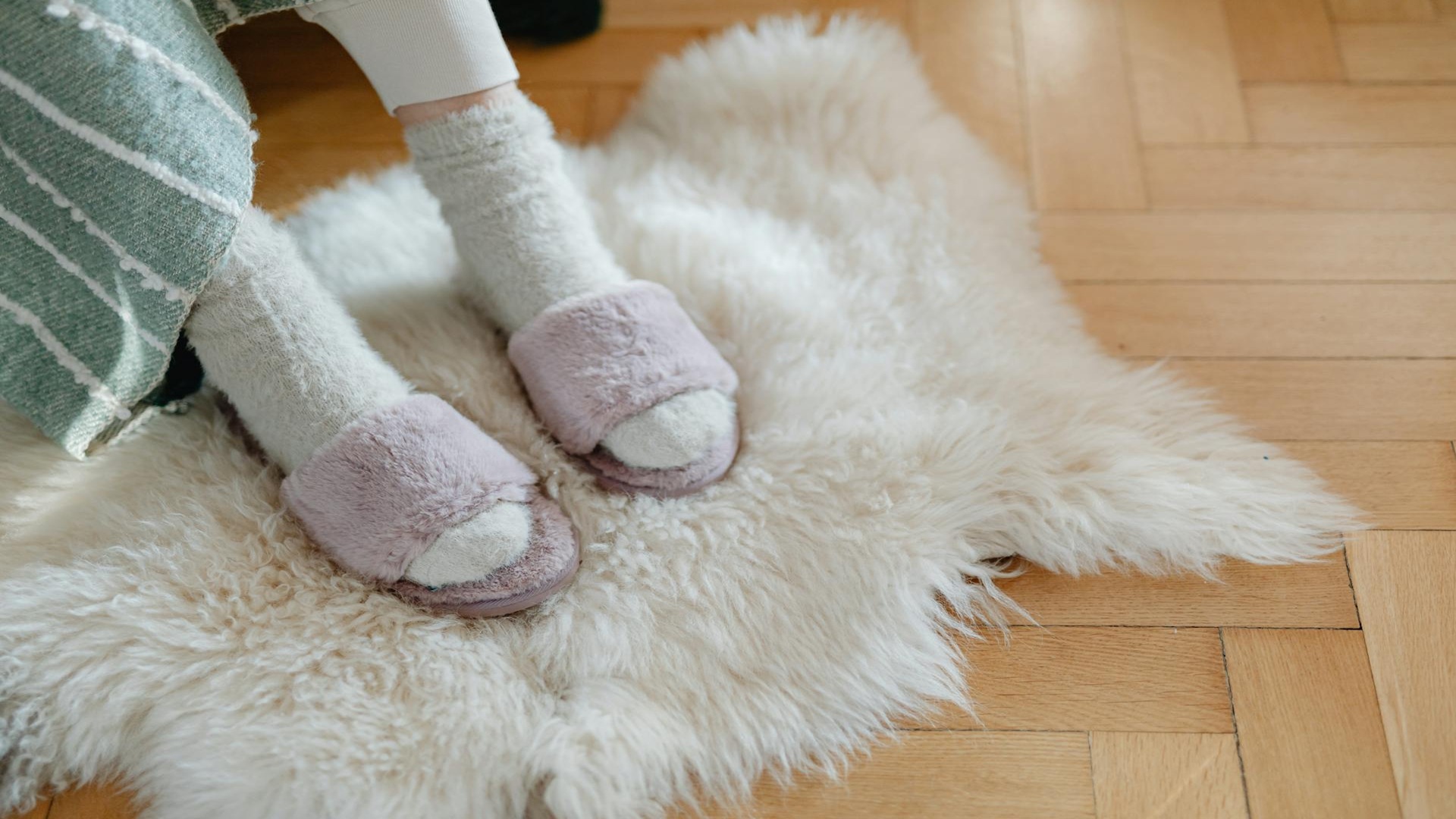
Nothing beats a pair of handmade women 's slippers to pamper your feet after a long day. Sewing or knitting your own slippers is an accessible, quick, and incredibly satisfying project.
We will guide you step by step through this creative adventure, with techniques adapted to all levels and body types.
Why make your own women's slippers
The handcrafted production of homemade slippers for women has seen a real resurgence of interest in recent years.
According to a study published by the French Federation of Creative Leisure in 2023, more than 4.5 million French women regularly practice sewing or knitting at home.
This figure illustrates a deep enthusiasm for handmade goods, far beyond a simple fad.
Making your own indoor slippers offers a major advantage: total freedom of personalization. You choose the material, the color, the shape and especially the dimensions.
For women who struggle to find what they're looking for in traditional stores — which are often too narrow or poorly suited to wide feet — this solution is particularly valuable.
Beyond the custom comfort, making your own slippers represents a real saving. A pair of handcrafted slippers costs on average less than 10 euros in raw materials, compared to 20 to 40 euros for a model bought in a store.
And the result is often much warmer, both literally and figuratively.
There is also a significant ecological dimension. By reusing fabric scraps, leftover balls of yarn, or old wool sweaters, we reduce our textile waste.
A simple gesture that is part of a more responsible consumption approach.
Choosing the right materials for your homemade slippers
Before you start sewing or knitting your homemade women's slippers , choosing the right materials is crucial. It determines the comfort, durability, and final appearance of your slippers. Here are the most suitable options depending on your project.
The ideal fabrics for sewing slippers
For a sewing project, several fabrics are perfectly suited for making women's slippers . Fleece is undoubtedly the most popular: soft, warm, easy to cut, and it doesn't fray.
Ideal for beginners, it is very forgiving of minor cutting errors.
Corduroy adds a touch of elegance while remaining very comfortable. Boiled wool, on the other hand, is particularly durable and naturally possesses thermoregulating properties.
It is perfectly suited for thick and durable slippers .
For the sole, opt for imitation leather, vinyl, or a non-slip lining. This last material is essential for safety, especially on tiled or parquet floors.
You can find iron-on anti-slip strips in haberdasheries, which are very easy to apply.
Consider lining your slippers with thermal wadding or fleece for added comfort. This step makes all the difference, especially for feet that need extra support or a more enveloping fit.
Wool and yarn for knitting slippers
When it comes to knitting, merino wool remains the gold standard for homemade slippers. Soft, breathable, and naturally antibacterial, it's even suitable for sensitive skin.
For a more robust result, opt for a thread with a small proportion of nylon or polyamide — about 20% — which enhances wear resistance.
Carpet wool or "bulky" (thick) wool allows you to knit slippers quickly , even for inexperienced knitters.
A few hours are enough to make a complete pair with this type of thread.
For women with wider feet or larger ankle circumference, elastic yarns such as cotton jersey or wool-elastane blends offer a more comfortable and adaptive fit.
The result fits the foot perfectly without compressing it.
Sewing tutorial: homemade women's slippers in fleece or boiled wool
Here's a simple sewing tutorial for making a pair of slippers in fleece or boiled wool. This pattern is suitable for all sizes, from size 36 to size 44 and up. Simply adjust the pattern accordingly.
The necessary equipment
Before you begin, gather what you need. You will need two types of fabric : approximately 30 cm of fleece or boiled wool for the outer layer, and 30 cm of soft fabric for the inner lining.
Also have on hand matching thread, pins, sewing scissors, and your sewing machine.
For the sole, cut a piece of faux leather or non-slip fabric the same size as your sole pattern. For even more comfort, add a thin layer of foam (3 to 5 mm) between the sole and the lining.
Print or trace your pattern at full size. To adapt the dimensions to your feet, simply trace the outline of your foot onto a sheet of paper and add a 1.5 cm seam allowance all around.
For a more generous cut , add an extra 2 cm to the sides.
The sewing steps, step by step
Step 1: Cutting. Cut two upper pieces (insteps) and two soles from your main fabric, then the same pieces from your lining. Do the same for the non-slip sole.
Step 2: Assembling the upper. Place the two main fabric upper pieces right sides together. Sew the center of the foot (the toe seam) with a straight stitch. Repeat for the lining.
Step 3: Attaching the sole. Pin the sewn upper to the sole, right sides together. Sew all around, leaving a 5 cm opening at the back for turning. Repeat for the lining.
Step 4: Final assembly. Slip the lining into the outer slipper. Carefully align the opening edges. Sew all around the opening of the slipper (the upper), then turn it right side out through the opening left in the sole. Close this opening by hand or machine with an invisible stitch. Then glue the non-slip sole in place with fabric glue or attach it with a few hand stitches.
The result is a sturdy and comfortable homemade slipper , infinitely customizable with pompoms, decorative buttons or embroidery.
For wide feet or rounder ankles, consider slightly widening the opening of the shaft before sewing.
Knitting tutorial: how to easily knit homemade slippers
Knitting offers an equally accessible alternative for making homemade women's slippers .
Basic patterns don't require knowledge of complex stitches. With a few rows of stockinette stitch and a little patience, you can have a pair of cozy slippers in less than an evening.
Materials for knitting slippers
For this project, you will need 100 to 150 grams of thick wool (chunky or bulky type), two straight needles size 6 or 7, a yarn needle for finishing, and a pair of scissors.
If you want to make slippers even faster, short circular needles can be useful.
To customize the size, use a size chart to find the corresponding number of stitches to cast on. For a shoe size 38-40, you would generally cast on 36 to 38 stitches.
For a shoe size 42-44, you would cast on 42 to 44 stitches. These numbers will vary depending on your knitting tension and the thickness of your yarn.
The steps of knitting, a simplified method
Step 1: Casting on the stitches. Cast on the number of stitches corresponding to your shoe size. Knit in stockinette stitch (one knit row, one purl row) for a height of 15 to 18 cm, depending on your desired ankle circumference. This piece forms the upper of the slipper.
Step 2: Shaping the heel. Bind off half the stitches at the heel edge. Knit these stitches back and forth for 6 to 8 rows to form the heel pocket. This step is key to keeping the foot secure in the slipper.
Step 3: The sole. Pick up all the stitches and knit in stockinette stitch for an additional 20 cm to form the sole of the slipper. Cast off all the stitches, then sew the side edges to close the slipper.
Step 4: Finishing touches. Weave in all the ends with a yarn needle. Turn the slipper inside out to check the seams. If necessary, lightly felt the wool sole with hot water to thicken it and make it more durable. Finally, apply dots of glue or anti-slip pads to the bottom of the sole.
To make knitted slippers even more enveloping , line the inside with fleece fabric glued on with hot melt glue.
This tip is especially appreciated for feet that need extra warmth.
Personalize and decorate your handmade slippers
Decoration is one of the most enjoyable steps in creating women's slippers . It transforms a utilitarian object into a true interior fashion accessory. The possibilities are virtually endless.
Woolen pom-poms remain a classic. Easy to make with a simple round piece of cardboard, they instantly give your slippers a festive and warm look.
Sew them securely onto the top of the slipper or at the back, at the heel.
Chain stitch or cross stitch embroidery allows you to add floral, geometric or personalized designs to the top of the slipper.
A technique used for centuries in craft traditions around the world, from Alsatian embroidery to fine leather Turkish slippers.
Decorative buttons, embroidery beads, satin ribbons or iron-on appliqués are all options for personalizing your creations.
For a cozier style, add a faux fur trim to the opening of the slipper. This detail adds a luxurious and very trendy touch.
Remember to adapt the finishes according to the season. In winter, opt for sherpa or synthetic sheepskin linings for maximum warmth. In the mid-seasons, a thin cotton lining is perfectly sufficient.
This modularity is one of the great advantages of handmade products.
Adapt the pattern to all body shapes and shoe sizes
One of the major advantages of DIY is precisely this ability to adapt each pattern to one's actual body shape , without compromise. Unlike standardized commercial sizes, handmade patterns allow you to work with the true measurements of your foot.
To create a perfectly fitting pattern, place your bare foot on a sheet of paper and trace its outline with a pencil held vertically. Then measure the length of your foot (from heel to big toe), the maximum width, and the ankle circumference.
These three measures are sufficient to create a functional pattern.
For wider or fleshier feet, increase the width of the sole and upper by 0.5 to 1 cm on each side.
For a larger ankle circumference, enlarge the opening of the shaft by cutting a semi-circular notch at the back, then edge it with elastic bias tape for support.
This bespoke approach guarantees a result perfectly suited to your foot , whatever your size. That's the beauty of handmade shoes: each pair is unique and designed for a single person.
For knitters, adjusting the size is even simpler. Just change the number of starting stitches or add a few extra rows. Since wool is naturally elastic, it easily adapts to various shapes.
Knitting patterns for "all sizes" slippers are also abundant on platforms like Ravelry, which now lists more than 10 million knitting patterns referenced since its creation in 2007.
Maintaining and extending the life of your homemade slippers
Proper care can significantly extend the lifespan of your handcrafted slippers. A few simple steps make all the difference.
For fleece or boiled wool slippers, a machine wash at 30°C on a delicate cycle is usually sufficient. Avoid high spin speeds, which can distort the seams.
Dry them flat, away from direct heat, to retain their shape.
For wool-knitted slippers , hand washing with a gentle detergent for delicate wools is recommended. Rinse thoroughly and gently squeeze out excess water in a towel.
Never twist wool, as this risks irreparably deforming the fibers.
The non-slip sole wears out over time. It's easy to replace by peeling off the old one and attaching a new strip. This simple operation extends the life of your slippers by several months.
Finally, to freshen up your slippers between washes, lightly spray the inside with a natural sanitizing spray made from bicarbonate and lavender or tea tree essential oil.
A simple and effective remedy that neutralizes odors without damaging materials.
Resources and inspiration to take your creations further
The DIY textile community is huge and particularly generous. Thousands of free tutorials are available online for sewing or knitting homemade women's slippers of all shapes and styles.
Specialized blogs like Couture en ligne, YouTube channels dedicated to knitting, and active Facebook groups bring together enthusiasts ready to share their patterns, tips, and experiences.
Solidarity among female creators is a daily reality there.
French brands like DMC and Phildar offer free downloadable patterns on their websites, often accompanied by very detailed instructions. These resources are invaluable for beginners as well as experienced sewers and knitters looking for new ideas.
Specialized trade shows like the European Yarn Fair in Paris or local craft markets are also excellent places to discover new materials, get inspired and meet other enthusiasts of handcrafted sewing.
Don't hesitate to experiment, mix techniques — sewing for the sole, knitting for the upper — and appropriate existing designs to adapt them to your style.
Creating homemade slippers is above all a pleasure to share and to develop according to one's desires and needs.
The most beautiful thing about the handmade adventure is precisely that moment when you slip on a pair of slippers for the first time that you have made with your own hands.
Tailor-made comfort, legitimate pride, and an everyday object transformed into a true act of creativity. That's what handcrafting women's slippers at home offers, whether they're sewn or knitted.