For wheelchair users, public spaces are like an obstacle course, a path strewn with pitfalls. Getting on a bus, jumping curbs, crossing the threshold of shops... these actions, natural for able-bodied people, are a real challenge for those with reduced mobility. City infrastructure isn't really compatible with this medical vehicle, which is otherwise designed to be all-terrain. However, some gyms are providing adaptable equipment to better accommodate the "invisible members of society." And the video @thejourneyofabravewoman proves that there is hope.
Gyms, more open to diversity
Crossing the road, taking the subway, climbing between floors of a building, opening a door, or even ringing the intercom… these actions seem utterly commonplace to people who can use their legs. It's a simple formality and requires almost no effort, except perhaps a good burst of breath.
However, for wheelchair users, getting around is an arduous journey, a series of obstacles placed in their path. Every daily trip becomes an exercise in patience and requires a great capacity for adaptation. To get from one point to another, these individuals, whether disabled from birth or as a result of an accident, spend three times as much time. According to figures from APF France Handicap , 9 out of 10 people experience daily difficulties navigating urban environments.
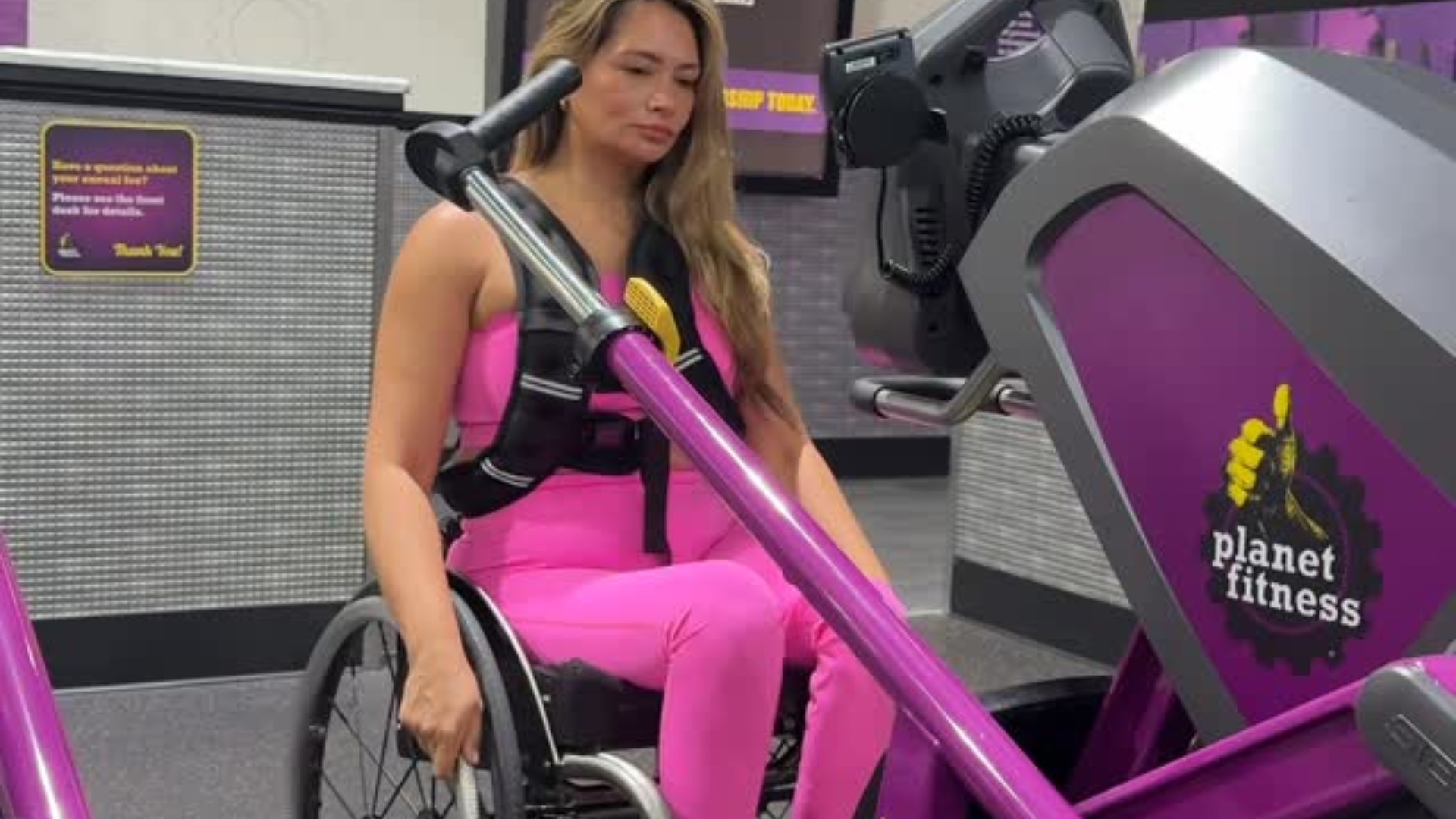
However, some places are adapting to this reality to become more accessible and embrace inclusivity, which should be the norm, not an optional extra. Content creator @thejourneyofabravewoman, who gets around using only her biceps, provides a heartening example in her gym. For her wheelchair, which has become an extension of her body, she doesn't need to lift herself out of the chair to use a machine similar to an elliptical trainer.
She can unscrew the original seat in a few movements and take her place in front of the aircraft, without having to perform a whole series of maneuvers. For some, it's just a detail, but for her, it's the outline of a better world, one that accepts difference instead of rejecting it.
View this post on Instagram
Staying active despite disability, a way to celebrate oneself
In the collective imagination, disability signals the end of all leisure activities and imposes a sedentary lifestyle. For this young woman, who radiates joie de vivre and embodies the saying "where there's a will, there's a way," this has never been the core issue. A nomad at heart, but above all a free spirit, her disability has never been an obstacle or a limitation. On the other hand, the layout of streets, buildings, shops, and public transportation has regularly caused her frustration and disrupted her plans.
So when she sees improvements, however small, she can only approve. This exercise machine isn't a revolution, it's a welcome step forward. And when Marcela Marañon, her real name, doesn't have that privilege, she's always looking for ways to satisfy her thirst for adrenaline and escape.
As the author of a practical travel guide for people with her condition, she promotes destinations designed with mobility impairments in mind. Whether paragliding over the hills of Dallas or ziplining above the dense forests of Costa Rica, she champions equal opportunities. As she reminds us, through her exhilarating experiences and sometimes disappointing observations, disability should never be a barrier, much less a prohibition.
An invitation to rethink common spaces
This accessible machine serves as a stark reminder of a fundamental truth: the problem doesn't always stem from the wheelchair itself, but rather from the surrounding environment. A gym equipped with adaptable equipment allows more people to exercise without having to ask for special treatment or navigate an obstacle course between machines.
And this logic should extend far beyond the walls of gyms. Sidewalks, public transportation, restaurants, hotels, and shops should all be usable without having to anticipate every obstacle. A step that's too high, a door that's too heavy, or a few centimeters less clearance can transform a simple journey into a real expedition.
Marcela isn't asking for special treatment. She's simply demonstrating that spaces designed for a diversity of bodies benefit everyone. A ramp can be used by a person in a wheelchair, but also by a parent with a stroller. An automatic door facilitates passage for a person with reduced mobility, but also for someone carrying bags.
Through her videos, Marcela doesn't just show what a person in a wheelchair can accomplish. Above all, she shows everything she could do if her environment stopped holding her back.