Split ends, rough lengths, less shiny hair: the effects of heat styling tools can gradually take their toll. The good news is, you can minimize this damage while still enjoying your favorite hairstyles. And most importantly, you don't have to straighten your hair to feel beautiful: wearing it natural is just as valid.
Why does heat weaken hair?
Heat acts directly on keratin, the protein that makes up the hair fiber. When it is too intense or repeated, it can alter its structure and weaken the cuticle, the protective layer on the surface of the hair. As a result, hair can lose its shine, become drier, absorb treatments less effectively, and break more easily.
Unlike skin, damaged hair fibers don't regenerate: once the damage is done, only cutting it can remove it. This doesn't mean you should banish straighteners and curling irons. The idea is rather to adopt a few good habits to take care of your hair.

The thermal protector: your best ally
If there's one step you absolutely shouldn't skip, it's this one. Heat protectant creates a thin film around the hair fiber to better distribute heat and limit sudden moisture loss. Depending on its texture, it can be used on towel-dried or dry hair. In all cases, apply it primarily to the lengths and ends, which are more vulnerable than the roots.
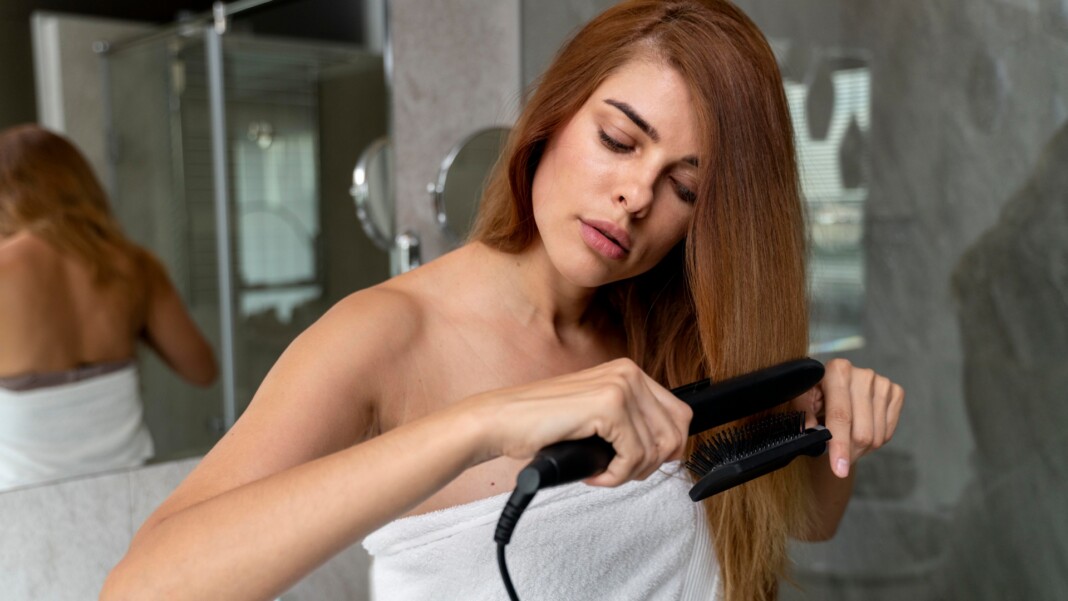
One detail is particularly important: your hair must be completely dry before using a straightener or curling iron. Any remaining moisture in the hair fiber can turn into steam under the effect of heat and weaken it from within.
No need to push the temperature to the maximum
Hotter doesn't necessarily mean more effective. On the contrary, excessive heat unnecessarily increases thermal damage. For fine or color-treated hair, a temperature around 150°C is generally sufficient. Thick or very curly hair may need around 180°C. In all cases, avoid exceeding 200°C: the benefit to hold the style becomes limited while heat exposure increases. Therefore, opt for a device with a temperature setting. This will allow you to adapt it to your hair rather than systematically subjecting it to maximum heat.
One passage is worth more than three
Do you tend to go over the same section of hair multiple times to achieve a perfectly smooth result? That's precisely what you should avoid. Work on small sections and make one slow, controlled pass, rather than several quick passes. To organize yourself easily, divide your hair into four sections before you begin. This method allows for better control while limiting the amount of time each section is exposed to heat.
What if you just left your hair alone?
This is probably the simplest… and most effective advice. The best way to protect your hair from heat is still not to use it. You don't need to straighten your hair to be stylish. Curly, wavy, kinky, textured, or simply natural hair deserves exactly the same place and consideration. Your natural texture doesn't have to be corrected to conform to a standard.
If you love your hair the way it is, let it be. And if you sometimes enjoy a blow-dry, sleek hair, or pretty waves, simply make it an option, not a necessity. Between blow-dries, consider heatless styles: a braid, a loose bun, or air drying. You can also use dry shampoo to prolong a blow-dry and avoid immediately reaching for the straightener.

Ultimately, keep this in mind: you have nothing to prove with your hair. Wearing it natural, changing your hairstyle as you please, or using your straightener occasionally—all of this is perfectly compatible with a positive relationship with your hair. The goal isn't to achieve "perfect" hair, but to take care of the hair you have and feel good about it.