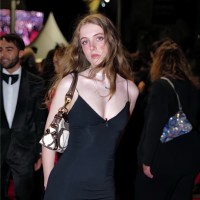
American actress and web video creator Lana Condor gave an interview to Refinery29 Australia to mark the release of her new film, a survival thriller shot largely underwater. Having risen to fame in 2018 with "To All the Boys I've Loved Before," she discusses a topic she has spoken about publicly for several years: her journey with body dysmorphia, and what it's like to be on a film set where the body is constantly being filmed.
A film shoot that puts the body in the foreground
Directed by Jeff Wadlow, the film follows five friends who encounter a shark during an expedition gone wrong. It will be available for streaming starting July 29, 2026. American actress and web video creator Lana Condor recounts that her first reaction upon reading the script was very concrete: she immediately thought she would be exposed, filmed for approximately three months in ultra-high definition. A fact she says she "weighed before accepting the role."
“Feeling safe in my body”
During the fittings, Lana Condor explained that she had a clear condition. She said she insisted on feeling safe in her own skin, "period." She added that she understands the constraints of the genre: in an aquatic film, bodies are constantly visible on screen. The costume team therefore designed a one-piece outfit for her that met specific requirements, designed to make her feel confident during filming.
The apprehension of the public's gaze
Lana Condor acknowledges that "exposing herself under these conditions puts an actress in a vulnerable position." She says she's curious to see what kind of discussion her choice will spark and hopes it will be received positively. Lana Condor places this testimony in a broader context: that of an industry where extreme thinness is once again valued, making the visibility of other body types on screen still rare.
View this post on Instagram
A reflection that goes beyond the question of appearance
In the same interview, actress Lana Condor broadens the discussion to include representation. She believes that leading roles written for Asian-American actors remain too few, despite progress observed in recent years. What motivates her to continue acting, she says, is "the desire for viewers to feel seen." A motivation she directly links to her relationship with the image and the way bodies are portrayed in film.
Lana Condor's testimony illustrates a subtle but real shift: that of actresses who negotiate the conditions under which they are filmed in advance. Far from being a militant statement, the actress primarily describes a working method where personal comfort becomes a legitimate professional criterion.