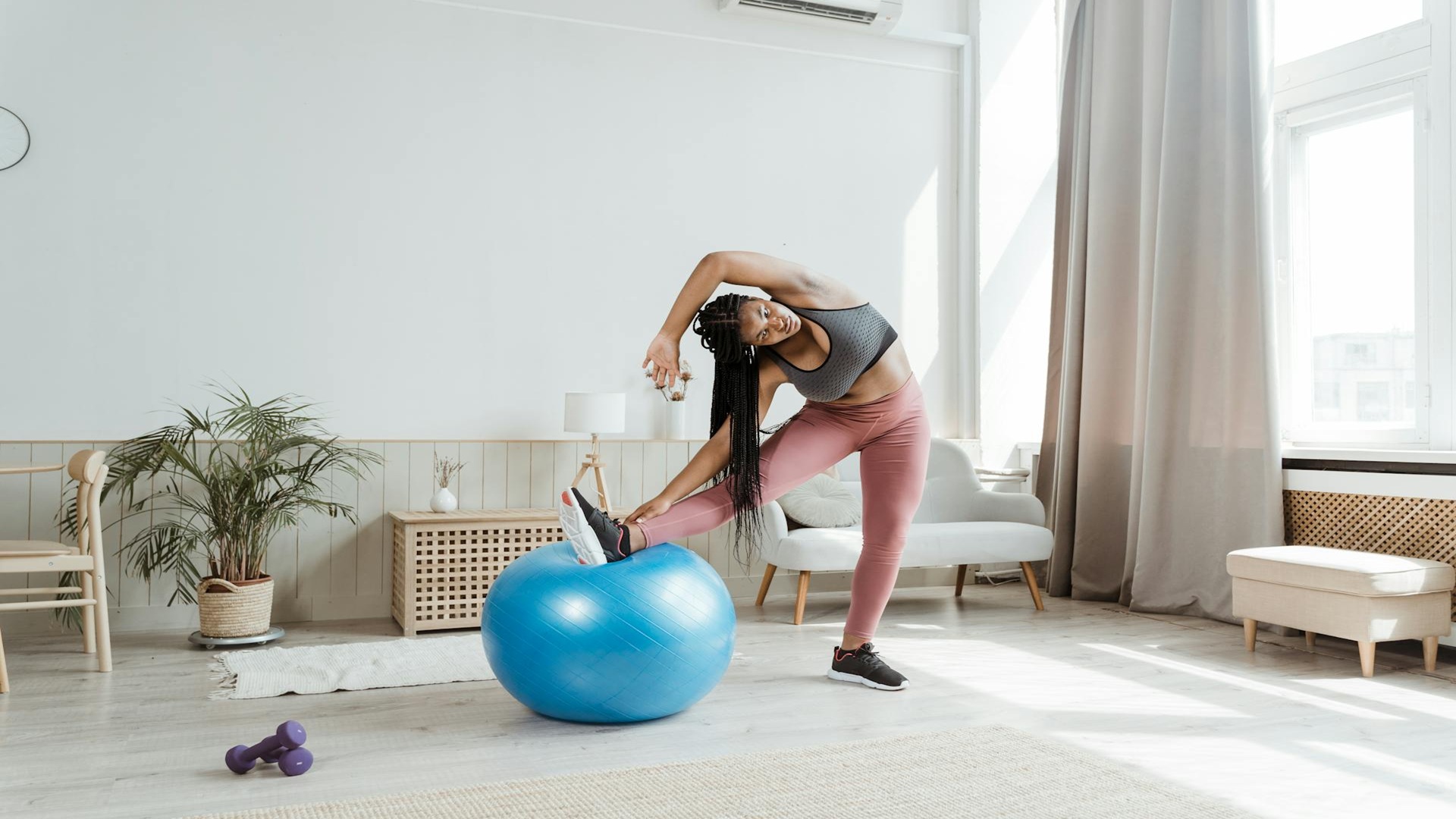
Working out at home is no longer a compromise. It's a smart strategy, adopted by millions of women worldwide.
Whether you're a busy mom, a student on a tight budget, or a working woman with a hectic schedule, exercising at home offers a practical and convenient solution. No need for a gym, expensive membership, or sophisticated equipment to make effective progress.
In this post, we offer you a complete program: fundamental exercises accessible to all, routines structured according to your level, advice to maintain your motivation over time and classic mistakes to absolutely avoid.
Every body is different, every rhythm is valid. The key is to start and stay consistent.
The tangible benefits of training at home
Saving time and real cost savings
Eliminating trips to the gym saves considerable time . A complete and effective workout takes only 30 minutes. No waiting for equipment, no crowded changing rooms.
Training is naturally integrated into the day.
The savings achieved are also far from negligible. In Morocco, a monthly gym membership costs between 200 and 800 MAD, or up to 9,600 MAD per year.
Bodyweight exercises require no special budget. They offer financial freedom accessible to everyone.
Flexibility and comfort to progress at your own pace
The flexibility of scheduling is one of the major advantages of home fitness. Whether you train early in the morning, during your lunch break, or late at night, there are no opening hours to worry about.
Comfort and privacy allow you to fully concentrate on your movements. You choose your playlist, your atmosphere, your pace. This freedom promotes smoother and more sustainable progress.
The fundamental exercises without equipment to master
Modified squats and push-ups
The squat remains the king of home fitness exercises for women. With feet shoulder-width apart and back straight, lower yourself until your thighs are parallel to the ground, then push through your heels to come back up.
This exercise works the quadriceps, glutes and hamstrings, while stabilizing the trunk.
Beginners start with 3 sets of 15 repetitions. More experienced practitioners can do 4 sets of 20. Variations—sumo squat, pulse squat, jump squat—allow for a more diverse range of muscle stimulation.
Modified push-ups on your knees target the chest, arms, and shoulders. With hands slightly wider than shoulder-width apart and body aligned from knees to head, lower yourself towards the ground and then extend your arms.
We start with 3 sets of 8 to 10 repetitions, with a gradual progression towards classic push-ups.
glute bridge, plank and jumping jacks
The glute bridge is unanimously recognized as the most effective exercise for sculpting the glutes, and it remains particularly gentle on the lower back. Lying on your back with your knees bent, lift your hips by contracting your glutes, holding for 2 seconds at the top.
Three sets of 20 repetitions are enough to feel the first effects.
The plank strengthens the entire abdominal area and improves posture. Supported on the forearms, with the body aligned from head to heels, the abdominal and gluteal muscles are contracted without allowing the lower back to sag.
Jumping jacks quickly raise your heart rate and burn calories. For women who prefer a low-impact version, the side step with arm raises offers the same gentle cardio benefits.
Ideal frequency and duration for visible results
How many sessions per week
According to World Health Organization recommendations, adults should engage in at least 150 minutes of moderate physical activity per week.
In reality, 3 to 4 weekly sessions represent the optimal frequency to progress without getting exhausted.
Rest days are not optional. The body repairs and strengthens itself during recovery. Incorporating these breaks into your routine improves performance and prevents injuries.
How long does each session last depending on their level?
The ideal duration varies depending on the level of practice. 25 minutes is perfectly suitable for beginners, 35 minutes for intermediate practitioners, and 45 minutes for advanced practitioners.
Remember that 15 minutes is enough to start a solid habit. Consistency is always more important than the length of the sessions.
Beginner program: 25-minute routine over 3 days
This accessible routine requires no equipment or prior experience. Here is the complete sequence of a session:
- Warm-up: 3 minutes of jumping jacks and walking in place
- Squats: 3 sets of 12 repetitions
- Modified push-ups: 3 sets of 8 repetitions
- Glute bridge: 3 sets of 15 repetitions
- Plank: 3 sets of 20 seconds
- Cool down: 3 minutes of stretching
The quality of the movement always takes precedence over speed or the number of repetitions. It's better to perform 8 push-ups correctly than 15 and risk injury.
This kind approach to one's body guarantees sustainable and risk-free progress.
Intermediate program: 35-minute routine over 4 days
This level requires regular practice of at least 4 to 6 weeks. The routine gradually intensifies:
- Warm-up: 5 minutes of jumping jacks and high knees
- Sumo squats: 4 sets of 15 repetitions
- Classic push-ups: 3 sets of 10 repetitions
- Alternating lunges: 3 sets of 12 repetitions per leg
- One-legged glute bridge: 3 sets of 12 repetitions per side
- Side plank: 3 sets of 20 seconds per side
- Mountain climbers: 3 sets of 30 seconds
- Stretching: 5 minutes
Alternating lunges strengthen the thighs and glutes and improve balance. The side plank targets the obliques, often neglected in traditional routines. This variety keeps you motivated and stimulates different muscles each session.
Advanced program: 45-minute routine over 5 days
Reaching this level requires several months of regular practice and good technical mastery. Here is the complete session:
- Dynamic warm-up: 5 minutes
- Jump squat: 4 sets of 15 repetitions
- Diamond push-ups: 3 sets of 10 repetitions
- Bulgarian split squats: 3 sets of 12 repetitions per leg
- Pulsed glute bridge: 4 sets of 20 repetitions
- Plank: 4 sets of 45 seconds
- Burpees: 3 sets of 10 repetitions
- Bicycle crunches: 3 sets of 20 repetitions
- Stretching and relaxation: 5 minutes
Burpees and jump squats significantly increase calorie expenditure. Bicycle crunches target all abdominal muscles with remarkable precision. This advanced routine represents a truly complete fitness program, without equipment.
Common mistakes that hinder your progress
Technical errors to correct
Neglecting a warm-up is one of the most common mistakes. Three to five minutes is enough to prepare the joints and muscles. Skipping this step significantly increases the risk of injury.
The other classic pitfall is sacrificing the quality of the movement to accumulate repetitions. A poorly executed squat engages the wrong muscle group and unnecessarily fatigues the lower back.
Form systematically takes precedence over performance.
Planning and lifestyle errors
Training every day without rest prevents muscle recovery. The body doesn't progress during exercise, but rather during rest. Three to five sessions per week offer an optimal balance between stimulation and recovery.
An inadequate diet significantly limits results, even with a flawless routine. Nutrition plays a fundamental role in physical progress. Finally, comparing oneself to others stifles motivation.
Each woman progresses at her own pace, according to her body type and her history.
Concrete strategies to stay motivated in the long term
Create a favorable environment
Setting a fixed time for training transforms the session into a non-negotiable appointment. Scheduling it in your calendar like any other professional obligation reinforces commitment.
This habit, once ingrained in daily routine, quickly becomes automatic.
Preparing a dedicated space with a floor mat and enough room to move around makes it easier to get started. You don't need an entire room: two square meters is enough to begin.
Track your progress and vary your sessions
Taking photos regularly and recording your performance is a powerful motivational tool. Observing your own progress, however small, encourages you to persevere.
Varying your exercises prevents monotony, which depletes motivation long before it depletes muscles. Finding a workout partner, even virtually, strengthens commitment.
And celebrating each completed session as a personal victory maintains this essential positive momentum in the long term.
Frequently Asked Questions
Can you really build muscle without equipment? Absolutely. Bodyweight exercises effectively develop muscle mass.
Studies in sports science confirm that body resistance is sufficient to stimulate muscle growth when training is regular and progressive.
How long before seeing results? The first improvements in tone and endurance usually appear after 3 to 4 weeks of regular practice.
More noticeable visual results are observed after 6 to 8 weeks.
- Should you stretch before or after? Static stretching is done after your workout. Before exercise, it's best to do a dynamic warm-up to activate your muscles without weakening them.
- How can you adapt exercises if you have joint pain? The glute bridge and plank remain the gentlest exercises for the knees and back. If pain persists, consulting a healthcare professional is essential.
- What's the minimum equipment needed to make further progress? An exercise mat is the basic investment. Resistance bands then allow you to intensify exercises for your glutes and arms at a lower cost.
Scientific basis and recommendations
Research in exercise physiology confirms that bodyweight exercises effectively activate both slow-twitch and fast-twitch muscle fibers. Squats, glute bridges, and planks are among the best-documented movements in terms of targeted muscle activation.
International public health bodies recommend between 150 and 300 minutes of moderate physical activity per week for adults.
Studies published in biomechanics confirm that 3 to 5 weekly sessions , combined with recovery days, optimize progress and limit the risk of injury.
- Research in sports endocrinology highlights the positive impact of regular physical activity on female hormonal regulation.
- Research in sports nutrition confirms that diet accounts for approximately 70% of observable physical results.
- Studies on long-term adherence show that flexible scheduling and the comfort of home workouts double the rate of regularity.
This scientific data fully legitimizes the home fitness approach as a serious and effective alternative to the traditional gym. Every woman has everything she needs at home to make lasting progress.